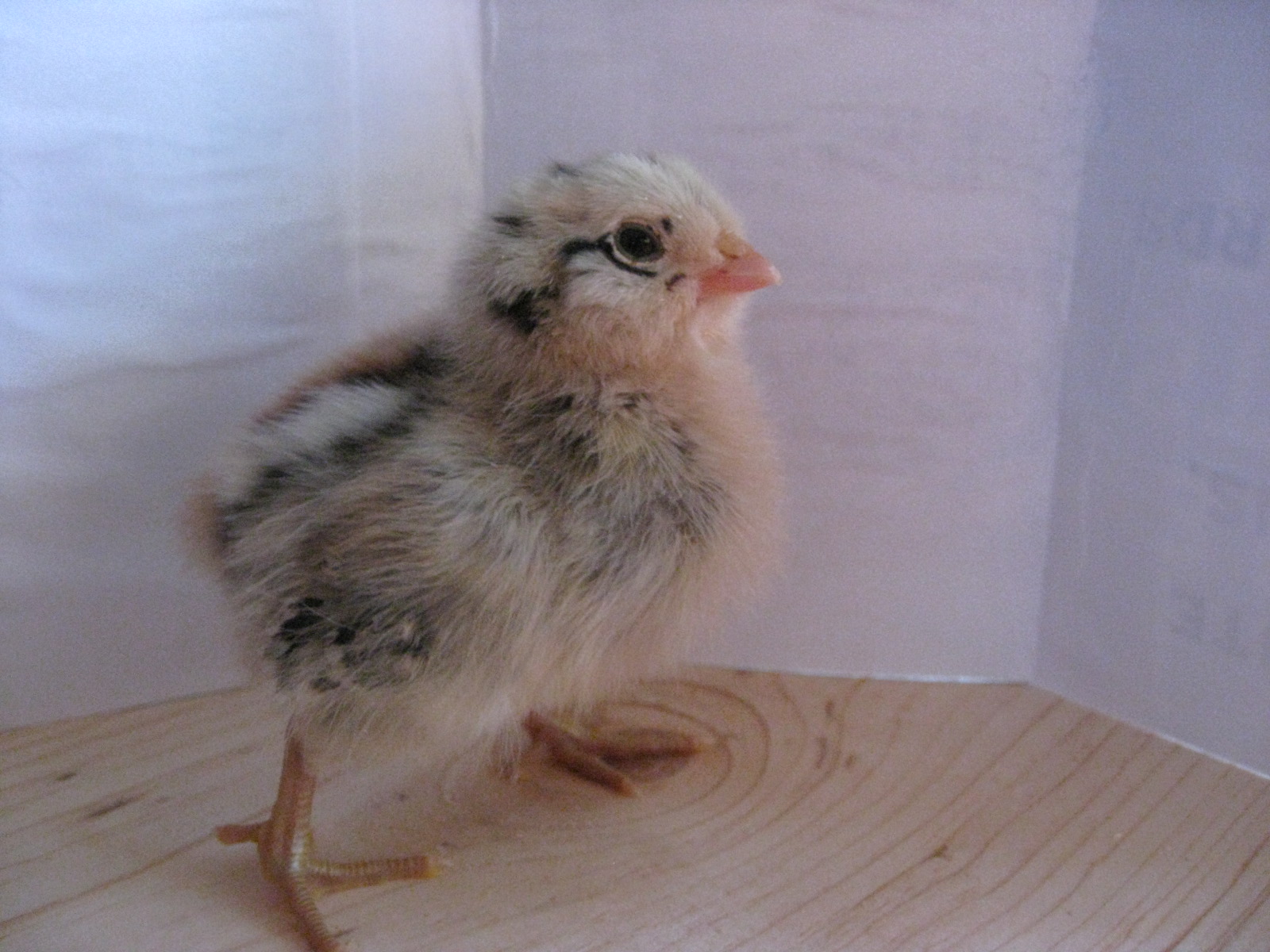
The telephone rang at 7:45 this morning. The post office informed us that we could pick up our box of chicks right away! We knew the babies had been hatched and shipped on Monday and we were ready for their arrival. As we stood at the counter in the post office annex, we could hear the peeping loudly from the back room---a good sign that they had survived the journey.
With no further ado, let me introduce the new girls:
This white one is Daisy. She's a Delaware, a heritage breed on the threatened list. At first, Daisy was very weak and we thought she wouldn't live through the day, but she's turning out to be rather bossy in the brooder box.
The striped chick is Crocus. She's a hybrid known as an Easter Egger because she'll lay green or blue eggs. This breed is usually gentle.
This is Rhododendron, the Rhode Island Red. She's a standard breed that lays lots and lots of big brown eggs.
This black and white chick is Petunia, a Barred Plymouth Rock. You can't see her white bottom in the photo, but she looks like she's wearing a diaper! So far, Petunia seems pretty mellow.
The brown chick is Poppy, a Partridge Plymouth Rock. She's the tiniest of our new chicks, but full of personality.
And this ugly duckling is Squill, a Speckled Sussex. Isn't she something?
Many thanks to my teenaged daughter, who took the glamour shots of the chicks---not an easy undertaking.
Welcome
Red Bucket Farm is an urban farm on a quarter acre property in an average residential neighborhood. We are located in Wisconsin, USDA Zone 5. We focus on chickens, bees, orchard fruit, and raised garden beds for fruits and veggies. We hope to reduce our footprint on the planet by growing some of our food, reducing our use of fossil fuels, and gardening with sustainable practices. Thanks for visiting!
Wednesday, March 30, 2011
Sunday, March 27, 2011
Bare Root Room Open
It's a true harbinger of spring and a moment of happiness in the heart of every gardener. I'm referring to the weekend that the local garden center hangs out the sign reading "Bare Root Room Open."
For a few weeks each spring, the garden center sells a variety of bushes and trees "bare root." Dormant plants are displayed in a chilly storage room, sorted into bins and labeled. They look like dead sticks with a few branches above and a few roots below.
This is not glamorous shopping. Gardeners who buy plants this way are going on faith that this will soon be a viable plant. The advantage to acquiring plants this way is primarily cost savings. Fruit trees cost around $25 bare root rather than $40 potted later in the spring. The other main advantage is the reduced bulk. We easily loaded four bushes and three trees in the trunk of our economy sedan.
We soaked the new items overnight in buckets of water, and today planted three new fruit trees: a Contender Peach tree, a Chinese apricot and a Goldcot Apricot. We also potted a Brown Turkey fig tree and four blueberry bushes (Blueray, Northland, Patriot and Rubel). The blueberries will get transferred to the ground when the planter is terraced later this spring.
Don't wait---the bare root opportunity only lasts a few weeks. Once the dormant branches start to sprout, it's time to pot them and then the bare root room is closed again until next year. Besides, planting trees in the partially frozen ground is fun and tells a good story later.
For a few weeks each spring, the garden center sells a variety of bushes and trees "bare root." Dormant plants are displayed in a chilly storage room, sorted into bins and labeled. They look like dead sticks with a few branches above and a few roots below.
This is not glamorous shopping. Gardeners who buy plants this way are going on faith that this will soon be a viable plant. The advantage to acquiring plants this way is primarily cost savings. Fruit trees cost around $25 bare root rather than $40 potted later in the spring. The other main advantage is the reduced bulk. We easily loaded four bushes and three trees in the trunk of our economy sedan.
We soaked the new items overnight in buckets of water, and today planted three new fruit trees: a Contender Peach tree, a Chinese apricot and a Goldcot Apricot. We also potted a Brown Turkey fig tree and four blueberry bushes (Blueray, Northland, Patriot and Rubel). The blueberries will get transferred to the ground when the planter is terraced later this spring.
Don't wait---the bare root opportunity only lasts a few weeks. Once the dormant branches start to sprout, it's time to pot them and then the bare root room is closed again until next year. Besides, planting trees in the partially frozen ground is fun and tells a good story later.
Friday, March 25, 2011
What do you do with all those eggs?
I never get tired of slipping my way down the back hill to the chicken coop and gathering the eggs of the day. Just this morning I discovered three lovely eggs all in one nest. I imagine the girls waiting patiently in line to use the preferred nest basket, even though the other nest boxes are available.
I am perhaps a little too proud of my urban chickens. Too often I have bragged that my three happy hens lay 18 eggs per week. Very often I get a startled look and the incredulous question: What in the world do you do with all those eggs?
Well, we eat them, of course. I think our egg consumption has increased since raising our own chickens, but I also think that our consumption of meat and meat products has decreased. We're not vegetarian by any stretch, but I'm concerned about eating meat that has been produced in large feed lots. I'd prefer grass fed meat which is hard to find and expensive. Our diet continues to modify in order to eat more locally and organically produced foods. It's all good.
Here are a few ways that eggs get used in our house: bean burgers,1 egg; parmesan rice cakes, 2 eggs; tortilla espanola (Spanish omlet with potatoes) 6 eggs; pumpkin torte or pumpkin gratin, 3 eggs; spinach gratin, 3 eggs; pumpkin custard, 3 eggs. Also, many breads, muffins and cookies use an egg or two per recipe. Yesterday I made mayonnaise for the first time---really wonderful---and today I'll use the leftover mayo to make ranch dressing for salad.
On Sunday mornings we actually have eggs for breakfast. One teenager prefers plain scrambled eggs. The other teen likes them soft boiled with a pat of butter and a pinch of salt. The adults have scrambled eggs with leftovers, perhaps some rice or barley, mushrooms, scallions, cheese and whatever is leftover in the refrigerator.
What's your favorite egg recipe?
I am perhaps a little too proud of my urban chickens. Too often I have bragged that my three happy hens lay 18 eggs per week. Very often I get a startled look and the incredulous question: What in the world do you do with all those eggs?
Well, we eat them, of course. I think our egg consumption has increased since raising our own chickens, but I also think that our consumption of meat and meat products has decreased. We're not vegetarian by any stretch, but I'm concerned about eating meat that has been produced in large feed lots. I'd prefer grass fed meat which is hard to find and expensive. Our diet continues to modify in order to eat more locally and organically produced foods. It's all good.
Here are a few ways that eggs get used in our house: bean burgers,1 egg; parmesan rice cakes, 2 eggs; tortilla espanola (Spanish omlet with potatoes) 6 eggs; pumpkin torte or pumpkin gratin, 3 eggs; spinach gratin, 3 eggs; pumpkin custard, 3 eggs. Also, many breads, muffins and cookies use an egg or two per recipe. Yesterday I made mayonnaise for the first time---really wonderful---and today I'll use the leftover mayo to make ranch dressing for salad.
On Sunday mornings we actually have eggs for breakfast. One teenager prefers plain scrambled eggs. The other teen likes them soft boiled with a pat of butter and a pinch of salt. The adults have scrambled eggs with leftovers, perhaps some rice or barley, mushrooms, scallions, cheese and whatever is leftover in the refrigerator.
What's your favorite egg recipe?
Monday, March 21, 2011
Chicken Poop Tea
Yesterday I started brewing a bucket of chicken poop tea. No, this isn't the latest blend from Celestial Seasonings. Instead, it's homemade liquid fertilizer.
In the February/March 2011 issue of Mother Earth News, I learned that my tiny seedlings are at risk of nutrient deficiency because the lightweight seedling soil mix is quickly depleted. I can give them a boost with liquid fertilizer, and I can make my own at home because I have the correct ingredients close at hand.
I took my red bucket out to the chicken coop and gathered several handfuls of chicken poop along with wood shavings. Then I added a gallon or so of water and gave it a stir. I'm letting it brew in the greenhouse for a day or two before I strain out the gunk (which will go to the compost bin). I'll still need to dilute the tea 1:1 so it doesn't burn the seedlings. I'll be able to use this treatment on my baby plants every two weeks.
Sounds yummy, doesn't it? I hope it helps my little seedlings.
In the February/March 2011 issue of Mother Earth News, I learned that my tiny seedlings are at risk of nutrient deficiency because the lightweight seedling soil mix is quickly depleted. I can give them a boost with liquid fertilizer, and I can make my own at home because I have the correct ingredients close at hand.
I took my red bucket out to the chicken coop and gathered several handfuls of chicken poop along with wood shavings. Then I added a gallon or so of water and gave it a stir. I'm letting it brew in the greenhouse for a day or two before I strain out the gunk (which will go to the compost bin). I'll still need to dilute the tea 1:1 so it doesn't burn the seedlings. I'll be able to use this treatment on my baby plants every two weeks.
Sounds yummy, doesn't it? I hope it helps my little seedlings.
Saturday, March 19, 2011
Fencing the Chicken Yard
Today was a glorious spring day and I had my whole work crew at home, so we set about fencing the chicken yard.
I've mentioned in previous posts that my hens are well-cared for, spoiled, even pampered. Last year we built the casa gallina, a veritable fortress for chickens. The girls are happy there and have plenty of room, but they do love to get outside and search for bugs. We let them outside daily, of course, but we never leave them alone for a moment because we know the hawks will show up in an instant and snatch them.
It took about four hours to fence the chicken yard. We recycled two gates from our veggie gardens and added rabbit fencing around the coop in the corner of the farm. Then we erected tall corner poles to hang the bird netting overhead. We still won't leave them out for long periods unattended, but now we can work in the yard without wondering where the girls have wandered.
I've mentioned in previous posts that my hens are well-cared for, spoiled, even pampered. Last year we built the casa gallina, a veritable fortress for chickens. The girls are happy there and have plenty of room, but they do love to get outside and search for bugs. We let them outside daily, of course, but we never leave them alone for a moment because we know the hawks will show up in an instant and snatch them.
It took about four hours to fence the chicken yard. We recycled two gates from our veggie gardens and added rabbit fencing around the coop in the corner of the farm. Then we erected tall corner poles to hang the bird netting overhead. We still won't leave them out for long periods unattended, but now we can work in the yard without wondering where the girls have wandered.
Friday, March 18, 2011
Starting Seeds Indoors
I got spring fever early this year. I needed to do something garden-related, so I started some perennial flowers by seed indoors in very early February. I was thinking about blossoms for my honeybees. Truth be told, the perennials-by-seed have been only marginally successful. I have one echinacea plant, a couple of hollyhock seedlings, and several lemon balm.
At the same time I started spinach, chard and lettuce in bowls for indoor germination. This has been far more successful. Today I moved the salad bowls out to the greenhouse.
Later in February I started some vegetable seeds in peat pots for indoor germination. I planted Amish Paste Tomatoes, Sun Sugar Cherry Tomatoes, Flamme Tomatoes, Brussels Sprouts, Basil, Yummy Mini Bell Peppers, Carmen Hybrid Peppers, and Eggplant Rosa Bianca.
I don't have the greatest conditions for starting seeds indoors. I keep my house rather cool (62 degrees during the day) and the soil might need to be warmer for those seeds to germinate. Still, with a little creativity my plants are slowly getting started and I'm trying to remain hopeful.
In a few more weeks, I'll move all the seedlings to the greenhouse, but temperatures out there still fluctuate too widely for the tender seedlings.
At the same time I started spinach, chard and lettuce in bowls for indoor germination. This has been far more successful. Today I moved the salad bowls out to the greenhouse.
Later in February I started some vegetable seeds in peat pots for indoor germination. I planted Amish Paste Tomatoes, Sun Sugar Cherry Tomatoes, Flamme Tomatoes, Brussels Sprouts, Basil, Yummy Mini Bell Peppers, Carmen Hybrid Peppers, and Eggplant Rosa Bianca.
I don't have the greatest conditions for starting seeds indoors. I keep my house rather cool (62 degrees during the day) and the soil might need to be warmer for those seeds to germinate. Still, with a little creativity my plants are slowly getting started and I'm trying to remain hopeful.
In a few more weeks, I'll move all the seedlings to the greenhouse, but temperatures out there still fluctuate too widely for the tender seedlings.
Tuesday, March 15, 2011
What is an Urban Farm?
Last night at my other, non-farming job, I overheard this conversation:
"Have you read Cindy's blog?" asked one person. "It's really good."
"This Cindy?" asked the other person incredulously. She jerked her head in my direction.
"Yeah, this Cindy. You should read her blog," maintained the first person.
"What's it about?"
"Her farm."
"She doesn't have a farm," came the firm response.
"Sure she does," my defender replied. "It's her backyard."
"That's not a farm," the doubter shot back.
"It's an urban farm." My friend stretched the word for emphasis. "You should read her blog. It's good."
Urban farming is hardly a modern phenomenon, it's certainly not my invention, and it is growing in America. Today's urban farmers are concerned about sustainability. We work carefully to avoid harming the environment even if it means we might lose part of our crops. Many of us might be locavores, meaning that we try to eat food that has been grown locally. We want to decrease our carbon footprint by consuming foods that have not been shipped for hundreds or thousands of miles.
When I was growing up, our next door neighbors were a German family who had narrowly escaped the Nazis. When they came to America, they brought their European gardening tradition with them. Every inch of their backyard was intensively gardened, and I'm sure they rarely purchased vegetables from the grocery store. Similarly, today's Hmong immigrants show remarkable resourcefulness, ingenuity and productivity from their small community garden plots. Sometimes I ride my bike very slowly past their plots just to learn from them. Remember that large expanses of green grassy lawns are a peculiarly and wasteful American phenomenon.
What separates a garden from a farm? Livestock. Urban farmers often raise chickens, ducks, geese, turkeys, rabbits or honeybees. Occasionally they might be able to raise goats or sheep, depending on their local ordinances.
One well-known urban farmer and author, Novella Carpenter, has documented the story of her farm on an abandoned lot in the slums of Oakland. In her novel Farm City, Novella details her experience of dumpster diving behind restaurants to scavenge food for her pair of backyard pigs. That's commitment.
Urban farming has become savvy and sophisticated. I recommend Urban Farm magazine, dedicated to sustainable city living. It's by the same publishers as Hobby Farms Magazine, but it has a distinctly urban emphasis. There are hundreds of blogs on urban farming, beekeeping, backyard chickens and more. Join the movement, grow at least some of your own food, help care for Mother Earth.
And thanks for reading my blog and defending my farm, LM!
"Have you read Cindy's blog?" asked one person. "It's really good."
"This Cindy?" asked the other person incredulously. She jerked her head in my direction.
"Yeah, this Cindy. You should read her blog," maintained the first person.
"What's it about?"
"Her farm."
"She doesn't have a farm," came the firm response.
"Sure she does," my defender replied. "It's her backyard."
"That's not a farm," the doubter shot back.
"It's an urban farm." My friend stretched the word for emphasis. "You should read her blog. It's good."
Urban farming is hardly a modern phenomenon, it's certainly not my invention, and it is growing in America. Today's urban farmers are concerned about sustainability. We work carefully to avoid harming the environment even if it means we might lose part of our crops. Many of us might be locavores, meaning that we try to eat food that has been grown locally. We want to decrease our carbon footprint by consuming foods that have not been shipped for hundreds or thousands of miles.
When I was growing up, our next door neighbors were a German family who had narrowly escaped the Nazis. When they came to America, they brought their European gardening tradition with them. Every inch of their backyard was intensively gardened, and I'm sure they rarely purchased vegetables from the grocery store. Similarly, today's Hmong immigrants show remarkable resourcefulness, ingenuity and productivity from their small community garden plots. Sometimes I ride my bike very slowly past their plots just to learn from them. Remember that large expanses of green grassy lawns are a peculiarly and wasteful American phenomenon.
What separates a garden from a farm? Livestock. Urban farmers often raise chickens, ducks, geese, turkeys, rabbits or honeybees. Occasionally they might be able to raise goats or sheep, depending on their local ordinances.
One well-known urban farmer and author, Novella Carpenter, has documented the story of her farm on an abandoned lot in the slums of Oakland. In her novel Farm City, Novella details her experience of dumpster diving behind restaurants to scavenge food for her pair of backyard pigs. That's commitment.
Urban farming has become savvy and sophisticated. I recommend Urban Farm magazine, dedicated to sustainable city living. It's by the same publishers as Hobby Farms Magazine, but it has a distinctly urban emphasis. There are hundreds of blogs on urban farming, beekeeping, backyard chickens and more. Join the movement, grow at least some of your own food, help care for Mother Earth.
And thanks for reading my blog and defending my farm, LM!
Subscribe to:
Posts (Atom)