Welcome

Red Bucket Farm is an urban farm on a quarter acre property in an average residential neighborhood. We are located in Wisconsin, USDA Zone 5. We focus on chickens, bees, orchard fruit, and raised garden beds for fruits and veggies. We hope to reduce our footprint on the planet by growing some of our food, reducing our use of fossil fuels, and gardening with sustainable practices. Thanks for visiting!

Thursday, April 30, 2015

Spring Chicks 2015

Spring chicks are a happy event at Red Bucket Farm. Some years we obtain chicks from a local hatchery so that we can drive over and pick them up. This year we opted for more unusual breeds, so we ordered from My Pet Chicken. Our chicks hatched on April 6 and arrived by USPS on April 8.


Baby chicks are packaged carefully with a gel heat pack, but it's a difficult trip. All of our little ones were alive upon arrival, but we lost one within 24 hours. It was disappointing but not unexpected. The plumage (really it's fluff) of little chicks doesn't necessarily reflect their mature colors, so it can be difficult to ascertain which breed is which. We think the one that died immediately was a Partridge Plymouth Rock.

The new chicks are now three weeks old. They live in their brooder box in the basement. A heat lamp keeps them nice and warm. We refill water and food regularly, and check for vent blockage to make sure all systems are operating properly. (That's a nice way of saying that we check for poopy butts.)


This particular flock has seemed more flighty than previous flocks. We suspect that our choice of breeds may be playing into this. We decided to try Light Brown Leghorn, Exchequer Leghorn, Buff Chantecler, Silver Cuckoo Marans and Ancona as new breeds. Some of these breeds have a reputation for nervousness and flightiness.

Late last night I removed their water and stepped to the sink to refill. The girls were scrambling around in their brooder box in their usual panicky manner. Suddenly I heard a loud squawk and returned to find one little chick laying on her side, evidently paralyzed. She died in a minute. It's a mystery to us. Did she have a heart attack or aneurysm? Can a flighty chick die of a panic attack? We think the victim was either the Exchequer Leghorn or the Ancona.

We always order extra chicks so our flock will be strong enough to survive winter. Perhaps we'll try the new breeds again next, or maybe we'll just stick with the hardy heritage breeds. Stay tuned.

Saturday, December 27, 2014

Winter Bees


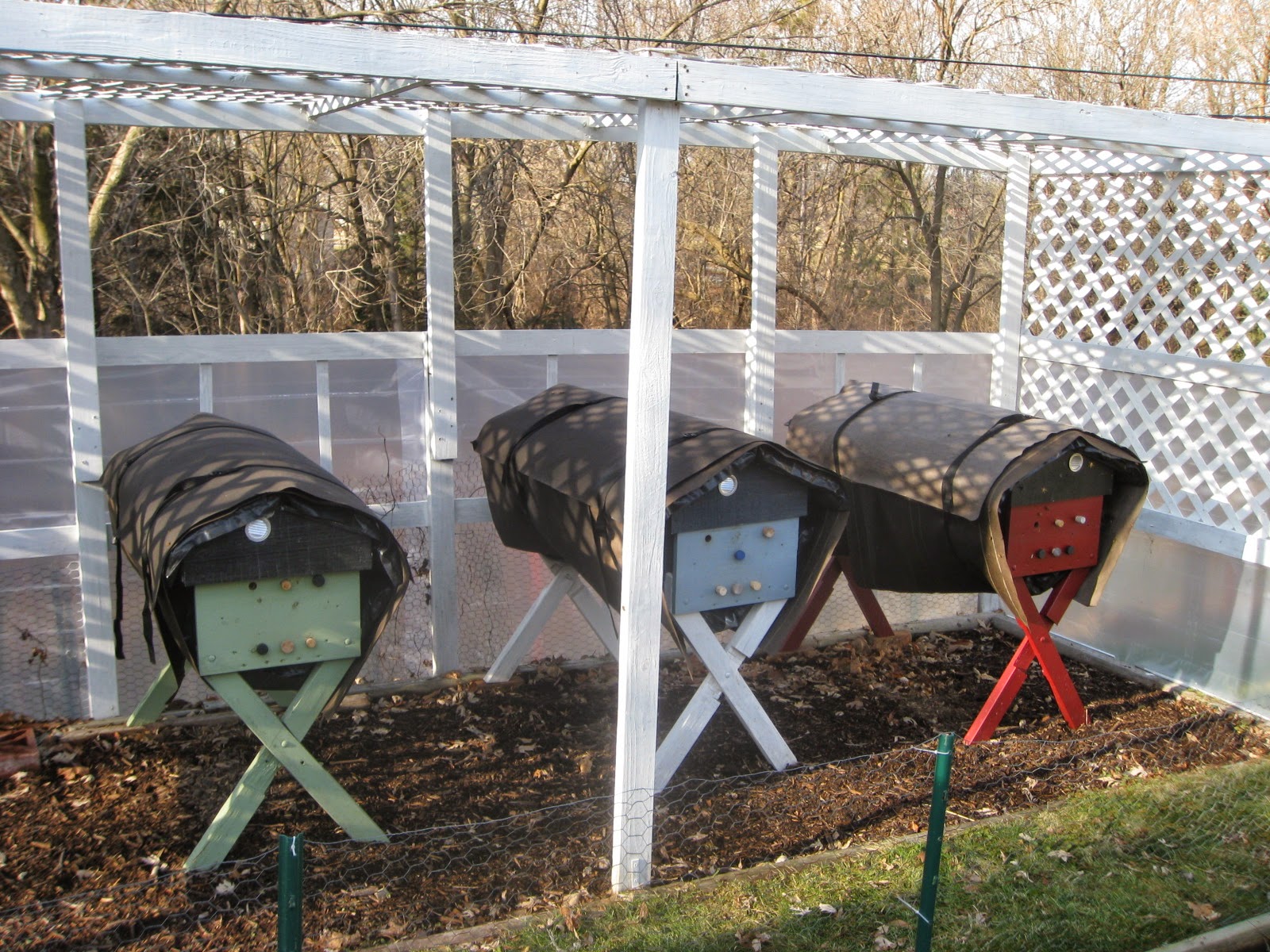
The weather at Red Bucket Farm has been fairly dreadful in terms of our honeybees. Towards the end of October, we covered the hives with insulation blankets and wrapped the entire bee yard with plastic to protect the hives from western winds.

November was just plain cold. Outdoor air temperatures were way below normal, hovering in the teens during the day and close to zero at night. The bees disappeared into the hives where they clustered together in a tight ball around the queen.

December has been warmer but cloudy, foggy, damp and drippy. It's normal for bees to take "cleansing flights" during winter months. They prefer to not poop in their hives and will slip outside on a sunny afternoon for quick trip to the ladies room. Unfortunately, we haven't seen the sun or the bees in weeks---until yesterday. Finally we had a few hours of sunshine and one of our hives took the opportunity to get outside.


This video is about one second long, but you get the idea. (Sorry that I'm not so clever with technology.) We'll be happy if even one hive survives the winter so that we can build and split with the hardy bees that make it. Replacing bees each spring is expensive---about $100 per hive---and we may not be able to justify the expense if they die each winter.

So, at the risk of repeating myself endlessly, if you still use lawn chemicals, please reconsider. Chemicals weaken the bee population significantly. If the bees approach winter in a compromised state, they can't possibly survive. Pollination is tenuous these days, and without it, we all suffer. Backyard bees are better off than rural bees because foraging is more varied, but lawn chemicals are toxic. Remember that dandelions are bee food.

Meanwhile, we have a glimmer of hope that some of our bees are still alive!

Tuesday, November 4, 2014

Planting Garlic

Planting garlic is similar to planting tulip and daffodil bulbs: push them deep in the soil in the late fall and wait for the magic to happen in the spring.


First make sure the soil is loose, friable, and free of weeds. Add a bit of compost and get ready to plant. I placed my garlic cloves gently on the surface of the soil to get a sense of how closely to space them. Then I pushed my garden knife into the soil the full length of the blade and dropped the garlic down. After all were planted, I covered the bed with a layer of hay and watered.

Garlic is the crop that keeps on giving. Two years ago I visited Seed Savers Exchange in Decorah, Iowa, where I purchased one head of Inchelium Red (softneck) Garlic and one head of Eric's German White (hardneck) Garlic. I planted them in October 2012 and saved my entire harvest the next summer without eating a bite.

In November 2013, I separated the cloves from the heads of garlic and planted again. By July 2014, I had 73 heads of softneck garlic (about 3.75 pounds) and 31 heads of hardneck garlic. From that harvest, I reserved five heads each of hardneck and softneck for replanting. The five heads of hardneck garlic separated into 17 large cloves; the five heads of softneck garlic separated into 62 small cloves.

I learned that garlic slowly adapts to its micro climate, so my garlic is now Red Bucket Farm garlic, specific to my little piece of paradise. Garlic smells fantastic even when planting, and it's not too late to plant this fall. What are you waiting for?

Thursday, October 30, 2014

Drying Herbs

As the growing season slowly comes to an end, I'm experimenting with drying herbs for cooking use as well as for my chickens.


A farm colleague has suggested that using dried herbs in the hen house over the winter will help discourage mites or creepy crawlies and will certainly help the fragrance in that crowded space. For that goal, I've been harvesting the herbs that are underplanted in my front yard orchard--oregano, lemon balm and lavender. It's important to keep these herbs separate from those designated for human consumption because the front yard is subject to every dog in the neighborhood. 'Nuff said?

Other herbs at the farm have been living comfortably in the green house--basil, sage, rosemary, and chives. These I can dry and crush, then store in jars in the kitchen.


The process of drying herbs is simple. I cut the stems into a size that will fit in my large roasting pan and place it in a cool oven at 140 degrees Fahrenheit with the fan running. (I have a convection oven.) I prop the oven door open an inch or so to allow moisture to escape, checking on them periodically. The timing will vary depending on the herb and quantity being processed. When it all seems a bit crunchy, I take it out of the oven and gently pull the leaves off the stems. Then I crush it with my hands and place it in storage containers. The herbs for use in the hen house are stored in large plastic bags in the freezer.

Drying herbs in the oven makes my house smell fantastic. It's quicker than the traditional method of hanging bunches of herbs in the basement or garage, which (for me) usually results in messy bits of dropped leaves and stems. Give this a try!

Tuesday, October 7, 2014

Bee Hatch


The red hive in the foreground and the green hive in the background are both exhibiting new hatches of bees. Notice most of the bees are taking short flights in little circles right at the hive entrances. These are known as orientation flights as the new bees get to know their surroundings. Soon these bees will begin taking longer flights.

Although the hives are slimming down in preparation for winter, it's good to see new bees and know that the queens are all alive and well.

Thursday, October 2, 2014

Fall Crops

One of the challenges of urban farming is learning how to keep all the garden beds productive through the fall months.


This morning's harvest was a continuation of late summer crops---tomatoes, beans and elderberries. About two dozen butternut squash remain on the vines. The fall-bearing raspberries ("Heritage Everbearing") are producing heavily, unlike the summer raspberries ("Nova" and "Latham") which produced almost nothing. We're not sure if that is the result of a harsh winter or uninformed pruning.

After harvesting potatoes, onions and garlic in mid-summer, I replanted those beds with bok choy, spinach, Swiss chard, scallions and beets. Most of these were started by seed in the greenhouse and were ready for transplant when the root crops were harvested. This is the tricky part---knowing when to seed so fall crops are ready to transplant to available beds. I've found that sowing fall crop seeds in the greenhouse in early July is helpful, and sowing seeds outdoors in the beds no later than mid-August is most productive. Any later than that, and our daylight is just too limited to get those seeds germinating even if the weather is cooperative.

Now I'm off to the kitchen to process my crops for winter storage.

Monday, August 18, 2014

Growing Shallots


Shallots have never been a part of my menu planning. I've heard of them, especially when watching cooking shows on television. But they are difficult to find in the grocery store and quite expensive for something described as a "mild onion." Just use a little onion or scallion, right?

In December I decided to educate myself about shallots so I added them to this year's garden plan. I chose Zebrune shallot seeds from Seed Savers Exchange. Zebrune shallots are a heritage variety from France. It's called a banana shallot because of its long shape. The bulbs are pinkish-brown and store well.

Just after the new year, I sprinkled shallot seeds in four inch pots and placed them under lights in the basement. Each time their green tops grew a few inches tall and began to flop over, I would give them a little haircut. In early May, I gently teased the little bunches apart and planted them individually in a raised bed outdoors. They grew tall and strong and without drama. Last week I harvested them and placed them in the sun to dry.

Truth be told, I can't quite figure out why this is a big deal. Shallots grow every bit as easily as onions and scallions. The bunnies and chipmunks leave them alone and they don't require any attention at all. It's a no brainer. If you haven't tried growing your own shallots, I recommend adding this to next year's wish list.