Anyone who has gardened for more than a year or two knows that the garden is never finished. Most great gardens are in a constant state of transition as the gardener discovers which plants flourish in any specific location and which do not. This is also true at our fruit orchard here at Red Bucket Farm.
Last year, our large peach tree produced ninety pounds of juicy sweet fruit. We're still eating from that harvest! But the winter of 2013-14 was cold and colder, and the peach tree has barely survived. This tree is located at the bottom of the hill in a micro-climate that didn't fare as well as the trees up the hill. It didn't bloom this spring at all, and we're nursing it with chicken poop tea and hoping that it will recover this summer to produce again in 2015.
On the other hand, our three cherry trees bloomed beautifully and are developing little fruits. Hooray for winter-hardy pie cherries!
The new trees in the front yard orchard are doing well, or most of them are. Two peach trees, three pear trees and one apricot tree all bloomed lightly and are making a few small fruits---not bad considering these are still very small trees. One additional apricot tree (important for cross pollination) is struggling. This is the second tree of that variety we've planted in that location and it's just not happy. We suspect that the roots are too wet and the soil isn't draining well. We've removed the tree to a container for recuperation, and we've ordered a different apricot variety to plant in its place. We'll create a mounded hill to help with drainage and we'll amend the soil with Turface and chicken grit.
Every evening we wander through the orchard and check on our trees. Slowly we're discovering which trees belong in each location. A fruit tree gives a lot of bang for your buck, so it pays to be attentive and invest in the home orchard.
Welcome
Red Bucket Farm is an urban farm on a quarter acre property in an average residential neighborhood. We are located in Wisconsin, USDA Zone 5. We focus on chickens, bees, orchard fruit, and raised garden beds for fruits and veggies. We hope to reduce our footprint on the planet by growing some of our food, reducing our use of fossil fuels, and gardening with sustainable practices. Thanks for visiting!
Thursday, May 29, 2014
Wednesday, May 21, 2014
Gardening Hand Tools
All our gardening efforts at Red Bucket Farm occur in raised beds or terraced beds, so hand tools are very important. We've never used a rototiller! So without further ado, here are my favorite hand tools.
This is my cultivator. It's triangular head moves large amounts of soil with minimal effort. I use this extensively in the spring when I'm preparing the beds for planting---loosening the soil after the compaction of winter snow and stirring in fresh compost. I use it again in the fall when I remove old plants and add more compost. I painted the handle bright blue after I lost it in the yard for a few days.
This garden knife is awesome. Manufactured by A.M. Leonard, the six inch blade is serrated on one side, good for cutting off those volunteer black walnut trees that the squirrels insist on planting. This tool is the perfect dibber, opening a quick hole in the soil to drop in seed potatoes or tiny onion plants. It's also great for opening bags of chicken bedding and food. Please notice that I washed it nicely for it's photograph.
I've had this hand rake for many years. I use it to remove the straw mulch covering beds in the spring and fall, for raking the yuck from between the currant bushes, and for a hundred other things that I can't remember. It's not particularly valuable, but I don't know how I would function without it.
This is a CobraHead weeder, made right here in Wisconsin. It's tiny head is perfect for weeding in small spaces. A bright blue plastic handle means that I don't lose it too often.
Forget those adorable little hand shovels that move dirt a few tablespoons at a time. This scoop moves a considerable amount of compost. Sorry that I didn't wash this one.
Remember that hand tools do not require gasoline or spew pollution. Their storage needs are simple---just clean them up, oil them occasionally and store in a dry location.
This is my cultivator. It's triangular head moves large amounts of soil with minimal effort. I use this extensively in the spring when I'm preparing the beds for planting---loosening the soil after the compaction of winter snow and stirring in fresh compost. I use it again in the fall when I remove old plants and add more compost. I painted the handle bright blue after I lost it in the yard for a few days.
This garden knife is awesome. Manufactured by A.M. Leonard, the six inch blade is serrated on one side, good for cutting off those volunteer black walnut trees that the squirrels insist on planting. This tool is the perfect dibber, opening a quick hole in the soil to drop in seed potatoes or tiny onion plants. It's also great for opening bags of chicken bedding and food. Please notice that I washed it nicely for it's photograph.
I've had this hand rake for many years. I use it to remove the straw mulch covering beds in the spring and fall, for raking the yuck from between the currant bushes, and for a hundred other things that I can't remember. It's not particularly valuable, but I don't know how I would function without it.
This is a CobraHead weeder, made right here in Wisconsin. It's tiny head is perfect for weeding in small spaces. A bright blue plastic handle means that I don't lose it too often.
Forget those adorable little hand shovels that move dirt a few tablespoons at a time. This scoop moves a considerable amount of compost. Sorry that I didn't wash this one.
Remember that hand tools do not require gasoline or spew pollution. Their storage needs are simple---just clean them up, oil them occasionally and store in a dry location.
Thursday, May 8, 2014
Accidental Rooster
Our spring chicks are now eight weeks old and no longer little balls of fluff. They have grown adult feathers and spend their days outside comfortably in the portable coop. The only problem we're experiencing is that one of them isn't a pullet (hen). He's a cockerel and he is quickly becoming a rooster.
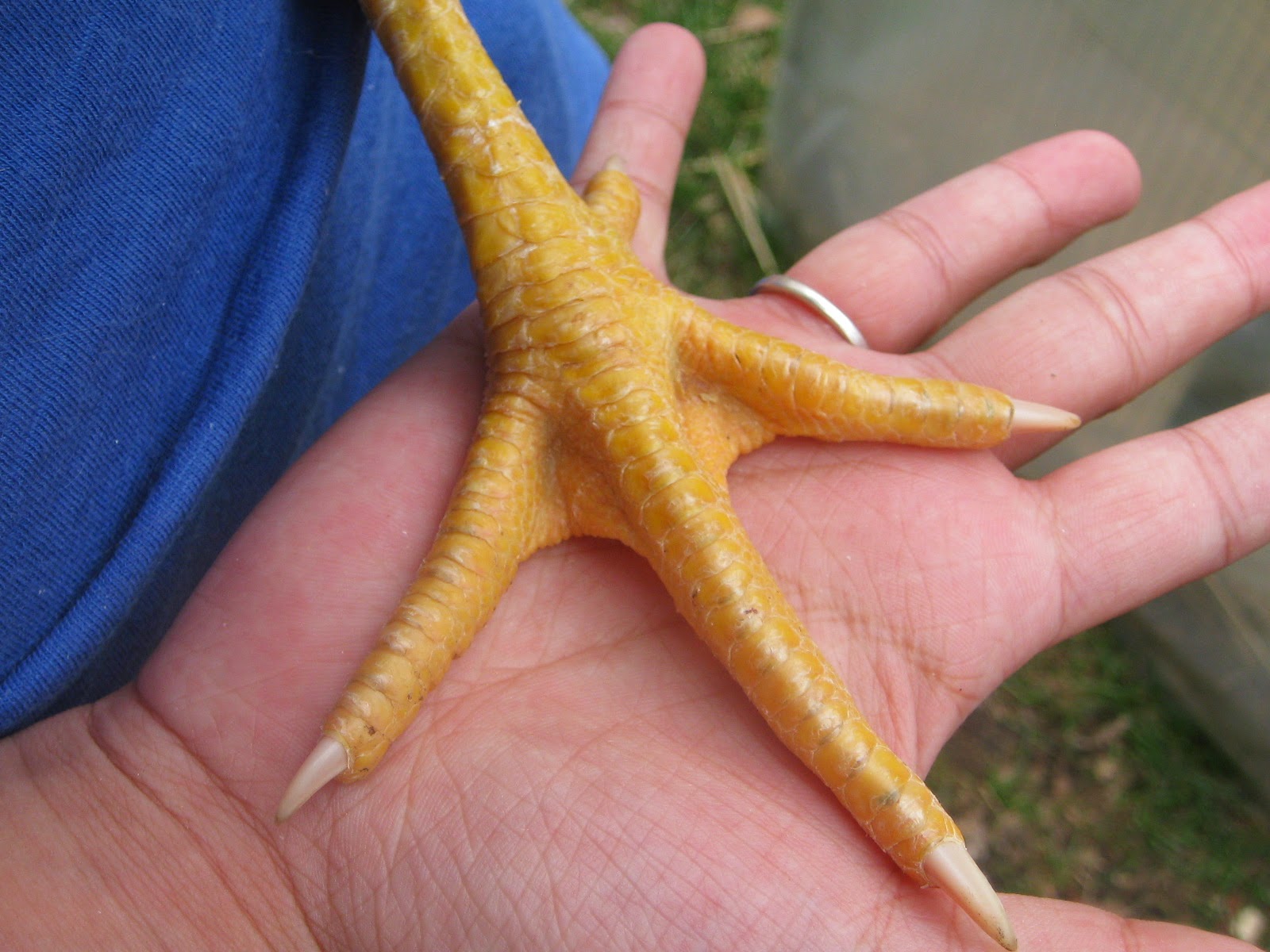
We named him Bob. His feet are huge. His comb and wattles are impressive for only eight weeks. He's bigger than the pullets in his breed (White Rock), and he's much bigger than the other breeds (Australorp, Wyandotte, Americauna). He protects all of his girls dutifully.
The Chicken Whisperer came home for a short visit today. When she picked up Bob, he immediately raised his hackles and was as fierce as possible, but soon calmed down. Impressive, isn't he?
Roosters aren't allowed in our municipality, so Bob will move on soon. It's been fun to watch his distinctly rooster behaviors. We'll miss him. I think....
Wednesday, March 12, 2014
Introducing Spring Chicks
We picked up our chicks at Abendroth's Hatchery on Monday morning. The hatchery was clean, friendly and well organized. Our girls were carefully packaged and ready to go when we arrived.
In previous years, we've gotten our chicks delivered by US Postal, so the "day old" chicks were really three days old upon arrival. Now that we've experienced true day-old chicks, we can clearly see a difference in size. What a difference a day makes in the life of something so small and fragile!
And now, without further ado, here they are:
This is Little Mittens, an Easter Egger. She will grow golden brown plumage and lay green eggs. Her name is a long-standing family joke. We haven't allowed Kavi to name any of the animals around here until today....for obvious reasons. He says he's going to get a mastiff or an Angus bull and name it Little Mittens, which he pronounces Wittle Mittens in a very high voice.
Pictured above is Queen Latifah, a Black Australorp. She will grow into a beautiful bird with shiny, soft black feathers, black legs and black beak. Right now she has a little white diaper butt. She will lay light brown eggs.
This one is Marilyn, a Silver Laced Wyandotte. She'll grow silvery white plumage with black edges outlining most of her feathers. We expect her to be the glamour girl of the flock, with her curvy body shape and fancy dress. She'll lay light brown eggs.
These three are Ping, Pang and Pong. They are White Plymouth Rock, an excellent dual purpose breed. Their names come from Puccini's opera Turandot. Yeah, you knew I couldn't stay out of the naming process entirely. But I tried!
In previous years, we've gotten our chicks delivered by US Postal, so the "day old" chicks were really three days old upon arrival. Now that we've experienced true day-old chicks, we can clearly see a difference in size. What a difference a day makes in the life of something so small and fragile!
And now, without further ado, here they are:
This is Little Mittens, an Easter Egger. She will grow golden brown plumage and lay green eggs. Her name is a long-standing family joke. We haven't allowed Kavi to name any of the animals around here until today....for obvious reasons. He says he's going to get a mastiff or an Angus bull and name it Little Mittens, which he pronounces Wittle Mittens in a very high voice.
Pictured above is Queen Latifah, a Black Australorp. She will grow into a beautiful bird with shiny, soft black feathers, black legs and black beak. Right now she has a little white diaper butt. She will lay light brown eggs.
This one is Marilyn, a Silver Laced Wyandotte. She'll grow silvery white plumage with black edges outlining most of her feathers. We expect her to be the glamour girl of the flock, with her curvy body shape and fancy dress. She'll lay light brown eggs.
These three are Ping, Pang and Pong. They are White Plymouth Rock, an excellent dual purpose breed. Their names come from Puccini's opera Turandot. Yeah, you knew I couldn't stay out of the naming process entirely. But I tried!
Saturday, March 8, 2014
Collapsible Brooder Box
Our brooder box is stored in six (relatively) flat pieces: the base/floor, four side walls, and the screen top. The entire design grew from an old window frame found at the curb. Using hardware cloth as a screen, the window frame is the top of the box. The hardware cloth is sturdy enough to keep out our cats and hold up the heat lamps.
The base/floor of the box is covered with cheap vinyl squares, making clean up easier than scrubbing a rough plywood base. In the photos, you can see the 1x2 wood frame in the corners and around the top perimeter. The design is easy to screw together now and unscrew for storage later. Be sure to keep the screws properly labeled in a container during the off season.
It's much too cold in the garage right now, so the chicks will begin their lives in the basement. They're adorable at first, but soon begin to toss around their bedding materials. It's a dusty mess. Don't say I didn't warn you.
Tomorrow we'll add the heat lamps and thermometer. We need to get it around 90 degrees before the arrival of the babies on Monday. We're nearly ready!
Wednesday, March 5, 2014
Ginger Lemonade
Are you suffering from late winter creeping crud? Here's an easy recipe that will sooth a scratchy throat.
Ginger Lemonade
6. cups water
1 cup sugar
1 cup bottled lemon juice
ginger
Combine all ingredients in a pot, simmer and steep. Simple!
I use a variety of ginger. You can buy crystallized ginger in little bags (shown above). If you feel ambitious, you can buy fresh ginger root and grate it yourself. We buy grated ginger in small jars, found in the ethnic section of the grocery store. We also just discovered a jar of dried ginger slices from Penzeys in the back of our cabinet. I suppose you could even use dried ginger powder.
Any unused portions can be stored in the refrigerator and reheated later. Try it!
Monday, March 3, 2014
Hooped Raised Beds
Last fall, this covered raised bed grew spinach, Swiss chard, arugula and kale, which we harvested by Thanksgiving. After harvest, we decided to retain the hooped cover over the winter months so that (theoretically) we could access this bed in early spring. Since then, Old Man Winter has completed buried the whole thing until this weekend, when my boys shoveled out the excess snow and tossed it downhill. We hope the sun will warm the raised bed in the next few weeks to allow planting of early spring greens. Meanwhile, I'm sowing seeds--indoors, of course--in 4" containers for transplant when the weather allows, perhaps late March or early April.
Gardening under snow? Well, maybe.....
Subscribe to:
Posts (Atom)