Welcome

Red Bucket Farm is an urban farm on a quarter acre property in an average residential neighborhood. We are located in Wisconsin, USDA Zone 5. We focus on chickens, bees, orchard fruit, and raised garden beds for fruits and veggies. We hope to reduce our footprint on the planet by growing some of our food, reducing our use of fossil fuels, and gardening with sustainable practices. Thanks for visiting!

Showing posts with label molt. Show all posts

Wednesday, February 12, 2014

Green Egg


Cassie the Easter Egger has finally started laying eggs again! Her last egg was Dec. 21, nearly eight weeks ago. It's normal for molting hens to stop laying in the winter, but Cassie is a pullet and didn't molt. It's also normal for hens to lay fewer eggs during the dark months. Cassie has been a bit disappointing, eating a lot and providing little in return. She's back in production now, which will keep her from the soup kettle for a while. Her green eggs are far more beautiful than my limited photography skills can demonstrate. Welcome back, Cassie!

Friday, February 7, 2014

Increased Egg Production


What's wrong with this picture? Nothing, I suppose. Egg production from my backyard flock is way up. I should hardly be concerned!

The numbers bottomed out - predictably - the week of the winter solstice. (Remember that egg production is dependent upon light, not necessarily temperature.) That week we gathered only 11 eggs from the girls. With the increase in natural daylight and a little supplemental lighting in the early morning, egg production is currently up to about 23 eggs per week.

Thelma and Louise (our Buckeye-Delaware hybrids) began molting around Thanksgiving. The poor things looked quite miserable for a month or so. It takes all their energy to grow new feathers and they ceased laying eggs entirely for about eight weeks. Happily, they are both back into production now.

So what's wrong with the picture? My silly Easter Egger, Cassie, hasn't laid an egg since Dec. 21. She's not molting or sick, just unproductive. It's not uncommon for egg laying to slow or stop in the winter, but she's less than a year old and should be doing something other than eat, sleep and poop. All that expensive organic chicken food needs to translate into organic eggs. This is an urban farm, not a zoo. Tick-tock, Cassie.

Tuesday, January 29, 2013

Lighting the Coop


We began lighting our chicken coop a week ago. We installed compact fluorescent bulbs in the rafters above the covered run and the hen house. The lights shine through the hardware cloth ceiling to the run below. With this arrangement there is very little chance that the coop will catch fire.

Coop fires happen too frequently. Many farmers use wood shavings, hay and straw as bedding materials, which will make any coop a tinder box. It's important to be very cautious when lighting or heating a chicken coop.


Our lights are set on a timer to turn on at 4 am and off at 7 am. This extends the day for the hens to about 13 hours of light, which is roughly the equivalent of daylight in April. We hope this is enough light to stimulate egg production. We chose to not extend the light in the evenings because this confuses the birds regarding bedtime. If the lights shut off suddenly at 9 pm, it will be too dark for the girls find their way to the roost. 

We'll stop using the lights as the spring progresses. We plan to resume lighting later in the year, but not until after the girls have a chance to molt. If we begin lighting too early in the fall, it may cause the hens to delay their molt until mid-winter when it is dangerously cold weather. Instead, we'll allow the girls to have a natural rest in the fall, and begin lighting again after the winter solstice. 

The new schedule has been working reasonably well. The girls are up early in the morning, scratching and feeding in their coop. But the last week has been a strange transition for them. They've gone to bed at 4 pm in spite of the continuing day light. I think they're tired out with the sudden extension of their day. Perhaps they need their beauty sleep! 

Still....no eggs yet. 

Tuesday, January 1, 2013

Unproductive Hens


I'll admit that I'm pretty frustrated with my backyard flock of hens. We haven't gathered an egg from these girls since November 3---a full two months without fresh eggs. Ours is a fairly common predicament. We have a couple of pullets who haven't arrived at maturity and aren't yet laying, and we have a few older hens who are stuck in the annual molt.

A chicken's annual molt, which occurs in the fall, lasts anywhere from a month to three or even four months depending on the age of the hen. The older a hen gets, the more stressful and time-consuming it becomes for her to shed old feathers and grow new ones. 

A spring chick will grow over the summer and begin laying eggs in the fall. She might experience a light molt her first fall, which will reduce her egg production but probably not halt egg laying entirely. She's likely to produce eggs her first winter and lay abundantly through spring and summer. But her second autumn will induce a more dramatic molt, and she is likely to stop producing eggs completely while her body works on growing new feathers. After the molt she'll start to produce eggs again, but her eggs will be larger and fewer than previously. As each year passes, her molt will become increasingly severe and her eggs less abundant.

As an urban farmer with a limit to flock size, how long do I continue to feed unproductive hens? Although the girls are obviously healthy and normal, when is it okay to cull the flock and raise new chicks? How can I justify the expense of chicken feed without any eggs?

Wednesday, November 28, 2012

Chickens Mid-molt


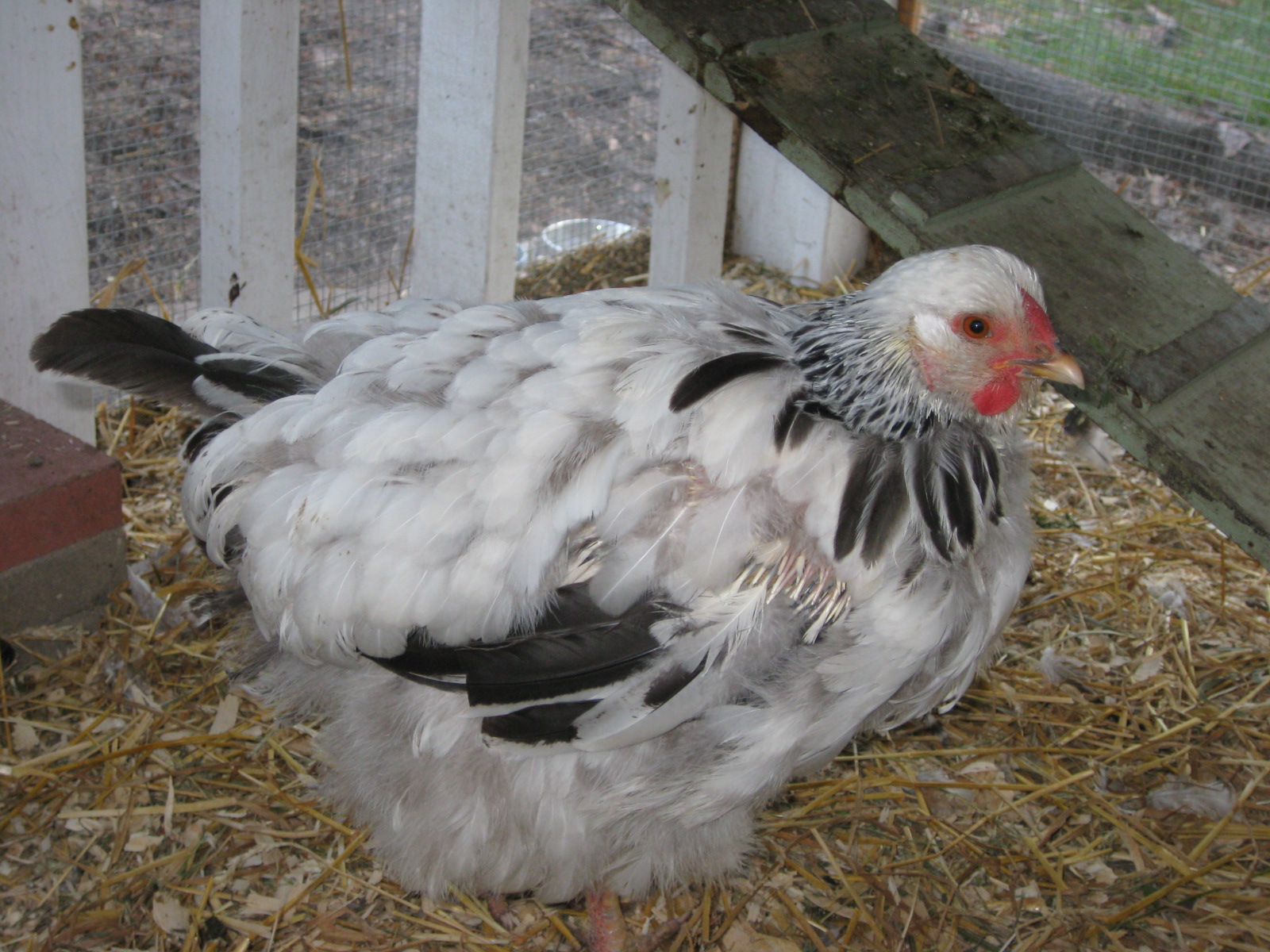
Several people have inquired, so here is a quick update on my molting hens. The girls are doing okay, or at least they're not completely miserable. It is normal for them to molt at this time of year. It doesn't make much sense to me, as the nights are quite cold and I wish they were all fully feathered, but this is considered normal. Egg production began tapering off quickly in October. I haven't retrieved an egg since November 3. The same three hens that formerly gave 15-20 eggs per week are now on hiatus while their feathers grow in. It takes all their energy to accomplish this. In the photo above, you can see tiny quills poking through Crocus's head and neck. They resemble white needles against her darker feathers.


Daisy's tail feathers are growing in now and I think she is approaching the end of her molt. Each hen begins and ends the molt at her own pace. Squill, who preferred to not be photographed today, still has bare skin patches on her neck and shoulders.


Meanwhile, we've winterized the coop by covering it with sheet plastic and plexiglass. The girls have plenty of space to stay out of the wind and precipitation, yet they have the freedom to wander outside when it's sunny and warm. They have open water in their heated water dish, and we've increased their protein intake with sunflower seeds as treats.

We're hoping for eggs again after the holidays. Meanwhile, we try to keep the girls clean, dry and well-fed. This is Mother Nature's way of giving the hens a vacation from many months of hard work. And this year I gave them holiday lights on their fence to keep them cheerful.

Thursday, November 8, 2012

Naked Chickens


I'm trying to remain optimistic. Every day I wander out to the chicken coop and check the nest boxes for eggs, but it's to no avail. My flock is betwixt and between. The pullets haven't started laying yet, and the experienced hens are molting.


It's almost painful to watch. Feathers drop out in large clumps. Daisy the Delaware is half naked, her pink skin obviously chilled in the cool fall weather. She has no tail feathers left and there are large bare patches on her sides.


As pin feathers begin grow in, Daisy limps around the chicken yard without any energy, clearly stressed by the process. We've been supplementing with sunflower seeds for extra protein, and we make sure the girls are clean, dry and protected from wind and rain. And we wait. Poor things.


Thursday, March 15, 2012

Egg Production


Egg production is up at Red Bucket Farm--way up, in fact. Chickens vary seasonally in egg production. Much of it is based on hours of daylight. In fact, many chicken wranglers provide artificial lighting in the hen house during the darker winter months to encourage their girls to lay more eggs. We prefer to go with whatever natural light Mother Nature provides. The girls deserve a little break in the winter.

Another factor in reduced winter egg production is the natural inclination to molt. Mature hens will generally lose feathers in the late fall and early winter. They grow new feathers in preparation for the deep winter freeze, but it takes so much energy to molt that a hen may stop laying eggs for several weeks. Some chicken breeds molt more significantly than others.

During the course of the winter, our small flock produced a steady supply of about 20 eggs per week. Half of our girls molted and stopped laying eggs entirely. We had enough for our family, including holiday baking, but we didn't have much surplus.

In mid-February, our weekly egg count jumped from 20 eggs per week to 30 eggs, and then immediately up to 42 or 43 eggs per week. All the girls are back in production again and they seem happy. Our unseasonably warm spring weather has brought 80-degree daytime temperatures, which is causing me to worry that production may decrease because of the heat.

Meanwhile, the girls have regrown their flight feathers after the molt, which means that a couple of them have decided to repeatedly jump the fence. After chasing them around and returning them to the safety of the chicken yard several times, I finally marched out there with my kitchen shears and gave two of the mischief makers a little trim. So there.