Photos from top to bottom: cherries, crabapples, peach, apricot, pear, currants, kiwi. How did you do?
Welcome
Red Bucket Farm is an urban farm on a quarter acre property in an average residential neighborhood. We are located in Wisconsin, USDA Zone 5. We focus on chickens, bees, orchard fruit, and raised garden beds for fruits and veggies. We hope to reduce our footprint on the planet by growing some of our food, reducing our use of fossil fuels, and gardening with sustainable practices. Thanks for visiting!
Showing posts with label urban farm. Show all posts
Sunday, June 5, 2016
Spring Fruit
A photo survey of the orchard this morning reveals several kinds of baby fruits. Can you name them?
Photos from top to bottom: cherries, crabapples, peach, apricot, pear, currants, kiwi. How did you do?
Friday, August 21, 2015
Epic Tomatoes
Over the winter, I read Craig LeHoullier's new book, Epic Tomatoes (2015, Storey Publishing). I was dubious that I could read an entire book about nothing but tomatoes, but Craig's book is compelling and inspiring; it influenced me to grow a much wider variety of tomatoes than ever before. His focus is on "heirloom" or open-pollinated varieties rather than hybrids. I've learned that if I'm willing to compromise on appearance and shipping/storage qualities, I'm likely to gain in fantastic and unique flavors.
Here is a photo of a variety called Purple Cherokee. The flesh is sweet, juicy and it is indeed purple-ish in color. Notice that this tomato is huge---one pound and four ounces. There are so many varieties of tomatoes to grow. It's ridiculously limiting to buy the few varieties that your garden center provides. We urge you to plan ahead for next year and try something new.
Now I'm back to the canning, freezing and processing that consumes my day. Happy gardening!
Here is a photo of a variety called Purple Cherokee. The flesh is sweet, juicy and it is indeed purple-ish in color. Notice that this tomato is huge---one pound and four ounces. There are so many varieties of tomatoes to grow. It's ridiculously limiting to buy the few varieties that your garden center provides. We urge you to plan ahead for next year and try something new.
Now I'm back to the canning, freezing and processing that consumes my day. Happy gardening!
Tuesday, August 4, 2015
Ruthless and Strategic
Dee and Cathy have watched Red Bucket Farm grow over the last several years. They are dear friends who have shared many meals with us; they have also laughed and cried with us. So I'm not offended when they refer to my last blog as "the best rant on the internet" or when they describe me as a "ruthless and strategic" urban farmer.
Ruthless and strategic refers to the fact that I don't get emotionally attached to a bush or a tree or even a chicken. For example, we have been attempting to grow gooseberries for years. After two attempts in different locations and about six years invested, we have finally arrived at a crop large enough to produce one fruit pie. And guess what? Even though it was delicious, I'm pulling out those thorny bushes---way too much trouble and space for too little food. It's just a matter of practicality.
Reactions to my last blog (May 29, 2015, The Cost of Gardening) varied widely. Many were stunned and silent, and one person accused me of being hostile. Interestingly, the folks who agreed with me felt the need to do so privately. A friend who operates a small business understood entirely---so many people expect a discount large enough to obliterate his profit. But the most telling response came from a lifelong farmer, a pig expert who I know at my church. When I told him about the cost-of-gardening blog and the responses to it, he laughed out loud and said, "Now you understand the economics of agriculture."
Ruthless and strategic? Yes, indeed.
Ruthless and strategic refers to the fact that I don't get emotionally attached to a bush or a tree or even a chicken. For example, we have been attempting to grow gooseberries for years. After two attempts in different locations and about six years invested, we have finally arrived at a crop large enough to produce one fruit pie. And guess what? Even though it was delicious, I'm pulling out those thorny bushes---way too much trouble and space for too little food. It's just a matter of practicality.
Reactions to my last blog (May 29, 2015, The Cost of Gardening) varied widely. Many were stunned and silent, and one person accused me of being hostile. Interestingly, the folks who agreed with me felt the need to do so privately. A friend who operates a small business understood entirely---so many people expect a discount large enough to obliterate his profit. But the most telling response came from a lifelong farmer, a pig expert who I know at my church. When I told him about the cost-of-gardening blog and the responses to it, he laughed out loud and said, "Now you understand the economics of agriculture."
Ruthless and strategic? Yes, indeed.
Friday, May 29, 2015
The Cost of Gardening
When I mention to acquaintances that I'm an urban farmer, they seem to have visions of pastoral beauty---tomatoes dangling lusciously from the vine, bees buzzing around the lavender, vegetable beds neatly weeded, homemade lemonade on the picnic table. Sounds fantastic, doesn't it? And oh, by the way, if you have a surplus of tomatoes, I'll be happy to take some off your hands, they mention casually.
Let's get this straight. Tomatoes do not just happen. Any serious urban farmer works year-round to make it happen. We order seeds in January and begin sowing indoors immediately. We carefully watch the spring weather, cultivating beds, adding compost, and finding the right time to transfer seedlings to the greenhouse for hardening, and ultimately to the beds. Then we watch for bugs and disease, using labor-intensive methods to organically solve problems. Finally, we enjoy the harvest. If we've done our work properly and the weather has been generous, there will be enough to freeze, can and preserve for use all winter long, perhaps even into the next season.
Several years ago, before I was a gardener, my friend Diana gave me one, gigantic sweet onion. It was the size of a softball. I cradled the onion in my hands and planned carefully how to use it in a meal, because I knew the onion came from her garden.
Gardening is like quilting. It's a labor of love. I don't give a quilt to anybody who does not truly understand and appreciate the hours it took to create. Quilters refer to gift recipients as "quilt worthy."
Gardening is not free. At Red Bucket Farm, we have thousands of dollars invested in raised beds, compost bins, bee hives, rain barrels, terracing (both wood and brick), fencing, sheds, coops, greenhouses, trellises, and arbors. We consider this our retirement investment plan. Plants also cost plenty, even when purchased bare root in the spring. Fruit trees run about $25 each, and that's when they are a tiny stick in the ground. It takes years for a tree to become fruitful. Chickens are not free, nor is chicken food.
I don't mean to be ungenerous, but urban farming is my job. Asking for the fruits of my labor is like asking for my paycheck. I'm happy to share with my friends, those lovely folks who pray for me and check on me regularly to make sure that I'm doing okay. I'm also happy to sell a few eggs when the flock is producing abundantly. But please---think twice before making assumptions. Are you veggie worthy?
Let's get this straight. Tomatoes do not just happen. Any serious urban farmer works year-round to make it happen. We order seeds in January and begin sowing indoors immediately. We carefully watch the spring weather, cultivating beds, adding compost, and finding the right time to transfer seedlings to the greenhouse for hardening, and ultimately to the beds. Then we watch for bugs and disease, using labor-intensive methods to organically solve problems. Finally, we enjoy the harvest. If we've done our work properly and the weather has been generous, there will be enough to freeze, can and preserve for use all winter long, perhaps even into the next season.
Several years ago, before I was a gardener, my friend Diana gave me one, gigantic sweet onion. It was the size of a softball. I cradled the onion in my hands and planned carefully how to use it in a meal, because I knew the onion came from her garden.
Gardening is like quilting. It's a labor of love. I don't give a quilt to anybody who does not truly understand and appreciate the hours it took to create. Quilters refer to gift recipients as "quilt worthy."
Gardening is not free. At Red Bucket Farm, we have thousands of dollars invested in raised beds, compost bins, bee hives, rain barrels, terracing (both wood and brick), fencing, sheds, coops, greenhouses, trellises, and arbors. We consider this our retirement investment plan. Plants also cost plenty, even when purchased bare root in the spring. Fruit trees run about $25 each, and that's when they are a tiny stick in the ground. It takes years for a tree to become fruitful. Chickens are not free, nor is chicken food.
I don't mean to be ungenerous, but urban farming is my job. Asking for the fruits of my labor is like asking for my paycheck. I'm happy to share with my friends, those lovely folks who pray for me and check on me regularly to make sure that I'm doing okay. I'm also happy to sell a few eggs when the flock is producing abundantly. But please---think twice before making assumptions. Are you veggie worthy?
Thursday, April 30, 2015
Spring Chicks 2015
Spring chicks are a happy event at Red Bucket Farm. Some years we obtain chicks from a local hatchery so that we can drive over and pick them up. This year we opted for more unusual breeds, so we ordered from My Pet Chicken. Our chicks hatched on April 6 and arrived by USPS on April 8.
Baby chicks are packaged carefully with a gel heat pack, but it's a difficult trip. All of our little ones were alive upon arrival, but we lost one within 24 hours. It was disappointing but not unexpected. The plumage (really it's fluff) of little chicks doesn't necessarily reflect their mature colors, so it can be difficult to ascertain which breed is which. We think the one that died immediately was a Partridge Plymouth Rock.
The new chicks are now three weeks old. They live in their brooder box in the basement. A heat lamp keeps them nice and warm. We refill water and food regularly, and check for vent blockage to make sure all systems are operating properly. (That's a nice way of saying that we check for poopy butts.)
This particular flock has seemed more flighty than previous flocks. We suspect that our choice of breeds may be playing into this. We decided to try Light Brown Leghorn, Exchequer Leghorn, Buff Chantecler, Silver Cuckoo Marans and Ancona as new breeds. Some of these breeds have a reputation for nervousness and flightiness.
Late last night I removed their water and stepped to the sink to refill. The girls were scrambling around in their brooder box in their usual panicky manner. Suddenly I heard a loud squawk and returned to find one little chick laying on her side, evidently paralyzed. She died in a minute. It's a mystery to us. Did she have a heart attack or aneurysm? Can a flighty chick die of a panic attack? We think the victim was either the Exchequer Leghorn or the Ancona.
We always order extra chicks so our flock will be strong enough to survive winter. Perhaps we'll try the new breeds again next, or maybe we'll just stick with the hardy heritage breeds. Stay tuned.
Baby chicks are packaged carefully with a gel heat pack, but it's a difficult trip. All of our little ones were alive upon arrival, but we lost one within 24 hours. It was disappointing but not unexpected. The plumage (really it's fluff) of little chicks doesn't necessarily reflect their mature colors, so it can be difficult to ascertain which breed is which. We think the one that died immediately was a Partridge Plymouth Rock.
The new chicks are now three weeks old. They live in their brooder box in the basement. A heat lamp keeps them nice and warm. We refill water and food regularly, and check for vent blockage to make sure all systems are operating properly. (That's a nice way of saying that we check for poopy butts.)
This particular flock has seemed more flighty than previous flocks. We suspect that our choice of breeds may be playing into this. We decided to try Light Brown Leghorn, Exchequer Leghorn, Buff Chantecler, Silver Cuckoo Marans and Ancona as new breeds. Some of these breeds have a reputation for nervousness and flightiness.
Late last night I removed their water and stepped to the sink to refill. The girls were scrambling around in their brooder box in their usual panicky manner. Suddenly I heard a loud squawk and returned to find one little chick laying on her side, evidently paralyzed. She died in a minute. It's a mystery to us. Did she have a heart attack or aneurysm? Can a flighty chick die of a panic attack? We think the victim was either the Exchequer Leghorn or the Ancona.
We always order extra chicks so our flock will be strong enough to survive winter. Perhaps we'll try the new breeds again next, or maybe we'll just stick with the hardy heritage breeds. Stay tuned.
Saturday, December 27, 2014
Winter Bees
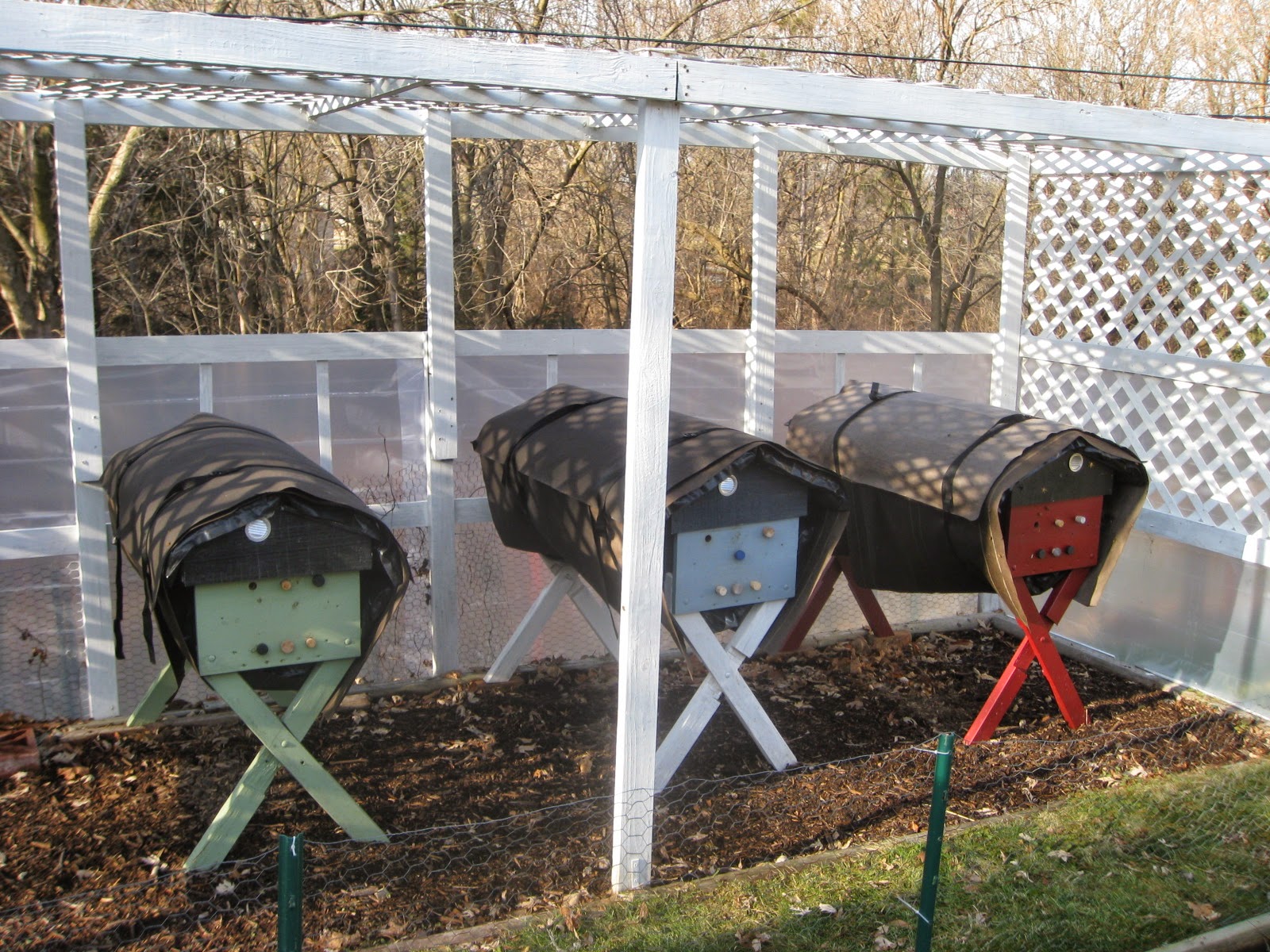
The weather at Red Bucket Farm has been fairly dreadful in terms of our honeybees. Towards the end of October, we covered the hives with insulation blankets and wrapped the entire bee yard with plastic to protect the hives from western winds.
November was just plain cold. Outdoor air temperatures were way below normal, hovering in the teens during the day and close to zero at night. The bees disappeared into the hives where they clustered together in a tight ball around the queen.
December has been warmer but cloudy, foggy, damp and drippy. It's normal for bees to take "cleansing flights" during winter months. They prefer to not poop in their hives and will slip outside on a sunny afternoon for quick trip to the ladies room. Unfortunately, we haven't seen the sun or the bees in weeks---until yesterday. Finally we had a few hours of sunshine and one of our hives took the opportunity to get outside.
This video is about one second long, but you get the idea. (Sorry that I'm not so clever with technology.) We'll be happy if even one hive survives the winter so that we can build and split with the hardy bees that make it. Replacing bees each spring is expensive---about $100 per hive---and we may not be able to justify the expense if they die each winter.
So, at the risk of repeating myself endlessly, if you still use lawn chemicals, please reconsider. Chemicals weaken the bee population significantly. If the bees approach winter in a compromised state, they can't possibly survive. Pollination is tenuous these days, and without it, we all suffer. Backyard bees are better off than rural bees because foraging is more varied, but lawn chemicals are toxic. Remember that dandelions are bee food.
Meanwhile, we have a glimmer of hope that some of our bees are still alive!
Tuesday, November 4, 2014
Planting Garlic
Planting garlic is similar to planting tulip and daffodil bulbs: push them deep in the soil in the late fall and wait for the magic to happen in the spring.
First make sure the soil is loose, friable, and free of weeds. Add a bit of compost and get ready to plant. I placed my garlic cloves gently on the surface of the soil to get a sense of how closely to space them. Then I pushed my garden knife into the soil the full length of the blade and dropped the garlic down. After all were planted, I covered the bed with a layer of hay and watered.
Garlic is the crop that keeps on giving. Two years ago I visited Seed Savers Exchange in Decorah, Iowa, where I purchased one head of Inchelium Red (softneck) Garlic and one head of Eric's German White (hardneck) Garlic. I planted them in October 2012 and saved my entire harvest the next summer without eating a bite.
In November 2013, I separated the cloves from the heads of garlic and planted again. By July 2014, I had 73 heads of softneck garlic (about 3.75 pounds) and 31 heads of hardneck garlic. From that harvest, I reserved five heads each of hardneck and softneck for replanting. The five heads of hardneck garlic separated into 17 large cloves; the five heads of softneck garlic separated into 62 small cloves.
I learned that garlic slowly adapts to its micro climate, so my garlic is now Red Bucket Farm garlic, specific to my little piece of paradise. Garlic smells fantastic even when planting, and it's not too late to plant this fall. What are you waiting for?
First make sure the soil is loose, friable, and free of weeds. Add a bit of compost and get ready to plant. I placed my garlic cloves gently on the surface of the soil to get a sense of how closely to space them. Then I pushed my garden knife into the soil the full length of the blade and dropped the garlic down. After all were planted, I covered the bed with a layer of hay and watered.
Garlic is the crop that keeps on giving. Two years ago I visited Seed Savers Exchange in Decorah, Iowa, where I purchased one head of Inchelium Red (softneck) Garlic and one head of Eric's German White (hardneck) Garlic. I planted them in October 2012 and saved my entire harvest the next summer without eating a bite.
In November 2013, I separated the cloves from the heads of garlic and planted again. By July 2014, I had 73 heads of softneck garlic (about 3.75 pounds) and 31 heads of hardneck garlic. From that harvest, I reserved five heads each of hardneck and softneck for replanting. The five heads of hardneck garlic separated into 17 large cloves; the five heads of softneck garlic separated into 62 small cloves.
I learned that garlic slowly adapts to its micro climate, so my garlic is now Red Bucket Farm garlic, specific to my little piece of paradise. Garlic smells fantastic even when planting, and it's not too late to plant this fall. What are you waiting for?
Thursday, October 30, 2014
Drying Herbs
As the growing season slowly comes to an end, I'm experimenting with drying herbs for cooking use as well as for my chickens.
A farm colleague has suggested that using dried herbs in the hen house over the winter will help discourage mites or creepy crawlies and will certainly help the fragrance in that crowded space. For that goal, I've been harvesting the herbs that are underplanted in my front yard orchard--oregano, lemon balm and lavender. It's important to keep these herbs separate from those designated for human consumption because the front yard is subject to every dog in the neighborhood. 'Nuff said?
Other herbs at the farm have been living comfortably in the green house--basil, sage, rosemary, and chives. These I can dry and crush, then store in jars in the kitchen.
The process of drying herbs is simple. I cut the stems into a size that will fit in my large roasting pan and place it in a cool oven at 140 degrees Fahrenheit with the fan running. (I have a convection oven.) I prop the oven door open an inch or so to allow moisture to escape, checking on them periodically. The timing will vary depending on the herb and quantity being processed. When it all seems a bit crunchy, I take it out of the oven and gently pull the leaves off the stems. Then I crush it with my hands and place it in storage containers. The herbs for use in the hen house are stored in large plastic bags in the freezer.
Drying herbs in the oven makes my house smell fantastic. It's quicker than the traditional method of hanging bunches of herbs in the basement or garage, which (for me) usually results in messy bits of dropped leaves and stems. Give this a try!
A farm colleague has suggested that using dried herbs in the hen house over the winter will help discourage mites or creepy crawlies and will certainly help the fragrance in that crowded space. For that goal, I've been harvesting the herbs that are underplanted in my front yard orchard--oregano, lemon balm and lavender. It's important to keep these herbs separate from those designated for human consumption because the front yard is subject to every dog in the neighborhood. 'Nuff said?
Other herbs at the farm have been living comfortably in the green house--basil, sage, rosemary, and chives. These I can dry and crush, then store in jars in the kitchen.
The process of drying herbs is simple. I cut the stems into a size that will fit in my large roasting pan and place it in a cool oven at 140 degrees Fahrenheit with the fan running. (I have a convection oven.) I prop the oven door open an inch or so to allow moisture to escape, checking on them periodically. The timing will vary depending on the herb and quantity being processed. When it all seems a bit crunchy, I take it out of the oven and gently pull the leaves off the stems. Then I crush it with my hands and place it in storage containers. The herbs for use in the hen house are stored in large plastic bags in the freezer.
Drying herbs in the oven makes my house smell fantastic. It's quicker than the traditional method of hanging bunches of herbs in the basement or garage, which (for me) usually results in messy bits of dropped leaves and stems. Give this a try!
Labels:
chickens,
gardening,
greenhouse,
herbs,
orchard,
urban farm
Tuesday, October 7, 2014
Bee Hatch
The red hive in the foreground and the green hive in the background are both exhibiting new hatches of bees. Notice most of the bees are taking short flights in little circles right at the hive entrances. These are known as orientation flights as the new bees get to know their surroundings. Soon these bees will begin taking longer flights.
Although the hives are slimming down in preparation for winter, it's good to see new bees and know that the queens are all alive and well.
Thursday, October 2, 2014
Fall Crops
One of the challenges of urban farming is learning how to keep all the garden beds productive through the fall months.
This morning's harvest was a continuation of late summer crops---tomatoes, beans and elderberries. About two dozen butternut squash remain on the vines. The fall-bearing raspberries ("Heritage Everbearing") are producing heavily, unlike the summer raspberries ("Nova" and "Latham") which produced almost nothing. We're not sure if that is the result of a harsh winter or uninformed pruning.
After harvesting potatoes, onions and garlic in mid-summer, I replanted those beds with bok choy, spinach, Swiss chard, scallions and beets. Most of these were started by seed in the greenhouse and were ready for transplant when the root crops were harvested. This is the tricky part---knowing when to seed so fall crops are ready to transplant to available beds. I've found that sowing fall crop seeds in the greenhouse in early July is helpful, and sowing seeds outdoors in the beds no later than mid-August is most productive. Any later than that, and our daylight is just too limited to get those seeds germinating even if the weather is cooperative.
Now I'm off to the kitchen to process my crops for winter storage.
This morning's harvest was a continuation of late summer crops---tomatoes, beans and elderberries. About two dozen butternut squash remain on the vines. The fall-bearing raspberries ("Heritage Everbearing") are producing heavily, unlike the summer raspberries ("Nova" and "Latham") which produced almost nothing. We're not sure if that is the result of a harsh winter or uninformed pruning.
After harvesting potatoes, onions and garlic in mid-summer, I replanted those beds with bok choy, spinach, Swiss chard, scallions and beets. Most of these were started by seed in the greenhouse and were ready for transplant when the root crops were harvested. This is the tricky part---knowing when to seed so fall crops are ready to transplant to available beds. I've found that sowing fall crop seeds in the greenhouse in early July is helpful, and sowing seeds outdoors in the beds no later than mid-August is most productive. Any later than that, and our daylight is just too limited to get those seeds germinating even if the weather is cooperative.
Now I'm off to the kitchen to process my crops for winter storage.
Labels:
gardening,
garlic,
greenhouse,
onions,
pole beans,
potatoes,
seeds,
squash,
urban farm
Saturday, August 2, 2014
Marilyn's First Egg
Marilyn laid her first egg today! She's been preparing for this big moment for a few weeks. Yesterday morning she snuggled in a nest box for a good thirty minutes--she was practicing--and for the last couple of weeks she's been hanging out in the hen house watching the older girls carefully as they lay. This morning Marilyn was mighty bossy to the other pullets, and I could tell she was feeling all grown up and important.
Marilyn is a Silver-Laced Wyandotte. We named her after actress Marilyn Monroe because a Wyandotte is a full-bodied and curvaceous hen, and the silver lacing on her plumage makes her an awfully glamorous addition to the chicken yard. Marilyn was hatched on March 10, 2014. The previous Wyandotte on Red Bucket Farm took a full seven months to lay her first egg, so Marilyn is ahead of schedule.
This morning's egg is tiny--less than two inches long--with a perfectly smooth and shiny tan-colored shell. Subsequent eggs will grow in size. Marilyn has finished bragging and strutting. She's settled in the dirt for a quiet afternoon in the shade. Well done, Marilyn!
Tuesday, July 15, 2014
Chicken Predators
Yesterday I agreed to a telephone interview with a student journalist writing for The Badger Herald. I was told that the article was about urban chickens and urban farms, but I quickly learned there was an ulterior motive. It seems the writer's mother knows urban hen keepers who are complaining about foxes. These folks have contacted the Department of Natural Resources and expect some sort of action regarding foxes in the city.
Red Bucket Farm is situated immediately adjacent to a wildlife sanctuary, part of the city parks department. Our section of the park is dense trees, brambles, and a few hiking paths. We have all kinds of predators---foxes, coyotes, hawks and a pair of great horned owls. We rely on these predators to keep the rabbit, squirrel and chipmunk population in check. Without their help, I'd have to start trapping the little critters to save my crops.
We researched our chicken coop for months before building it in 2010. Since safety was our primary concern, we covered the entire coop with half-inch hardware cloth. The hardware cloth covers the walls, windows, and ceiling; it's also sandwiched between two layers of flooring. We attached it with screws and fender washers. All doors and windows are secured with locks. It may seem extreme, but we've never lost a hen to any predator.
Remember that chickens sleep from dusk to dawn, and darkness causes them to go into "torpor," a kind of stupor or unconsciousness in which the heart rate is lowered. They can't make any effort to defend themselves. This is why chickens roost in a high place at night.
So let's be clear: protecting the urban flock from predators is a farmer's responsibility. Anyone who staples chicken wire to a wooden frame and calls it a coop is asking for trouble. Our hens provide us with fresh eggs, manure for fertilizing, and hours of entertainment. We owe it to them to care for them properly.
Red Bucket Farm is situated immediately adjacent to a wildlife sanctuary, part of the city parks department. Our section of the park is dense trees, brambles, and a few hiking paths. We have all kinds of predators---foxes, coyotes, hawks and a pair of great horned owls. We rely on these predators to keep the rabbit, squirrel and chipmunk population in check. Without their help, I'd have to start trapping the little critters to save my crops.
We researched our chicken coop for months before building it in 2010. Since safety was our primary concern, we covered the entire coop with half-inch hardware cloth. The hardware cloth covers the walls, windows, and ceiling; it's also sandwiched between two layers of flooring. We attached it with screws and fender washers. All doors and windows are secured with locks. It may seem extreme, but we've never lost a hen to any predator.
Remember that chickens sleep from dusk to dawn, and darkness causes them to go into "torpor," a kind of stupor or unconsciousness in which the heart rate is lowered. They can't make any effort to defend themselves. This is why chickens roost in a high place at night.
So let's be clear: protecting the urban flock from predators is a farmer's responsibility. Anyone who staples chicken wire to a wooden frame and calls it a coop is asking for trouble. Our hens provide us with fresh eggs, manure for fertilizing, and hours of entertainment. We owe it to them to care for them properly.
Thursday, June 5, 2014
Container Gardening
Every year my gardening ambitions exceed my ground space, and so I use containers as overflow. Many herbs grow well in pots. I'm growing parsley, rosemary, chives, pineapple sage and basil in containers on our back patio. Elevating them off the ground keeps the voracious bunnies from eating tender seedlings. Fresh herbs are amazing to eat and easy to grow.
This year is the first time I'm growing "Tom Thumb" dwarf peas in containers. The pea pods are beginning to form and we're excited to sample them soon.
I'm experimenting with growing leafy greens in shallow planting dishes that we like to call "salad bowls." In the foreground is kale, plus spinach and bok choi in the background (not yet germinated). Notice that I've hung the shade cloth in the greenhouse. It's frequently 100 degrees in there!
Finally, I intended to put this broccoli in the ground in a new raised bed, but it's not going to happen this year. I transplanted the little seedlings into 6" pots. I've got nothing to lose at this point, so we'll see if it works.
If you have even a tiny patio or balcony, you can do this too!
Thursday, May 29, 2014
Managing the Orchard
Anyone who has gardened for more than a year or two knows that the garden is never finished. Most great gardens are in a constant state of transition as the gardener discovers which plants flourish in any specific location and which do not. This is also true at our fruit orchard here at Red Bucket Farm.
Last year, our large peach tree produced ninety pounds of juicy sweet fruit. We're still eating from that harvest! But the winter of 2013-14 was cold and colder, and the peach tree has barely survived. This tree is located at the bottom of the hill in a micro-climate that didn't fare as well as the trees up the hill. It didn't bloom this spring at all, and we're nursing it with chicken poop tea and hoping that it will recover this summer to produce again in 2015.
On the other hand, our three cherry trees bloomed beautifully and are developing little fruits. Hooray for winter-hardy pie cherries!
The new trees in the front yard orchard are doing well, or most of them are. Two peach trees, three pear trees and one apricot tree all bloomed lightly and are making a few small fruits---not bad considering these are still very small trees. One additional apricot tree (important for cross pollination) is struggling. This is the second tree of that variety we've planted in that location and it's just not happy. We suspect that the roots are too wet and the soil isn't draining well. We've removed the tree to a container for recuperation, and we've ordered a different apricot variety to plant in its place. We'll create a mounded hill to help with drainage and we'll amend the soil with Turface and chicken grit.
Every evening we wander through the orchard and check on our trees. Slowly we're discovering which trees belong in each location. A fruit tree gives a lot of bang for your buck, so it pays to be attentive and invest in the home orchard.
Last year, our large peach tree produced ninety pounds of juicy sweet fruit. We're still eating from that harvest! But the winter of 2013-14 was cold and colder, and the peach tree has barely survived. This tree is located at the bottom of the hill in a micro-climate that didn't fare as well as the trees up the hill. It didn't bloom this spring at all, and we're nursing it with chicken poop tea and hoping that it will recover this summer to produce again in 2015.
On the other hand, our three cherry trees bloomed beautifully and are developing little fruits. Hooray for winter-hardy pie cherries!
The new trees in the front yard orchard are doing well, or most of them are. Two peach trees, three pear trees and one apricot tree all bloomed lightly and are making a few small fruits---not bad considering these are still very small trees. One additional apricot tree (important for cross pollination) is struggling. This is the second tree of that variety we've planted in that location and it's just not happy. We suspect that the roots are too wet and the soil isn't draining well. We've removed the tree to a container for recuperation, and we've ordered a different apricot variety to plant in its place. We'll create a mounded hill to help with drainage and we'll amend the soil with Turface and chicken grit.
Every evening we wander through the orchard and check on our trees. Slowly we're discovering which trees belong in each location. A fruit tree gives a lot of bang for your buck, so it pays to be attentive and invest in the home orchard.
Thursday, May 8, 2014
Accidental Rooster
Our spring chicks are now eight weeks old and no longer little balls of fluff. They have grown adult feathers and spend their days outside comfortably in the portable coop. The only problem we're experiencing is that one of them isn't a pullet (hen). He's a cockerel and he is quickly becoming a rooster.
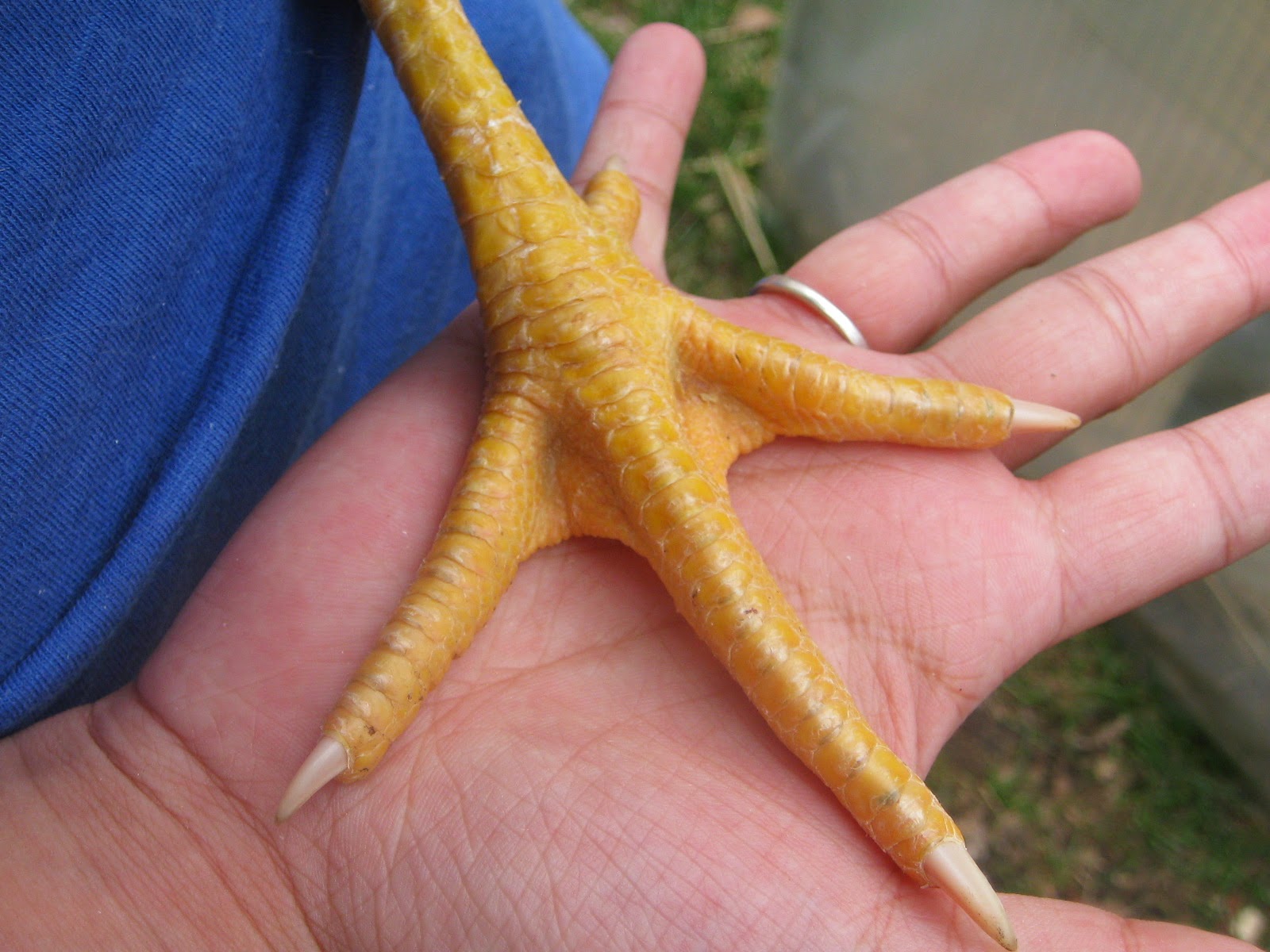
We named him Bob. His feet are huge. His comb and wattles are impressive for only eight weeks. He's bigger than the pullets in his breed (White Rock), and he's much bigger than the other breeds (Australorp, Wyandotte, Americauna). He protects all of his girls dutifully.
The Chicken Whisperer came home for a short visit today. When she picked up Bob, he immediately raised his hackles and was as fierce as possible, but soon calmed down. Impressive, isn't he?
Roosters aren't allowed in our municipality, so Bob will move on soon. It's been fun to watch his distinctly rooster behaviors. We'll miss him. I think....
Wednesday, March 12, 2014
Introducing Spring Chicks
We picked up our chicks at Abendroth's Hatchery on Monday morning. The hatchery was clean, friendly and well organized. Our girls were carefully packaged and ready to go when we arrived.
In previous years, we've gotten our chicks delivered by US Postal, so the "day old" chicks were really three days old upon arrival. Now that we've experienced true day-old chicks, we can clearly see a difference in size. What a difference a day makes in the life of something so small and fragile!
And now, without further ado, here they are:
This is Little Mittens, an Easter Egger. She will grow golden brown plumage and lay green eggs. Her name is a long-standing family joke. We haven't allowed Kavi to name any of the animals around here until today....for obvious reasons. He says he's going to get a mastiff or an Angus bull and name it Little Mittens, which he pronounces Wittle Mittens in a very high voice.
Pictured above is Queen Latifah, a Black Australorp. She will grow into a beautiful bird with shiny, soft black feathers, black legs and black beak. Right now she has a little white diaper butt. She will lay light brown eggs.
This one is Marilyn, a Silver Laced Wyandotte. She'll grow silvery white plumage with black edges outlining most of her feathers. We expect her to be the glamour girl of the flock, with her curvy body shape and fancy dress. She'll lay light brown eggs.
These three are Ping, Pang and Pong. They are White Plymouth Rock, an excellent dual purpose breed. Their names come from Puccini's opera Turandot. Yeah, you knew I couldn't stay out of the naming process entirely. But I tried!
In previous years, we've gotten our chicks delivered by US Postal, so the "day old" chicks were really three days old upon arrival. Now that we've experienced true day-old chicks, we can clearly see a difference in size. What a difference a day makes in the life of something so small and fragile!
And now, without further ado, here they are:
This is Little Mittens, an Easter Egger. She will grow golden brown plumage and lay green eggs. Her name is a long-standing family joke. We haven't allowed Kavi to name any of the animals around here until today....for obvious reasons. He says he's going to get a mastiff or an Angus bull and name it Little Mittens, which he pronounces Wittle Mittens in a very high voice.
Pictured above is Queen Latifah, a Black Australorp. She will grow into a beautiful bird with shiny, soft black feathers, black legs and black beak. Right now she has a little white diaper butt. She will lay light brown eggs.
This one is Marilyn, a Silver Laced Wyandotte. She'll grow silvery white plumage with black edges outlining most of her feathers. We expect her to be the glamour girl of the flock, with her curvy body shape and fancy dress. She'll lay light brown eggs.
These three are Ping, Pang and Pong. They are White Plymouth Rock, an excellent dual purpose breed. Their names come from Puccini's opera Turandot. Yeah, you knew I couldn't stay out of the naming process entirely. But I tried!
Saturday, March 8, 2014
Collapsible Brooder Box
Our brooder box is stored in six (relatively) flat pieces: the base/floor, four side walls, and the screen top. The entire design grew from an old window frame found at the curb. Using hardware cloth as a screen, the window frame is the top of the box. The hardware cloth is sturdy enough to keep out our cats and hold up the heat lamps.
The base/floor of the box is covered with cheap vinyl squares, making clean up easier than scrubbing a rough plywood base. In the photos, you can see the 1x2 wood frame in the corners and around the top perimeter. The design is easy to screw together now and unscrew for storage later. Be sure to keep the screws properly labeled in a container during the off season.
It's much too cold in the garage right now, so the chicks will begin their lives in the basement. They're adorable at first, but soon begin to toss around their bedding materials. It's a dusty mess. Don't say I didn't warn you.
Tomorrow we'll add the heat lamps and thermometer. We need to get it around 90 degrees before the arrival of the babies on Monday. We're nearly ready!
Monday, March 3, 2014
Hooped Raised Beds
Last fall, this covered raised bed grew spinach, Swiss chard, arugula and kale, which we harvested by Thanksgiving. After harvest, we decided to retain the hooped cover over the winter months so that (theoretically) we could access this bed in early spring. Since then, Old Man Winter has completed buried the whole thing until this weekend, when my boys shoveled out the excess snow and tossed it downhill. We hope the sun will warm the raised bed in the next few weeks to allow planting of early spring greens. Meanwhile, I'm sowing seeds--indoors, of course--in 4" containers for transplant when the weather allows, perhaps late March or early April.
Gardening under snow? Well, maybe.....
Thursday, February 27, 2014
Ordering Chicks: Which Breeds?
So you'd like to order a few backyard chicks and you don't know where to start? First, decide why you want to raise chickens. Do you want to raise eggs, meat or both? Are you interested in showing chickens competitively? Do you want full sized hens or the smaller bantams?
Here at Red Bucket Farm, we've concentrated on winter-hardy egg laying hens. We always have one or two hybrids---Red Star or Golden Comet---bred for excellent laying capabilities. These girls keep us in eggs all winter long. We also have a few dual purpose hens. These birds lay well but also dress out nicely for the table, hence their dual purpose. We've had Delaware and Dominique, both heritage breeds, as well as Plymouth Rocks (Barred and Partridge--these are color variations), Wyandotte, Rhode Island Red, Buff Orpington, and Speckled Sussex. We also have had an unusual Delaware-Buckeye hybrid that produce eggs like crazy! Later in life, our dual purpose birds arrive at their other purpose: soup.
We've never raised meat birds (Cornish X) because they are bred to be grossly breast-heavy, aggressive feeders that require exclusive quarters. They grow quickly and are butchered in 12-16 weeks. They don't get along well with dual purpose birds and can't be raised together.
When researching breeds, don't forget to consider winter hardiness and temperament. Some birds are happier in confinement than others. Certain breeds are more gentle or aggressive than others. Eventually, you make a decision and get started.
I've ordered my chicks and I'm excited to start my new babies. I included another Easter Egger for green eggs. We're trying a new (to us) breed, the popular Black Australorp. And we're going for a Silver Laced Wyandotte so that our farm has a new glamour girl. Finally, we're raising a few extra dual purpose White Plymouth Rocks for meat. This is a new effort for us because purchasing organic chicken is so expensive.
The new chicks will arrive in a week or so. Stay tuned for updates and get your order in soon!
We've never raised meat birds (Cornish X) because they are bred to be grossly breast-heavy, aggressive feeders that require exclusive quarters. They grow quickly and are butchered in 12-16 weeks. They don't get along well with dual purpose birds and can't be raised together.
When researching breeds, don't forget to consider winter hardiness and temperament. Some birds are happier in confinement than others. Certain breeds are more gentle or aggressive than others. Eventually, you make a decision and get started.
I've ordered my chicks and I'm excited to start my new babies. I included another Easter Egger for green eggs. We're trying a new (to us) breed, the popular Black Australorp. And we're going for a Silver Laced Wyandotte so that our farm has a new glamour girl. Finally, we're raising a few extra dual purpose White Plymouth Rocks for meat. This is a new effort for us because purchasing organic chicken is so expensive.
The new chicks will arrive in a week or so. Stay tuned for updates and get your order in soon!
Labels:
chickens,
chicks,
eggs,
heritage breeds,
urban farm
Tuesday, February 25, 2014
Ordering Chicks: When & Where?
I'm so excited! I just placed an order for spring chicks. In spite of the continuing cold weather and another visit from the polar vortex, spring will come again and it's time to plan ahead.
In past years, I've ordered day-old chicks from My Pet Chicken (www.mypetchicken.com). This is an excellent online resource for information, chicks and supplies. They ship chicks in boxes of as few as three birds, which is an important detail if your flock size is restricted by local ordinance. Buyers can choose from a very large selection of breeds, and you can choose your ship dates so that you are home to tend to the babies upon arrival. Be aware that online sources have become very popular, and you'll need to place an order well in advance of delivery to guarantee breed choice. There are several excellent online hatcheries: Murray McMurray, Cackle Hatchery, and Ideal Poultry are only a few of the choices.
Another option is to order chicks from the local farm store. In my region, they are taking orders now for spring delivery. The disadvantage with this choice is that minimum orders apply (anywhere from 10 to 25 birds) and there is no guarantee of gender. For those of us who can't keep roosters or large flocks, this is a problem.
This year I've ordered my day-old chicks from a local hatchery, Abendroth's Hatchery in Waterloo, Wisconsin. I pay a little extra to be sure that the chicks are all female. Since I'll pick them up at the hatchery in a couple weeks, the minimum shipping policy doesn't apply. Plus, I'm happy to support a local business.
In tomorrow's post, I'll describe how to choose chicken breeds. Meanwhile, I'd like to thank my husband and son for handling all my farm chores last week while I was out of town. Well done! The girls look happy and egg production is way up. My husband rocks. That is all.
Subscribe to:
Posts (Atom)