Welcome
Red Bucket Farm is an urban farm on a quarter acre property in an average residential neighborhood. We are located in Wisconsin, USDA Zone 5. We focus on chickens, bees, orchard fruit, and raised garden beds for fruits and veggies. We hope to reduce our footprint on the planet by growing some of our food, reducing our use of fossil fuels, and gardening with sustainable practices. Thanks for visiting!
Showing posts with label beekeeping. Show all posts
Wednesday, April 13, 2016
Mason Bees
We put the Mason Bees outdoors this morning. They have been in storage in the refrigerator for the winter, where they remain dormant but protected from sub-zero temperatures. (I have other strange things in my fridge, too---acorns, dormant onion plants and seed potatoes. Also hops and yeast, but we consider that quite normal.)
We expect the bees to be active in a few days. They will emerge from their cocoons and immediately begin pollinating. We try to time their emergence with the blooming of early fruit trees like apricot and crab apples. A few of our trees are almost at bloom stage, and the weather looks very promising this weekend.
Mason bees are solitary creatures that operate independently. There is no hive or honey, and they do not sting. They pollinate very efficiently, much more effectively than honey bees. They look a bit like a house fly. The females lay a single egg inside a straw-like tube, pack it with a bit of food and seal it with mud. She continues to alternate additional eggs and mud until she fills the tube.
We have several blocks of nesting tubes that we can rotate for cleaning purposes. I would caution against purchasing mason bees houses that look like tubes of bamboo bundled together. How does one clean those things?
At Red Bucket Farm, we have two Mason bees houses like the one pictured above. Both houses face east to catch the warmth of morning sunshine. The houses are sheltered from rain by the wide eaves of our house. They are situated close to our orchard trees so they don't have to travel far to accomplish their job.
Sadly, we lost all our honey bees over the winter, but that's a different post. See you outdoors!
Saturday, December 27, 2014
Winter Bees
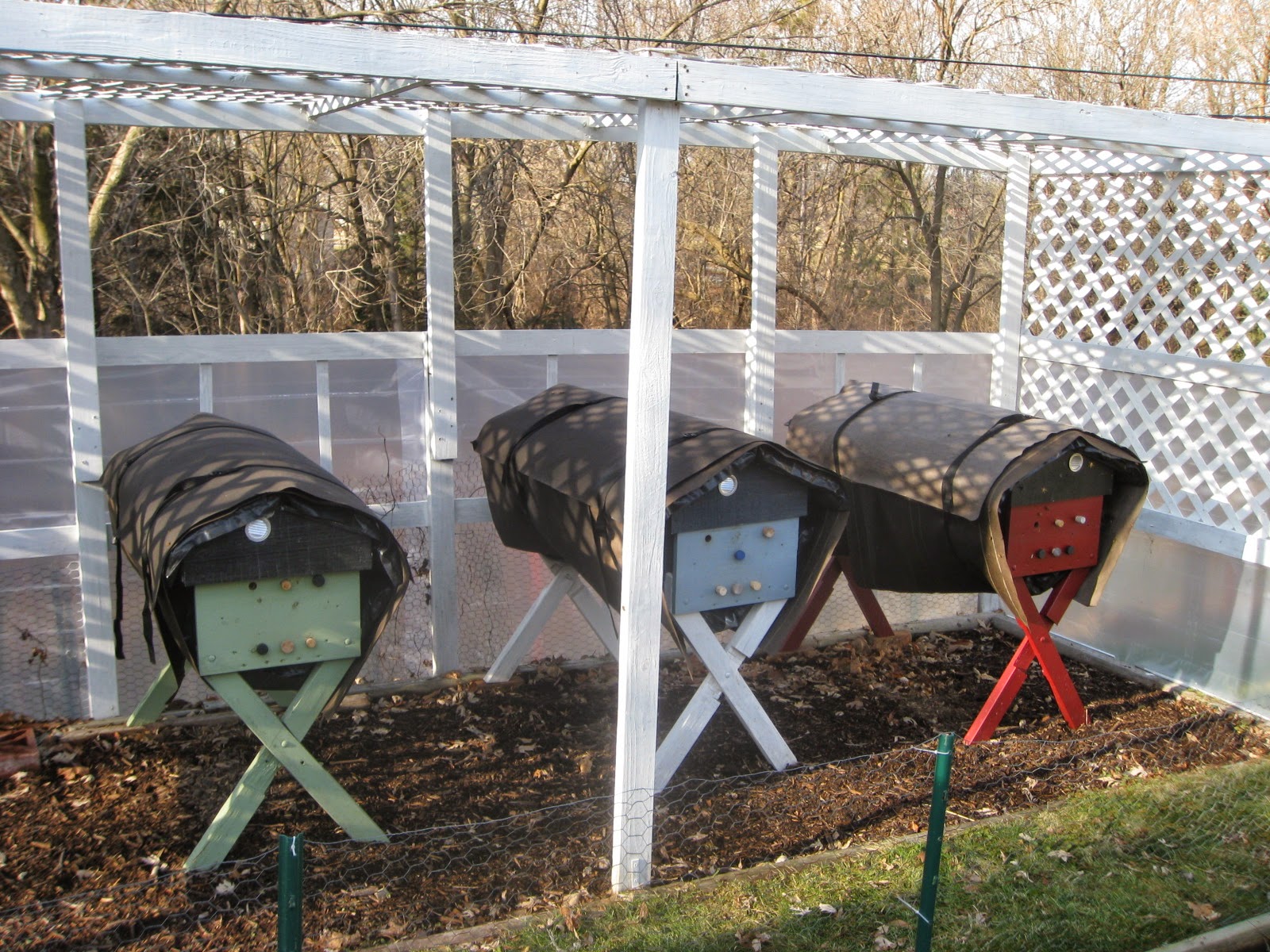
The weather at Red Bucket Farm has been fairly dreadful in terms of our honeybees. Towards the end of October, we covered the hives with insulation blankets and wrapped the entire bee yard with plastic to protect the hives from western winds.
November was just plain cold. Outdoor air temperatures were way below normal, hovering in the teens during the day and close to zero at night. The bees disappeared into the hives where they clustered together in a tight ball around the queen.
December has been warmer but cloudy, foggy, damp and drippy. It's normal for bees to take "cleansing flights" during winter months. They prefer to not poop in their hives and will slip outside on a sunny afternoon for quick trip to the ladies room. Unfortunately, we haven't seen the sun or the bees in weeks---until yesterday. Finally we had a few hours of sunshine and one of our hives took the opportunity to get outside.
This video is about one second long, but you get the idea. (Sorry that I'm not so clever with technology.) We'll be happy if even one hive survives the winter so that we can build and split with the hardy bees that make it. Replacing bees each spring is expensive---about $100 per hive---and we may not be able to justify the expense if they die each winter.
So, at the risk of repeating myself endlessly, if you still use lawn chemicals, please reconsider. Chemicals weaken the bee population significantly. If the bees approach winter in a compromised state, they can't possibly survive. Pollination is tenuous these days, and without it, we all suffer. Backyard bees are better off than rural bees because foraging is more varied, but lawn chemicals are toxic. Remember that dandelions are bee food.
Meanwhile, we have a glimmer of hope that some of our bees are still alive!
Tuesday, October 7, 2014
Bee Hatch
The red hive in the foreground and the green hive in the background are both exhibiting new hatches of bees. Notice most of the bees are taking short flights in little circles right at the hive entrances. These are known as orientation flights as the new bees get to know their surroundings. Soon these bees will begin taking longer flights.
Although the hives are slimming down in preparation for winter, it's good to see new bees and know that the queens are all alive and well.
Friday, January 31, 2014
Dead Bees
I'm sorry to report that the honeybees at Red Bucket Farm are all dead. It was not the polar vortex that secured their demise. I suspect the hive was dead before Christmas.
We last noticed bee activity in early December. Usually, we see some evidence of them over the winter. The housekeeping bees will toss dead bodies out into the snow, and little bits of bee poop will be obvious near the hive. But this year there has been no sign of life at all.
Due to various complications from the previous season, we entered the winter with only one populated hive. In the spring we will clean the dead hive and try to determine what killed them, but it's very likely this will remain a mystery.
I've ordered two 3-pound packages of bees (at $92 each!) to re-populate the hives in the spring. The packages will look similar to the photo above. We can use some of the comb and honey from last year to give the new girls a head start. If we're lucky and the weather is favorable, we can then divide one of the hives to populate our third hive box.
Meanwhile, I'm begging you to not use any lawn pesticides this spring. Urban bees fare better than rural bees because urban foraging opportunities are far more diverse than mono-culture farming methods provide. Nevertheless, lawn chemicals are completely toxic to bees. If a bee guardian can keep bees alive through the winter until the spring dandelions bloom, then all is well. Please remember,
dandelions = bee food
Wednesday, January 29, 2014
Landscape Pesticide Registry
The deadline to register for the Landscape Pesticide Registry in Wisconsin is February 1.
Go straight to the website for the Department of Agriculture, Trade and Consumer Protection at http://datcp.wi.gov. Click on the Environment tab and then click on Landscape Pesticide Registry. It's easy to register your own address. Then you can register the addresses of any neighbors who use commercial lawn pesticide application. The lawn company is required to contact you (usually by telephone) and give 24 hours notice that they will apply pesticide. This gives you enough time to protect your garden crops, poultry, pets, bees, and children from the harmful effects of pesticide.
Remember the deadline is quickly approaching. Don't delay. I've found this to be effective and helpful.
Monday, May 13, 2013
Honeybee Orientation Flights
Early this afternoon, I noticed a group of bees outside the red hive taking orientation flights. These bees have recently hatched and so far they have worked exclusively inside the hive. Today they came outside for the first time, stretching their wings and practicing flight for foraging later. Orientation flights occur only three or four feet away from the hive, giving the bees a chance to learn their neighborhood and program their internal global positioning systems. This is an excellent sign that the hive is producing new babies, so their queen must be alive and well.
Of our three hives, this is the only hive to successfully survive the long winter. The blue hive was completely dead, so we harvested the honey, cleaned out the dead bees, and closed all the entrances. The green hive had a few surviving worker bees but no queen. We transferred the survivors to the healthy red hive, harvested honey, removed dead bodies, and closed all the entrances. We use the low-tech crush and strain method of honey harvesting, and we put by about 30 pounds of honey from the two hives.
As the red hive multiplies, we will transfer a few top bars of comb with eggs and larvae into one of the empty hives. This is known as making a split or splitting the hive. The bees should crown a new queen because any worker egg can be groomed into a queen. Beehives grow at an astonishing rate in the spring. We hope to have two or even three hives thriving in a few months.
Wednesday, March 6, 2013
Honeybee late winter update
On Saturday, March 2, we conducted a partial inspection of two (out of three) top bar bee hives. At noon the weather was 40 degrees and sunny, so we worked very quickly. We had to shovel snow out of the bee yard to access the hives. Our main purpose was to insure the bees would have enough food to survive the late winter.
Last week, I made fondant bee candy following the recipe in Christy Hemenway's new book The Thinking Beekeeper. Fondant is a good way to feed bees in the winter because it won't freeze like sugar syrup. It's important to get the fondant as close as possible to the bee cluster.
We opened the red hive first because we're certain there are still living bees in that hive. Sure enough, those girls assured us that they didn't appreciate our intrusion. Since we found plenty of honey dripping from the combs, we quickly closed the hive.
Next we opened the blue hive where we also found plenty of honey. Rather than annoy any remaining bees, we closed up the hive and covered it with the insulation blankets. There hasn't been any activity from this hive in the last few weeks, and I'm unsure if there are any survivors.
Our green hive hasn't shown any activity since December. We presume it is dead and didn't bother to open it in winter conditions. There was plenty of honey in that hive last fall, which we'll retrieve in the spring.
Reports from other beekeepers have been discouraging. The survival rate this winter is very low mostly due to mites. If we can keep just one hive alive, we will consider it a huge success. Bees reproduce quickly in the spring and we can use the increase to make splits for the empty hives. Late winter is the most challenging!
Friday, February 22, 2013
Honeybee Cleansing Flight
On Monday, February 18, daytime temperatures at Red Bucket Farm approached 45 degrees with full sunshine. The honeybees in two of my topbar hives took the opportunity to come outside for quick cleansing flights (they poop outside of the hive). You can see them in this brief video. Unfortunately, my third hive appears to be dead. We hope to have enough surviving bees to make splits in the spring. Stay tuned for further developments!
Tuesday, December 25, 2012
Blizzard & Bees
A few days ago, Mother Nature delivered a significant blizzard---around 18 inches of snow and high winds. Since then, temperatures have remained below freezing and there has been very little melting. The day after the blizzard, I cleared the snow off the beehives and repaired the plastic wrap we use as wind break. Although the snow functions as insulation, I prefer to clear the roof of the hive so that the black tar paper wrap will help absorb as much heat from the sun as possible.
Yesterday I noticed a few dead bees laying on top of the snow immediately outside the hive entrances. I think this is a good sign that the housekeeping bees are cleaning house. I hope the hives are functioning normally in there!
Thursday, November 15, 2012
Winterizing Beehives
A few weeks ago we began winterizing our beehives. We started by wrapping the bee yard with heavy plastic. The arbor-like structure around the bee yard is multi-purpose. In the summer we hang awnings to provide shade for the hives; in the winter we wrap the lower sections to provide a wind break.
Next, we wrap each top bar hive individually. We make an insulation blanket out of large plastic bags filled with 4" fiberglass insulation. We wrap the blankets carefully around the hive box and cover it with tar paper. It's cinched down with nylon web straps. We also secure the box to the ground with more nylon straps and hurricane anchors. It seems excessive in the calm of November, but we might be glad for it during a January blizzard.
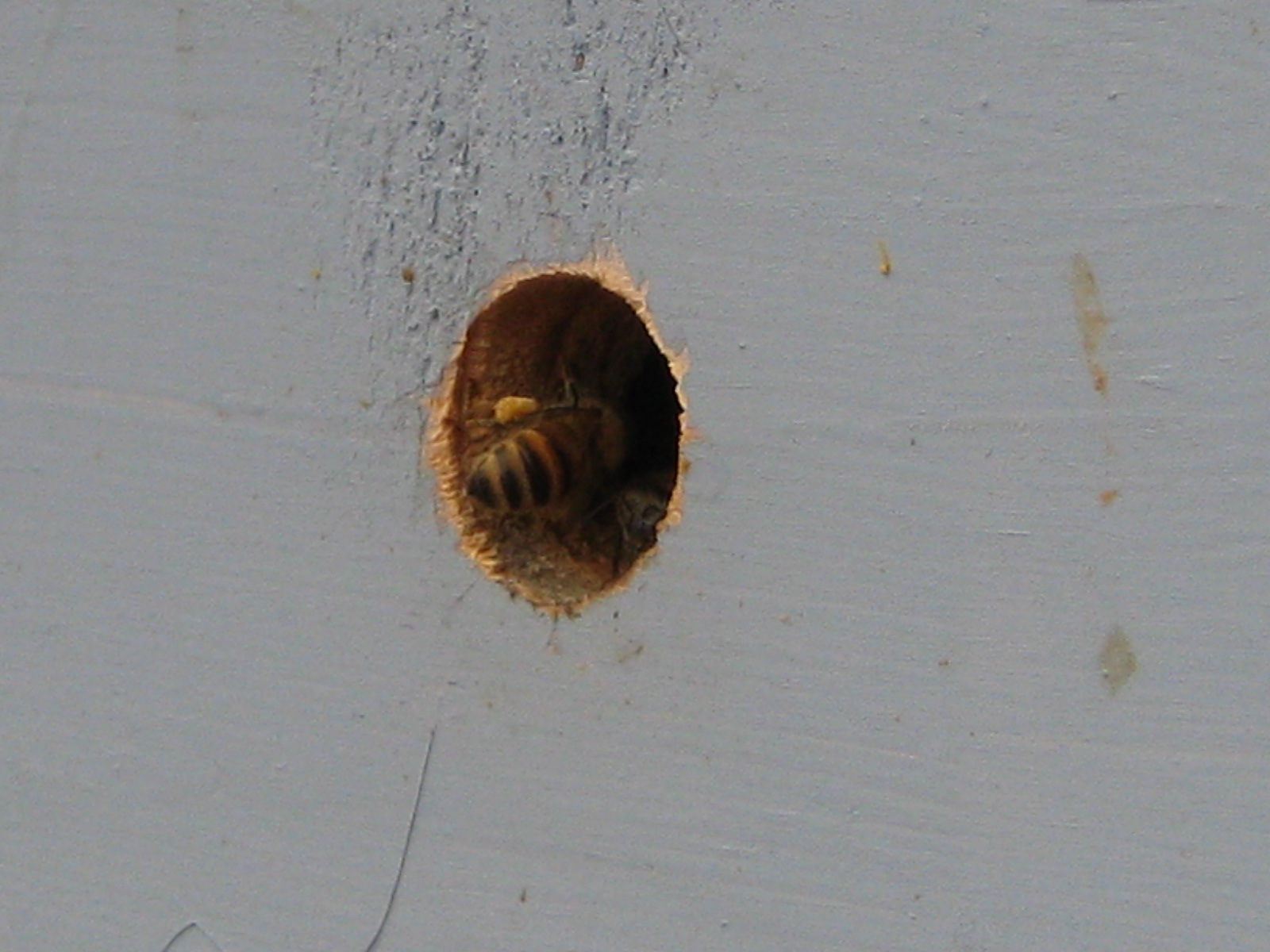
Each of our top bar hives has six entrance holes on the small east-facing end of the hive. As the weather gets cooler and the bees less active, it's a good idea to close up some of the entrances to reduce cold air flow.
Evidently, the bees in my blue hive thought I was too slow in closing up entrances. They decided to solve this problem themselves by filling in all three top entrance holes with propolis, their own special bee glue.
The three lower entrance holes on that hive are partially closed. They left a little room to exit and enter. I guess I won't mess with their system since they seem to have it worked out. I'll be curious to see if they open all six holes in the spring. And if they don't, should I do anything about it?
We're optimistic about our hives this winter. In spite of various summer challenges, all three hives seem to have plenty of honey stored and they appear healthy and strong. Now we wait out the winter and hope for the best.
Sunday, August 12, 2012
Apiary Update
This is just a quick update on our beehives. In July, we had such an extended heat wave that one of our top bar hives experienced a damaging meltdown. You can read the details of that on my July 22 post. But there is good news---the damaged colony is rebuilding. This week I noticed a new hatch of bees taking their orientation flights in and out of the hive, staying within a few feet of the hive while they get their bearings. (I avoided picking tomatoes in front of that hive while they were doing that!) They have about eight combs now and the colony is obviously queen-right. We're a little more hopeful that this hive will be able to survive the winter. Aren't they amazing little creatures?
Sunday, July 22, 2012
Apiary Meltdown
We experienced a disaster in the bee yard at Red Bucket Farm. Due to extreme heat in the first week of July (over 100 degrees for three consecutive days), we discovered that all the combs in the red hive had melted off the top bars and dropped to the floor of the hive, crushing hundreds or thousands of bees. This was our newest hive and it had been doing fabulously, building a dozen combs, laying eggs, tending brood, bringing in nectar and pollen.
Last weekend (July 14) we cleaned out the melted mess from the floor of the hive. The combs had not melted off the top bars. In fact, there was still an inch or two of comb attached to each top bar, but the bulk of the comb had dropped in the heat. I remember a day in the extreme heat (when I was preoccupied with trying to keep the chickens alive) that there were suddenly a large number of bees on the outside of that hive. At the time I assumed it was normal bearding behavior in the heat, but in retrospect I believe the returning forager bees clustered outside because of the disaster inside.
We also discovered bees building comb in the roof of that hive. This was new comb without honey or brood, so we suspect they began building there after the meltdown. I have to admire their work ethic and resourcefulness.
After cleaning up the disaster, we shook the bees out of the rooftop and back into the hive body, then replaced all the top bars and let the bees get back to work. We're rebuilding the rooftop to repair the warp and prevent them from accessing the space. We also built an arbor-like structure over the bee yard and sewed awnings to provide some shade from the summer sun. The awnings can be removed in the fall when the sunshine will be beneficial to the hives.
We're concerned that it's rather late in the summer for that hive to rebuild enough that it will be strong for winter survival. This morning we took two top bars from an adjacent healthy hive to share with the struggling colony. The borrowed combs were full of honey, brood and bees. Perhaps this will jump-start the red hive for a chance at survival. If the queen was lost in the disaster, they may be able to groom a new one. We're also providing supplemental cups of honey.
There is some good news. One of the hives is quite strong. We harvested 20 cups of honey which we can use to feed the weaker hive. Maybe there will even be some honey for us to enjoy. It's been a fascinating journey. There is nothing like an emergency to teach us about bee life.
Wednesday, May 2, 2012
More Swarms
Perhaps I was too eager in my blog post this morning. At 12:45 pm, my brave little swarm of bees absconded the red hive. It took them three minutes to exit, and about ten minutes to form a cluster around the queen in my spruce tree. This swarm is slightly larger than a softball.
While I was photographing the smaller cluster, I noticed an even larger group of bees higher in the tree (see above). This leads me to believe that both of my hives swarmed yesterday while I was out. I'm guessing the larger swarm is from the stronger blue hive, and the smaller swarm is from the weaker green hive, which obviously isn't weak at all if it's got enough energy to swarm.
Fortunately, I'm expecting delivery of a package of bees this week for the new red hive. Perhaps I'll even remember to cork up the entrances for a day or so to encourage them to stay.
Catching a Swarm
In the spring, the queen begins laying eggs in huge numbers in one central location of the hive known as the brood nest. When the bees perceive that the brood nest is getting too crowded, they prepare their current queen for flight by slimming her down while simultaneously grooming a new queen in one of several queen cells. Before long, several hundred or even thousand bees will gather up the queen and leave for a new home, while the remaining bees will stay and carry on with their new queen.
Last week's practice swarm warned me that this exodus would happen soon, but the weather turned cold and rainy, postponing the event until yesterday. In the morning I could sense that the bee yard was agitated, but my day's events called me away. By late afternoon, I noticed a cluster of bees on the foundation of my greenhouse. They were certainly clustered around a queen, and the day was quickly passing with storms predicted for night.
We jumped into action and scooped them into a shoe box. Homeless bees aren't aggressive, so it's not as scary as it sounds. Then we put the shoe box into the empty red hive along with two top bars of clean new comb (donated from the blue hive). I also gave them a jar of sugar water.
This morning they are still there. I'm keeping my fingers crossed that they won't abscond.
Wednesday, March 28, 2012
Crush and Strain Honey
When we pulled on our bee suits Sunday afternoon, we didn't have any intention of harvesting honey. We had noticed through the hive observation windows that one hive seemed significantly stronger than the other, so we thought we would transfer one top bar of honey comb and perhaps one top bar of brood comb from the strong hive to the weaker hive. This would help build up the weaker hive and moderate the stronger hive so it would be less tempted to swarm (permanently leave).
First we opened the weaker hive. We used our hive tool to gently release the top bars which are stuck in place with propolis, a fantastic glue that the bees make to secure their homes. Then we carefully removed top bars one at a time and inspected the combs and bees. We found yellow and orange pollen, plenty of honey, a moderate number of bees, and we even found the queen. Although we didn't see any brood (eggs or larvae), we decided to leave this hive alone and not harass them. We assume the brood comb is situated closer to the entrance where we did not remove the top bars. It was reassuring enough to find the queen.
The second hive was full of honey comb, so much that we decided it was time to take some for ourselves. We simply broke the dripping honey comb into a bowl, trying desperately to brush off bees before they got crushed in the process. (Note to self: buy a bee brush and another hive tool.) We took comb from three top bars and then quickly shut the hive because the bees were getting agitated. There is plenty of honey remaining for the bees.
We used an old fashioned enamel colander and potato masher to begin crushing the honey comb. We bottled eight cups of honey in canning jars, then transferred the crushed comb into another strainer to gain two more cups of honey.
The next day we noticed that the small bits of suspended comb had risen to the top of the jars where it could easily be spooned off and strained again for that last tablespoon or two of golden deliciousness.
Perhaps someday I'll learn to wash the comb wax and use it for candles, but today I'm very grateful for the work of the bees and the wonderful harvest they share. It's been only eleven months since we started keeping bees and we're thrilled with the results. We still have much to learn, but the bees will teach us.
First we opened the weaker hive. We used our hive tool to gently release the top bars which are stuck in place with propolis, a fantastic glue that the bees make to secure their homes. Then we carefully removed top bars one at a time and inspected the combs and bees. We found yellow and orange pollen, plenty of honey, a moderate number of bees, and we even found the queen. Although we didn't see any brood (eggs or larvae), we decided to leave this hive alone and not harass them. We assume the brood comb is situated closer to the entrance where we did not remove the top bars. It was reassuring enough to find the queen.
The second hive was full of honey comb, so much that we decided it was time to take some for ourselves. We simply broke the dripping honey comb into a bowl, trying desperately to brush off bees before they got crushed in the process. (Note to self: buy a bee brush and another hive tool.) We took comb from three top bars and then quickly shut the hive because the bees were getting agitated. There is plenty of honey remaining for the bees.
We used an old fashioned enamel colander and potato masher to begin crushing the honey comb. We bottled eight cups of honey in canning jars, then transferred the crushed comb into another strainer to gain two more cups of honey.
The next day we noticed that the small bits of suspended comb had risen to the top of the jars where it could easily be spooned off and strained again for that last tablespoon or two of golden deliciousness.
Perhaps someday I'll learn to wash the comb wax and use it for candles, but today I'm very grateful for the work of the bees and the wonderful harvest they share. It's been only eleven months since we started keeping bees and we're thrilled with the results. We still have much to learn, but the bees will teach us.
Wednesday, March 14, 2012
Spring Hive Cleaning
Look very closely at this photo. Can you see what it is? On the ground immediately below the entrances of the bee hives are hundreds of dead bees laying in the leaf litter and mulch.
The caretaker bees are cleaning out the hives. It's amazing to watch them haul out the dead bodies. There are so many dead bees on the ground outside the hives that I might be worried, except that there are also hundreds of active bees. They keep the inside of the hive remarkably clean without any human intervention.
Our prematurely warm spring is giving the bees an early start. I have removed the winter insulation wraps from the hives. The bees are actively gathering pale yellow pollen which you can see in the pollen sac on her back leg in the photo above.
We're thrilled that both hives survived the winter, although we mostly credit the success to a mild winter. One of the hives is small but feisty and the other hive is rather large. Happy spring cleaning!
Friday, January 6, 2012
Feeding the Bees
Yesterday the weather was warm and sunny. We reached a record high of 51 degrees and the bees took advantage of it. There was plenty of bee activity around the hives and the entire backyard for two or three hours during the warmest part of the day. Although I've seen them take short cleansing flights over the winter, yesterday they were stretching out for longer flights. I suspect that many of the older bees were leaving the hive for the last time, sacrificing themselves for the good of the group. Bees form an amazing democracy.
Today the weather is still warm but not sunny. There is far less activity outside the hives, as the bees are choosing to remain inside their shelters. We took the opportunity to unwrap the hive insulation covers and peek inside.
The blue hive looks great. The cluster of bees remains close to the entrance and they have plenty of honey stored in the combs. We looked only through the observation window, and chose to not open the cover or disturb this hive in any way. It's a big group of bees with mellow temperament, and they seem to be doing very well.
The green hive also looked busy through the observation window. We're more concerned about this hive because it's a much smaller cluster of bees, and they have fewer combs of stored honey. Nevertheless, this group seems more feisty than the blue hive, so I'm remaining optimistic. We quickly removed three top bars, creating just enough space to slip a hand inside. I removed three empty honey feeder cups that we had placed there in early November, and replaced them with two full honey cups. On warm days, the bees will be able to break cluster and gather the honey into the combs. We replaced the cover quickly and wrapped the hives again in the insulation blankets.
It's been an extremely mild winter. Perhaps Mother Nature is giving my bees a chance at survival. So far, so good.
Wednesday, January 4, 2012
Pesticide Notification Sign Up
Last spring I nearly had a heart attack when my neighbor's chemical lawn service arrived just as the currant bushes in my side yard were beginning to form fruit. I ran outside and talked to the employee, who tried to be cautious and respectful about spewing liquid chemicals on my food crops.
I've just learned that we have another option. The Wisconsin Department of Agriculture, Trade and Consumer Protection provides a Landscape Pesticide Advance Notice Registry, which means that the chemical lawn companies will give us advance notice of pesticide application. Here at Red Bucket Farm, this means that we can keep the bees inside the hives on the day of chemical application by corking their entrance holes when they return the previous night. Even one day's notice will give us a chance to protect them. We can also cover crops, keep the dog inside, close the house windows, and decide if the chickens are at risk.
You can register, too. Go to datcpservices.wisconsin.gov/landreg/index.jsp. First register yourself as a homeowner/renter, then register whatever adjacent property is causing concern. The deadline for signing up is February 1.
Thursday, December 29, 2011
Bee Poop on my Sheets
It's a beautiful fall day today--40 degrees and sunny with a light breeze--perfect for hanging clothes on the line. It's also a perfect day for the honeybees to leave the tight cluster inside the hive for a quick cleansing flight.
I knew there was a risk of soiling my white bed sheets out on the line, but I hoped the hives were just a bit too far from the clothesline, or perhaps my ladies might be too polite to poop on the sheets. It seemed like a risk worth taking.
And now I'm washing the sheets again, for the second time today. So much for saving energy!
Tuesday, December 13, 2011
Bee Cleansing Flights
Generally speaking, bees don't fly when the temperatures dip below 50 degrees Fahrenheit. They stay tightly clustered inside the hive, keeping each other warm and surviving on their stores of honey. But because bees are tidy little critters and they prefer to not poop inside the hive, they will make a quick appearance on "warm" winter days.
Last week we had a couple of unusually warm, sunny days. Around noon, when the air temperature reached 40 degrees, I noticed a handful of bees taking short flights from the hives. They would fly perhaps four or five feet, then swoop right back into the hive. Today I noticed little globs of bee poop on the sheet plastic wind screen that surrounds the bee yard. Most of the girls manage to make it home safely and only a few have been found dead outside the hive.
So far, so good. It's nice to see them periodically and be assured that they are still alive. It's only December and spring is still a long way off, but we'll remain hopeful and keep an eye open for cleansing flights as an indicator of survival.
Subscribe to:
Posts (Atom)