Welcome

Red Bucket Farm is an urban farm on a quarter acre property in an average residential neighborhood. We are located in Wisconsin, USDA Zone 5. We focus on chickens, bees, orchard fruit, and raised garden beds for fruits and veggies. We hope to reduce our footprint on the planet by growing some of our food, reducing our use of fossil fuels, and gardening with sustainable practices. Thanks for visiting!

Monday, March 21, 2011

Chicken Poop Tea

Yesterday I started brewing a bucket of chicken poop tea. No, this isn't the latest blend from Celestial Seasonings. Instead, it's homemade liquid fertilizer.

In the February/March 2011 issue of Mother Earth News, I learned that my tiny seedlings are at risk of nutrient deficiency because the lightweight seedling soil mix is quickly depleted. I can give them a boost with liquid fertilizer, and I can make my own at home because I have the correct ingredients close at hand.

I took my red bucket out to the chicken coop and gathered several handfuls of chicken poop along with wood shavings. Then I added a gallon or so of water and gave it a stir. I'm letting it brew in the greenhouse for a day or two before I strain out the gunk (which will go to the compost bin). I'll still need to dilute the tea 1:1 so it doesn't burn the seedlings. I'll be able to use this treatment on my baby plants every two weeks.

Sounds yummy, doesn't it? I hope it helps my little seedlings.

Saturday, March 19, 2011

Fencing the Chicken Yard

Today was a glorious spring day and I had my whole work crew at home, so we set about fencing the chicken yard.

I've mentioned in previous posts that my hens are well-cared for, spoiled, even pampered. Last year we built the casa gallina, a veritable fortress for chickens. The girls are happy there and have plenty of room, but they do love to get outside and search for bugs. We let them outside daily, of course, but we never leave them alone for a moment because we know the hawks will show up in an instant and snatch them.

It took about four hours to fence the chicken yard. We recycled two gates from our veggie gardens and added rabbit fencing around the coop in the corner of the farm. Then we erected tall corner poles to hang the bird netting overhead. We still won't leave them out for long periods unattended, but now we can work in the yard without wondering where the girls have wandered.

Friday, March 18, 2011

Starting Seeds Indoors

I got spring fever early this year. I needed to do something garden-related, so I started some perennial flowers by seed indoors in very early February. I was thinking about blossoms for my honeybees. Truth be told, the perennials-by-seed have been only marginally successful. I have one echinacea plant, a couple of hollyhock seedlings, and several lemon balm.

At the same time I started spinach, chard and lettuce in bowls for indoor germination. This has been far more successful. Today I moved the salad bowls out to the greenhouse.
Later in February I started some vegetable seeds in peat pots for indoor germination. I planted Amish Paste Tomatoes, Sun Sugar Cherry Tomatoes, Flamme Tomatoes, Brussels Sprouts, Basil, Yummy Mini Bell Peppers, Carmen Hybrid Peppers, and Eggplant Rosa Bianca.

I don't have the greatest conditions for starting seeds indoors. I keep my house rather cool (62 degrees during the day) and the soil might need to be warmer for those seeds to germinate. Still, with a little creativity my plants are slowly getting started and I'm trying to remain hopeful.
In a few more weeks, I'll move all the seedlings to the greenhouse, but temperatures out there still fluctuate too widely for the tender seedlings.

Tuesday, March 15, 2011

What is an Urban Farm?

Last night at my other, non-farming job, I overheard this conversation:

"Have you read Cindy's blog?" asked one person. "It's really good."
"This Cindy?" asked the other person incredulously. She jerked her head in my direction.
"Yeah, this Cindy. You should read her blog," maintained the first person.
"What's it about?"
"Her farm."
"She doesn't have a farm," came the firm response.
"Sure she does," my defender replied. "It's her backyard."
"That's not a farm," the doubter shot back.
"It's an urban farm." My friend stretched the word for emphasis. "You should read her blog. It's good."

Urban farming is hardly a modern phenomenon, it's certainly not my invention, and it is growing in America. Today's urban farmers are concerned about sustainability. We work carefully to avoid harming the environment even if it means we might lose part of our crops. Many of us might be locavores, meaning that we try to eat food that has been grown locally. We want to decrease our carbon footprint by consuming foods that have not been shipped for hundreds or thousands of miles.

When I was growing up, our next door neighbors were a German family who had narrowly escaped the Nazis. When they came to America, they brought their European gardening tradition with them. Every inch of their backyard was intensively gardened, and I'm sure they rarely purchased vegetables from the grocery store. Similarly, today's Hmong immigrants show remarkable resourcefulness, ingenuity and productivity from their small community garden plots. Sometimes I ride my bike very slowly past their plots just to learn from them. Remember that large expanses of green grassy lawns are a peculiarly and wasteful American phenomenon.


What separates a garden from a farm? Livestock. Urban farmers often raise chickens, ducks, geese, turkeys, rabbits or honeybees. Occasionally they might be able to raise goats or sheep, depending on their local ordinances.

One well-known urban farmer and author, Novella Carpenter, has documented the story of her farm on an abandoned lot in the slums of Oakland. In her novel Farm City, Novella details her experience of dumpster diving behind restaurants to scavenge food for her pair of backyard pigs. That's commitment.

Urban farming has become savvy and sophisticated. I recommend Urban Farm magazine, dedicated to sustainable city living. It's by the same publishers as Hobby Farms Magazine, but it has a distinctly urban emphasis. There are hundreds of blogs on urban farming, beekeeping, backyard chickens and more. Join the movement, grow at least some of your own food, help care for Mother Earth.

And thanks for reading my blog and defending my farm, LM!

Monday, March 14, 2011

Greenhouse Construction

I have always loved a greenhouse. I love the way the soil smells clean and earthy, the humidity steams my skin and hair, the plants may be blooming and fragrant. I've been known to visit a greenhouse just for a mental health break.

As my interest in urban farming has grown, I've become aware that a greenhouse is more than just a luxury location for potted flowers. A greenhouse is an urban farming tool that can significantly expand the seasons in spring and fall. 

Last summer we purchased a greenhouse kit on sale for $350 at our local home supply store. It was a humble kit for a 6x8 foot greenhouse with aluminum frame and 6mm polycarbonate twin walls. There is a sliding door in one end and a small roof vent in the top to allow for air exchange.

The boxes waited in the garage until Labor Day weekend when my work crew leveled a site, built a concrete block foundation and assembled the kit on a heavy wood base. The floor is crushed gravel to allow for drainage beneath containers.

We decided to build a raised bed along one of the 8 foot wall lengths. The other half of the greenhouse is open floor, which allows flexibility in terms of container plants, shelves for seed starting, or general winter storage.

For the fall months, we planted spinach, swiss chard and lettuce in the raised bed. We moved in herbs and peppers in containers. Our greenhouse crops did nicely until Thanksgiving. After that, we tucked it away for the winter months. But spring is flirting with us, and I'll be posting more about activities in the greenhouse.

Thursday, March 10, 2011

Mid-winter Greens

Six weeks ago I purchased a bag of fresh spinach at my local indoor farmer's market. Although it made wonderful salad, the cost ($4.50 a bag) inspired me to start my own indoor greens. I soon planted spinach, swiss chard and leaf lettuce in bowls and placed them on my lighted plant cart. This week I'll begin to harvest some of those tender greens. Why didn't I think of this in November?
Meanwhile, my chickens have spring fever, too. They rush the door when we open it, nearly tripping over each other trying to get outside unless, of course, it has snowed again. Snow brings them to a dead stop at the threshold, where they contemplate how badly they want to brave the weather.

Here they are enjoying leftover salad greens from the grocery store.

Wednesday, March 9, 2011

Yesterday was Spring

Spring in this part of the country is a fickle thing.

Yesterday was spring----I hung jeans out on the clothesline and mopped up leaking water in the greenhouse. The chickens enjoyed pecking around in the mud and there were large patches of open grass.


The Canada geese have been returning for a few weeks. We've also caught fleeting glimpses of other migrating water fowl, probably little grebes who keep a low profile and hide shyly when people are around. The Sandhill Cranes are also returning with their loud, rattling call flying overhead. I even heard the familiar call of Redwing Blackbirds when driving through a swampy area earlier this week. My mother-in-law used to say that the Robins always returned on March 8 regardless of the weather.

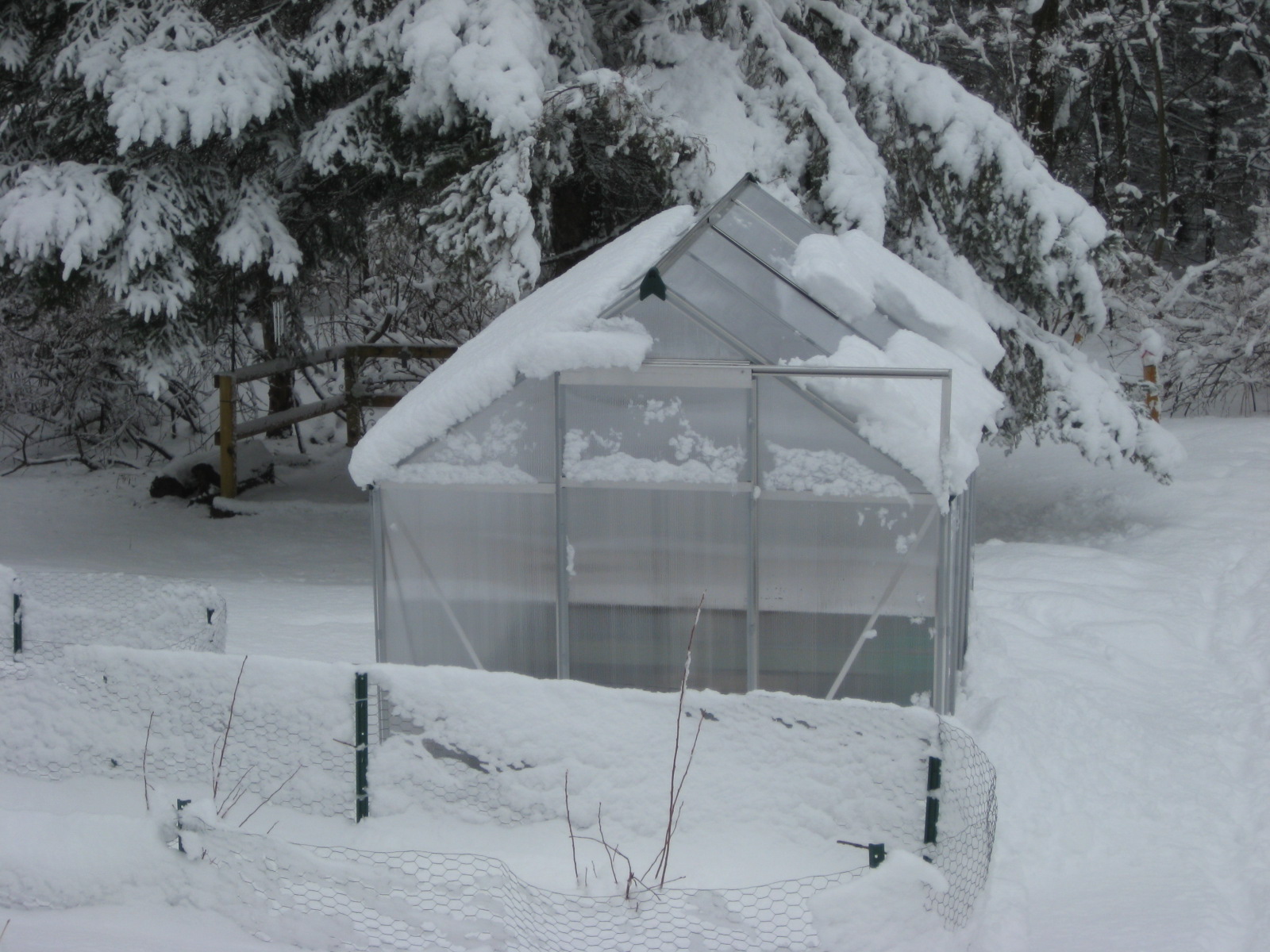
But in spite of the all signs of spring, this morning we awoke to five inches of fresh snow. It's the heavy, sticky kind of snow that can really do number on your back when shoveling. The greenhouse is covered in a thick layer, which is slowly slipping off the edge of the roof panels.
Looks as if I'd better go shovel a little patch for the chickens. Perhaps tomorrow it will be spring again.