Welcome

Red Bucket Farm is an urban farm on a quarter acre property in an average residential neighborhood. We are located in Wisconsin, USDA Zone 5. We focus on chickens, bees, orchard fruit, and raised garden beds for fruits and veggies. We hope to reduce our footprint on the planet by growing some of our food, reducing our use of fossil fuels, and gardening with sustainable practices. Thanks for visiting!

Showing posts with label chicks. Show all posts

Thursday, April 30, 2015

Spring Chicks 2015

Spring chicks are a happy event at Red Bucket Farm. Some years we obtain chicks from a local hatchery so that we can drive over and pick them up. This year we opted for more unusual breeds, so we ordered from My Pet Chicken. Our chicks hatched on April 6 and arrived by USPS on April 8.


Baby chicks are packaged carefully with a gel heat pack, but it's a difficult trip. All of our little ones were alive upon arrival, but we lost one within 24 hours. It was disappointing but not unexpected. The plumage (really it's fluff) of little chicks doesn't necessarily reflect their mature colors, so it can be difficult to ascertain which breed is which. We think the one that died immediately was a Partridge Plymouth Rock.

The new chicks are now three weeks old. They live in their brooder box in the basement. A heat lamp keeps them nice and warm. We refill water and food regularly, and check for vent blockage to make sure all systems are operating properly. (That's a nice way of saying that we check for poopy butts.)


This particular flock has seemed more flighty than previous flocks. We suspect that our choice of breeds may be playing into this. We decided to try Light Brown Leghorn, Exchequer Leghorn, Buff Chantecler, Silver Cuckoo Marans and Ancona as new breeds. Some of these breeds have a reputation for nervousness and flightiness.

Late last night I removed their water and stepped to the sink to refill. The girls were scrambling around in their brooder box in their usual panicky manner. Suddenly I heard a loud squawk and returned to find one little chick laying on her side, evidently paralyzed. She died in a minute. It's a mystery to us. Did she have a heart attack or aneurysm? Can a flighty chick die of a panic attack? We think the victim was either the Exchequer Leghorn or the Ancona.

We always order extra chicks so our flock will be strong enough to survive winter. Perhaps we'll try the new breeds again next, or maybe we'll just stick with the hardy heritage breeds. Stay tuned.

Thursday, May 8, 2014

Accidental Rooster


Our spring chicks are now eight weeks old and no longer little balls of fluff. They have grown adult feathers and spend their days outside comfortably in the portable coop. The only problem we're experiencing is that one of them isn't a pullet (hen). He's a cockerel and he is quickly becoming a rooster.


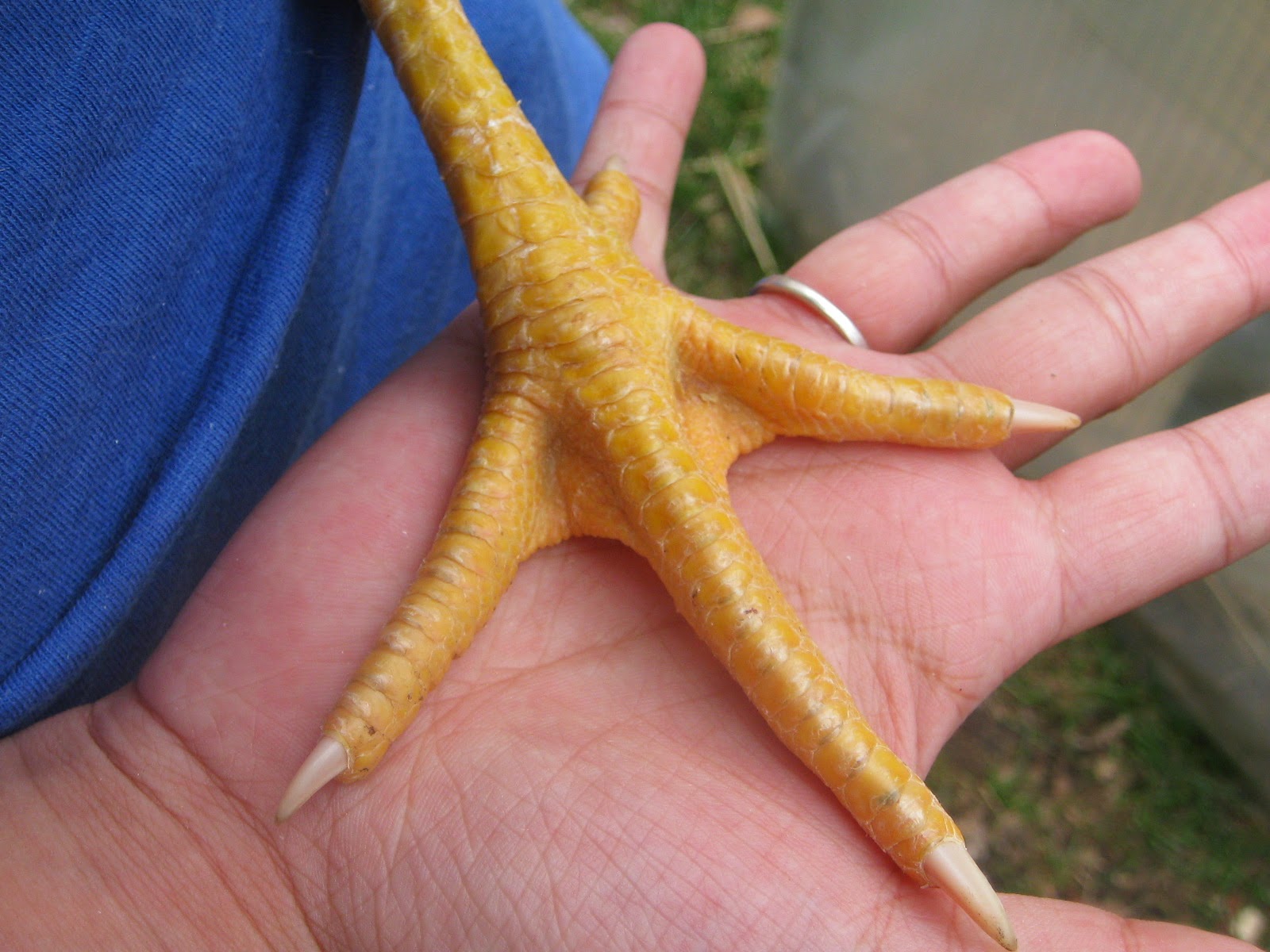
We named him Bob. His feet are huge. His comb and wattles are impressive for only eight weeks. He's bigger than the pullets in his breed (White Rock), and he's much bigger than the other breeds (Australorp, Wyandotte, Americauna). He protects all of his girls dutifully.


The Chicken Whisperer came home for a short visit today. When she picked up Bob, he immediately raised his hackles and was as fierce as possible, but soon calmed down. Impressive, isn't he?


Roosters aren't allowed in our municipality, so Bob will move on soon. It's been fun to watch his distinctly rooster behaviors. We'll miss him. I think....

Wednesday, March 12, 2014

Introducing Spring Chicks

We picked up our chicks at Abendroth's Hatchery on Monday morning. The hatchery was clean, friendly and well organized. Our girls were carefully packaged and ready to go when we arrived.

In previous years, we've gotten our chicks delivered by US Postal, so the "day old" chicks were really three days old upon arrival. Now that we've experienced true day-old chicks, we can clearly see a difference in size. What a difference a day makes in the life of something so small and fragile!

And now, without further ado, here they are:


This is Little Mittens, an Easter Egger. She will grow golden brown plumage and lay green eggs. Her name is a long-standing family joke. We haven't allowed Kavi to name any of the animals around here until today....for obvious reasons. He says he's going to get a mastiff or an Angus bull and name it Little Mittens, which he pronounces Wittle Mittens in a very high voice.


Pictured above is Queen Latifah, a Black Australorp. She will grow into a beautiful bird with shiny, soft black feathers, black legs and black beak. Right now she has a little white diaper butt. She will lay light brown eggs.


This one is Marilyn, a Silver Laced Wyandotte. She'll grow silvery white plumage with black edges outlining most of her feathers. We expect her to be the glamour girl of the flock, with her curvy body shape and fancy dress. She'll lay light brown eggs.


These three are Ping, Pang and Pong. They are White Plymouth Rock, an excellent dual purpose breed. Their names come from Puccini's opera Turandot. Yeah, you knew I couldn't stay out of the naming process entirely. But I tried!

Saturday, March 8, 2014

Collapsible Brooder Box

This morning we reassembled the brooder box in preparation for the arrival of day-old chicks on Monday. This is the fourth year we've used this box.


Our brooder box is stored in six (relatively) flat pieces: the base/floor, four side walls, and the screen top. The entire design grew from an old window frame found at the curb. Using hardware cloth as a screen, the window frame is the top of the box. The hardware cloth is sturdy enough to keep out our cats and hold up the heat lamps.


The base/floor of the box is covered with cheap vinyl squares, making clean up easier than scrubbing a rough plywood base. In the photos, you can see the 1x2 wood frame in the corners and around the top perimeter. The design is easy to screw together now and unscrew for storage later. Be sure to keep the screws properly labeled in a container during the off season.


It's much too cold in the garage right now, so the chicks will begin their lives in the basement. They're adorable at first, but soon begin to toss around their bedding materials. It's a dusty mess. Don't say I didn't warn you.


Tomorrow we'll add the heat lamps and thermometer. We need to get it around 90 degrees before the arrival of the babies on Monday. We're nearly ready!

Thursday, February 27, 2014

Ordering Chicks: Which Breeds?

So you'd like to order a few backyard chicks and you don't know where to start? First, decide why you want to raise chickens. Do you want to raise eggs, meat or both? Are you interested in showing chickens competitively? Do you want full sized hens or the smaller bantams?


Here at Red Bucket Farm, we've concentrated on winter-hardy egg laying hens. We always have one or two hybrids---Red Star or Golden Comet---bred for excellent laying capabilities. These girls keep us in eggs all winter long. We also have a few dual purpose hens. These birds lay well but also dress out nicely for the table, hence their dual purpose. We've had Delaware and Dominique, both heritage breeds, as well as Plymouth Rocks (Barred and Partridge--these are color variations), Wyandotte, Rhode Island Red, Buff Orpington, and Speckled Sussex. We also have had an unusual Delaware-Buckeye hybrid that produce eggs like crazy! Later in life, our dual purpose birds arrive at their other purpose: soup.


We've never raised meat birds (Cornish X) because they are bred to be grossly breast-heavy, aggressive feeders that require exclusive quarters. They grow quickly and are butchered in 12-16 weeks. They don't get along well with dual purpose birds and can't be raised together.


When researching breeds, don't forget to consider winter hardiness and temperament. Some birds are happier in confinement than others. Certain breeds are more gentle or aggressive than others. Eventually, you make a decision and get started.

I've ordered my chicks and I'm excited to start my new babies. I included another Easter Egger for green eggs. We're trying a new (to us) breed, the popular Black Australorp. And we're going for a Silver Laced Wyandotte so that our farm has a new glamour girl. Finally, we're raising a few extra dual purpose White Plymouth Rocks for meat. This is a new effort for us because purchasing organic chicken is so expensive.

The new chicks will arrive in a week or so. Stay tuned for updates and get your order in soon!  

Tuesday, February 25, 2014

Ordering Chicks: When & Where?

I'm so excited! I just placed an order for spring chicks. In spite of the continuing cold weather and another visit from the polar vortex, spring will come again and it's time to plan ahead. 

In past years, I've ordered day-old chicks from My Pet Chicken (www.mypetchicken.com). This is an excellent online resource for information, chicks and supplies. They ship chicks in boxes of as few as three birds, which is an important detail if your flock size is restricted by local ordinance. Buyers can choose from a very large selection of breeds, and you can choose your ship dates so that you are home to tend to the babies upon arrival. Be aware that online sources have become very popular, and you'll need to place an order well in advance of delivery to guarantee breed choice. There are several excellent online hatcheries: Murray McMurray, Cackle Hatchery, and Ideal Poultry are only a few of the choices. 

Another option is to order chicks from the local farm store. In my region, they are taking orders now for spring delivery. The disadvantage with this choice is that minimum orders apply (anywhere from 10 to 25 birds) and there is no guarantee of gender. For those of us who can't keep roosters or large flocks, this is a problem. 

This year I've ordered my day-old chicks from a local hatchery, Abendroth's Hatchery in Waterloo, Wisconsin. I pay a little extra to be sure that the chicks are all female. Since I'll pick them up at the hatchery in a couple weeks, the minimum shipping policy doesn't apply. Plus, I'm happy to support a local business. 


In tomorrow's post, I'll describe how to choose chicken breeds. Meanwhile, I'd like to thank my husband and son for handling all my farm chores last week while I was out of town. Well done! The girls look happy and egg production is way up. My husband rocks. That is all. 

Sunday, August 4, 2013

Ruby's First Eggs


Ruby has just begun laying her first eggs! She is a hybrid known sometimes as Red Star, Comet, or Golden Buff. The females are veritable egg machines, laying well in hot and cold weather. Our former Red Star was Rosie, who laid more than 600 eggs. That's quite an act to follow, but Ruby has begun laying at 16 weeks of age, precisely the same age that Rosie was when she began laying. So far, Ruby's eggs are undersized---slightly smaller than a golf ball---but we expect they will soon be larger.


It's comical to watch the spring chicks arrive at maturity. Last week the young pullets were all in the hen house watching one of the older hens lay an egg in the nest box. They were quiet and respectful. I wondered if there was some kind of tutorial experience happening in there.


Ruby's eggs are a welcome addition to the kitchen. We harvested our older hens a few weeks ago and egg production has been down. The other spring chicks will begin laying in the next few weeks.

Saturday, June 22, 2013

Chick Update


The spring chicks at Red Bucket Farm are growing quickly. They hatched April 8 and arrived here on the farm April 10. Their earliest weeks were spent entirely beneath the heat lamp in the brooder box. By the end of April, the chicks spent their daytime hours outside in the day pen.


You can see in the photos that the chicks are don't look much like babies anymore. They have fuller bodies and complete tail feathers. Their combs are starting to become more obvious but their voices are still little peeps. Vocal sounds, combs and wattles are the last obvious things to fully mature before they begin laying eggs, around four to six months of age.


Earlier this month the chicks moved into the main chicken yard during the daytime. They are separated from the biddies by a wire fence, which allows them time to grow accustomed to each other. In another month, the chicks should arrive at their adult size and we'll blend the two flocks into one. Meanwhile, the little ones still spend night time in the brooder box in the garage to keep them safe from predators. It's a bit of a circus to transfer them each morning and evening, but that's part of the fun.

Wednesday, May 1, 2013

Chicks in Day Coop


At Red Bucket Farm, we have a small portable structure we call the day coop. This little unit is especially useful for raising chicks, housing sick or injured hens, and as extra daytime shelter for the flock during the winter months.

Our day coop is 40"x 60" and 24" high. The wood frame is covered securely with hardware cloth. It has a hinged wood roof over an open floor. It keeps our birds relatively safe during the daytime from dogs and hawks, but it is not secure from nocturnal predators like coons and foxes.


Our spring chicks have been enjoying warm days outside in the day coop. The constellation girls (Andromeda, Cassiopeia, Ursa and Venus) are just over three weeks old. They are losing their baby fluff as their feathers fill in. On warm days, we transfer them outside for a few hours, but they always come back into the brooder box indoors at night.


The chicks are kept separately from the mature hens for a few months, until they are all approximately the same size. It's a bit tricky to incorporate new pullets into an established flock because the older hens can be aggressive towards the younger. For now we keep them at a distance. They can see each other across the lawn. Later in the summer, we'll start moving them together.


We had an unusual experience in our day coop this spring. The little coop had been inside the fenced chicken yard all winter and the hens would hang out there during the day. Somehow, a rabbit boldly built a nest inside the day coop. I found a little hole in the ground complete with six baby bunnies last week when I moved the day coop to clean the chicken yard. As I discovered the little critters, all of the hens came running to examine the squirming mass. They seemed as surprised as I was! Chickens are carnivores, so I quickly removed the bunnies to avoid a bloody slaughter. Evidently the day coop provides shelter for more than just my birds!

Thursday, April 18, 2013

Chick Update


The baby chicks at Red Bucket Farm are nine days old. This is a mellow flock of chicks. They eat, sleep and poop regularly and without drama. We've experienced no pasty butts (when dried feces blocks the vent which can quickly lead to death), no weakness or wobbliness, no aggression, no drama at all. It's very soothing to sit and watch them. I'm sure it lowers blood pressure!


Little chicks grow so quickly it seems you can practically watch them change. Pin feathers began appearing at their wing tips in only a few days. In the photo above, notice Andromeda's tiny comb beginning to form as well as the black and white stripes of her adult coloration (Barred Rock). Do you see her teeny little tail feathers?


Although we intended to keep the brooder in the garage this spring, current weather conditions have been too cold to allow that. For now, the brooder is in the basement. We hope to transfer them to the garage in a couple of weeks, before they begin to kick up their usual dust. The brooder box is heated by two heat lamps. Heat lamps have ceramic bases (rather than plastic) to allow for higher wattage bulbs. We recently decreased wattage because the girls are growing enough feathers to keep them warm.


Our brooder box has a sturdy cat-proof cover made of an old window frame and hardware cloth. Better safe than sorry!

Wednesday, April 10, 2013

Spring Chicks

Our shipment of spring chicks arrived at Red Bucket Farm this morning via USPS. These girls hatched late Monday or early Tuesday, and were shipped out Tuesday morning. Allow me to introduce the new babies:


This is Venus. She is a Buff Orpington. This breed grows to be rather large, fluffy and almost butterscotch in color. They have a reputation for friendliness and gentleness. Venus will be a good (not great) layer of brown eggs, and she'll be excellent for keeping her friends warm through the cold winter months. She was a last-minute substitution, because the Black Australorp that we ordered didn't hatch on time for shipment. This breed is popular among backyard chicken enthusiasts.


Above you see Andromeda, a Barred Plymouth Rock. She refused to pose for the camera. Andromeda will grow to have white and black stripes and a large red comb. She'll be winter hardy and a good egg layer of brown eggs. She is our second Barred Rock.


This is Ursa, a hybrid egg layer sometimes known as Red Star or Golden Comet. Ursa has two faintly brown stripes down her back and will grow to be a basic red-brown color. This breed lays eggs with amazing regularity. Our last Red Star (Rosie) gave us more than 600 eggs in her lifetime, so the pressure is on for Ursa to perform as well.


What backyard flock is complete without an Easter Egger? This is Cassiopeia. She will begin laying green (or more rarely, blue) eggs in September. Feather colors vary for this breed, so we'll wait to see what she looks like as an adult. Easter Egger chicks have a broad stripe down the back, which makes them look a vaguely chipmunk-y.

Just a note to apologize for the lousy photography in this post. Chicks do not pose. They don't slow down. They poop on everything. So this is as good as it gets for now. More later!

Friday, January 4, 2013

Mail-Order Chicks

Although there is nearly a foot of snow on the ground, it's time to think about placing an order for spring chicks.


Why do we mail order chicks? Of course, chicks are available each spring at the local farm store, but that requires a minimum order of ten chicks and all of them must be of the same breed. It's also possible to network with local farmers, but we're limited to whatever breed the farmer has available.

As urban farmers, we're restricted by ordinance to a handful of chickens. We'd like our little flock to fit our needs and provide variety. In the last few years, some hatcheries have made it possible for backyard flock owners to order as few as three chicks from a wide variety of breeds, and it's easy to place a mixed order.

The day-old chicks are carefully packaged with a warm gel pack and shipped express mail. There is a risk that one of the little babies might not survive the trip, but overall the procedure is quite successful. The cost of shipping is not insignificant (around $35), so it's nice if friends can combine an order and share the shipping cost.


Hatcheries plan several weeks ahead of shipping dates so that they can keep up with demand of popular breeds. Also, it's good idea to plan the raising of chicks into your family schedule and summer vacation plans. Our family hopes to raise our chicks early enough in the spring that we can incorporate the new birds into the flock before we take a summer camping trip. We'll allow at least three months for the chicks to reach an adult size.

So get a mug of hot chocolate or coffee and start researching breeds. We'll be placing our order soon. Think spring!