Photos from top to bottom: cherries, crabapples, peach, apricot, pear, currants, kiwi. How did you do?
Welcome
Red Bucket Farm is an urban farm on a quarter acre property in an average residential neighborhood. We are located in Wisconsin, USDA Zone 5. We focus on chickens, bees, orchard fruit, and raised garden beds for fruits and veggies. We hope to reduce our footprint on the planet by growing some of our food, reducing our use of fossil fuels, and gardening with sustainable practices. Thanks for visiting!
Showing posts with label fruit. Show all posts
Sunday, June 5, 2016
Spring Fruit
A photo survey of the orchard this morning reveals several kinds of baby fruits. Can you name them?
Photos from top to bottom: cherries, crabapples, peach, apricot, pear, currants, kiwi. How did you do?
Wednesday, February 17, 2016
Indoor Citrus
Mid-winter in Wisconsin can be dreary. As an urban farmer, I spend my winter perusing seed catalogs, planning next summer's veggie beds, mapping out crop rotation, and baking lots of pies and tarts with last summer's fruit harvest.
Last winter I began indoor citrus. I purchased a bag of Meyer lemons from Trader Joe's in January 2015 and saved all the seeds from the lemons. (I also bought a bag of organic limes, only to discover they were seedless. Buyer beware!) I germinated the seeds in a small plastic bag with damp paper towels. It was easy. Then I transplanted the little seedlings into light soil and watched them take off.
To add variety to my indoor citrus grove, I purchased four trees from an online vendor---a Meyer Lemon, a Venous Orange, a Key Lime and a Mediterranean Olive tree. These trees were more mature than the seedlings I had started myself. The Meyer Lemon produced two blossoms and eventually two beautiful lemons. One of them we harvested over the weekend, which you see in the photo at the top of this blog post.
All the citrus seedlings grew rapidly over the summer. In November I transplanted them into slightly larger pots. It's been a challenging winter for my citrus trees. They have dropped nearly all their leaves and generally expressed their displeasure at my care. Nevertheless, these sturdy trees are producing tiny new shoots and leaves where the old ones fell off.
Watering citrus trees is tricky. They prefer dry soil, but not parched. It's taken me months of guessing to ascertain if I'm over- or under-watering. Finally, I purchased a moisture meter with a long probe to help me determine when to water.
This isn't an instant gratification project, but one taste of that sweet lemon juice (yes, Meyer Lemons are sweet, not sour) has motivated me to keep my citrus grove growing. It gives me hope in the winter months.
Thursday, May 29, 2014
Managing the Orchard
Anyone who has gardened for more than a year or two knows that the garden is never finished. Most great gardens are in a constant state of transition as the gardener discovers which plants flourish in any specific location and which do not. This is also true at our fruit orchard here at Red Bucket Farm.
Last year, our large peach tree produced ninety pounds of juicy sweet fruit. We're still eating from that harvest! But the winter of 2013-14 was cold and colder, and the peach tree has barely survived. This tree is located at the bottom of the hill in a micro-climate that didn't fare as well as the trees up the hill. It didn't bloom this spring at all, and we're nursing it with chicken poop tea and hoping that it will recover this summer to produce again in 2015.
On the other hand, our three cherry trees bloomed beautifully and are developing little fruits. Hooray for winter-hardy pie cherries!
The new trees in the front yard orchard are doing well, or most of them are. Two peach trees, three pear trees and one apricot tree all bloomed lightly and are making a few small fruits---not bad considering these are still very small trees. One additional apricot tree (important for cross pollination) is struggling. This is the second tree of that variety we've planted in that location and it's just not happy. We suspect that the roots are too wet and the soil isn't draining well. We've removed the tree to a container for recuperation, and we've ordered a different apricot variety to plant in its place. We'll create a mounded hill to help with drainage and we'll amend the soil with Turface and chicken grit.
Every evening we wander through the orchard and check on our trees. Slowly we're discovering which trees belong in each location. A fruit tree gives a lot of bang for your buck, so it pays to be attentive and invest in the home orchard.
Last year, our large peach tree produced ninety pounds of juicy sweet fruit. We're still eating from that harvest! But the winter of 2013-14 was cold and colder, and the peach tree has barely survived. This tree is located at the bottom of the hill in a micro-climate that didn't fare as well as the trees up the hill. It didn't bloom this spring at all, and we're nursing it with chicken poop tea and hoping that it will recover this summer to produce again in 2015.
On the other hand, our three cherry trees bloomed beautifully and are developing little fruits. Hooray for winter-hardy pie cherries!
The new trees in the front yard orchard are doing well, or most of them are. Two peach trees, three pear trees and one apricot tree all bloomed lightly and are making a few small fruits---not bad considering these are still very small trees. One additional apricot tree (important for cross pollination) is struggling. This is the second tree of that variety we've planted in that location and it's just not happy. We suspect that the roots are too wet and the soil isn't draining well. We've removed the tree to a container for recuperation, and we've ordered a different apricot variety to plant in its place. We'll create a mounded hill to help with drainage and we'll amend the soil with Turface and chicken grit.
Every evening we wander through the orchard and check on our trees. Slowly we're discovering which trees belong in each location. A fruit tree gives a lot of bang for your buck, so it pays to be attentive and invest in the home orchard.
Saturday, August 24, 2013
Harvest Time
It's the time of year when fruits and veggies mature as fast (or faster) than we can bring them in and process them. It's a good problem to have, because it means the urban farm is increasingly productive and we'll have plenty of organic food to eat all winter.
Pole beans are growing like crazy. We pick a bucket of beans every day, blanch and flash freeze.
The tomatoes continue to arrive at an impressive rate. This is a fruit with plenty of options. I've roasted, pureed and frozen some of it, and canned simple tomato sauce. Soon I'll make pizza sauce, barbecue sauce and salsa, canning it for stable shelf storage because my freezer is getting quite full.
Our little peach tree has hit its stride. We've harvested more than sixty pounds of fruit from one tree, virtually without blemish. I've frozen peach slices for future pies; canned peaches in spiced honey syrup; canned more peaches in rum sauce; and canned even more peaches in a simple honey syrup. When I'm too exhausted to care, I just cut them into a freezer container, sprinkle it with a teaspoon of sugar, and put it in the freezer. We're approaching the end of the peach crop. Whew!
So if I seem like I haven't written, called or blogged lately, now you know why!
Thursday, July 25, 2013
Underplanting the Orchard
In his book The Holistic Orchard, fruit tree expert Michael Phillips offers recommendations for the overall health and productivity of fruit trees. Based on his concepts, we spent several hours over the weekend underplanting our home orchard. We removed the grass beneath each tree and added hardwood mulch to allow more nutrients and water to reach the roots of the trees.
Phillips recommends planting a "living mulch," an understory of widely diversified plants, some that attract beneficial insects, others than repel destructive insects. We have plenty to learn in this area, but diversity seems to be the operative concept.
Comfrey (above), known for its medicinal qualities, has a long tap root that pulls up nutrients from deep below ground and distributes them to tree roots. We planted oregano and lemon balm for their bee-friendly qualities. Chives are reported to help with peach leaf curl, so we planted that beneath the peach trees. Bitter herbs are thought to repel fruit pests, so we'll work on that next spring.
Of all the crazy projects we've done around here, this one has garnered most comments from the neighbors because in addition to having function, underplanting is also quite attractive.
Monday, July 8, 2013
Canning vs. Freezing
It rained a record-setting eleven inches in the month of June at Red Bucket Farm, which seems to have pleased our fruit bearing plants, bushes and trees. In the last few weeks, we've harvested many pounds of strawberries, rhubarb, currants and cherries. The raspberries, blueberries and tomatoes are just beginning to ripen, which will be followed by peaches and more vegetables.
What do we do with all the harvest? Our free-standing freezer is modest in size, so we follow the advice of our friend Lynn who says, "Can what you can and freeze what you can't." So far we have canned strawberry jam, apricot jam, rhubarb-currant jam, and currant sauce (for pancakes, ice cream, etc). We've frozen sour pie cherries, sliced strawberries and strawberry puree (for smoothies).
It concerns me that home canning has a reputation of being difficult and arduous. The whole process is rather simple. The main concept is to pour piping hot food into boiling hot jars, tighten the lids and simmer them for a few minutes. As they cool, the lid seals with a pop. That's it. The equipment is affordable and readily available---a few canning jars and lids, a large soup pot for cooking the food, one large canning pot for boiling the jars. A few tools are helpful, like a canning funnel, a jar lifter, a ladle. Keep it simple.
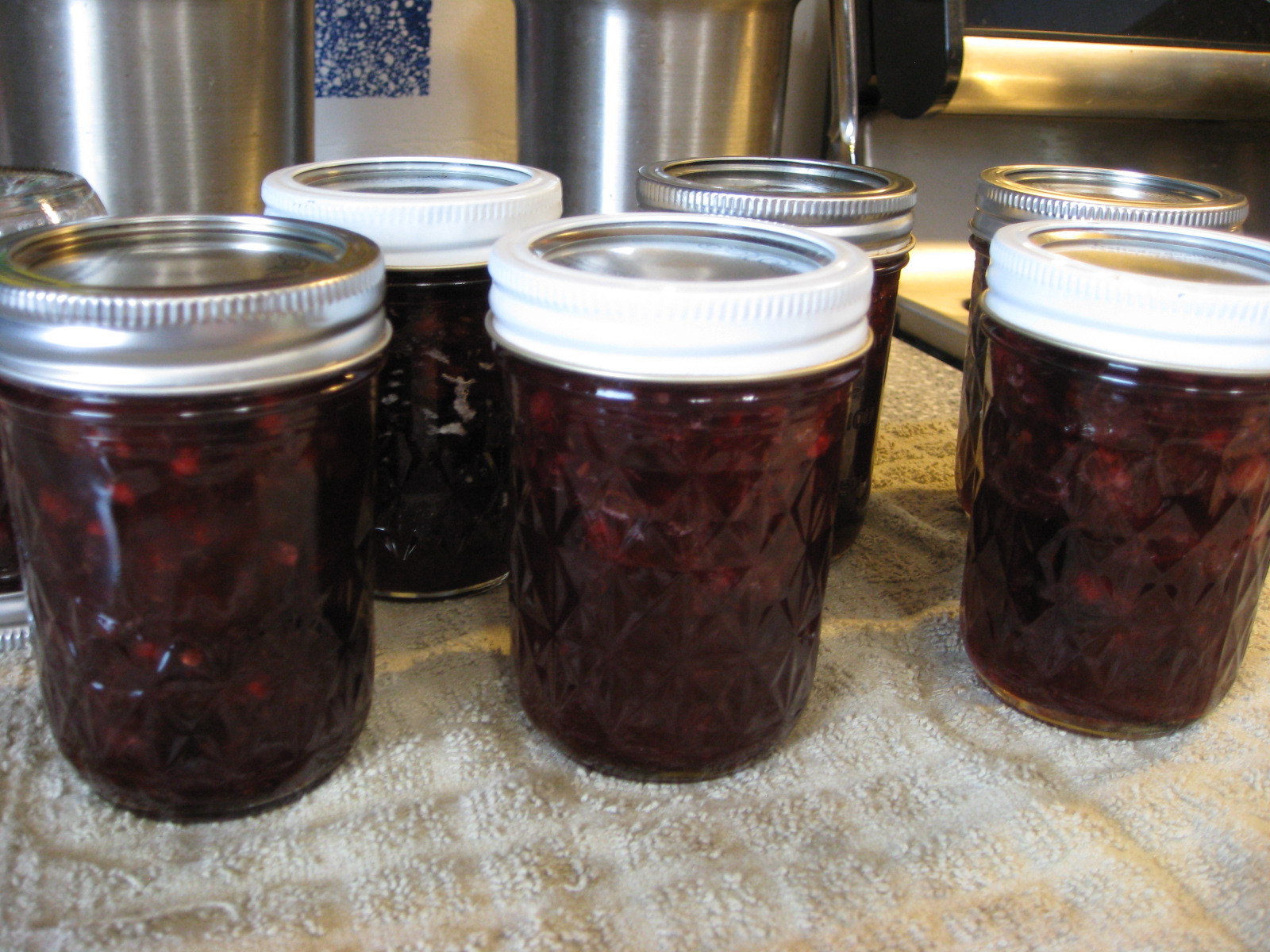
Let's take today as an example. I picked black currants this morning, separated them from their tiny vines and stems, and washed them. (Then I took a break.) After that I placed clean jelly jars inside the canning pot, filled it with water and started it on my high capacity burner. The currants went into the soup pot along with some sugar, while the new canning lids went into a sauce pan with water to simmer. My goal was to have the currants cooked down at about the same time the jars came to a boil. I lifted each jar out of the boiling water bath one at a time, filled with jam using the funnel and ladle, wiped the rim clean of any drips, added the lid and the canning jar ring, and lowered it back into the boiling water bath. When all the jam was in the jars, I cranked the heat back up to high and boiled for ten minutes. Then I turned off the heat, raised the lid and waited five more minutes. I lifted the jars out of the water bath onto a towel and listened to the lids pop as they sealed.
The process may seem complicated at first, but soon it becomes easy. I can make a batch of jam in a hour. It's the picking and cleaning the fruit that takes a long time. Visit www.freshpreserving.com for more details, or check out a canning book from the library. Try to avoid the high drama of 1950s home economics tutorials. This isn't rocket science. Just follow any recipe for guidance as to how much sugar to add, and whether or not you'll need lemon juice for acidity or pectin for thickening. The instruction sheet inside a box of powdered pectin is probably sufficient to get anyone making jam.
Freezing is even more simple than canning. Place clean fruit (such as cherries, raspberries, blueberries) in a single layer on a cookie sheet and pop it in the freezer. After a few hours, transfer the fruit to freezer bags or containers. Sliced strawberries and peaches can be placed directly into the freezer container. Make sure containers are tightly shut to avoid freezer burn. It is possible to use glass canning jars in the freezer (rather than plastic), but be sure to leave an extra inch of expansion space at the top of the jar.
Now, get out there and enjoy the fruit of the season!
What do we do with all the harvest? Our free-standing freezer is modest in size, so we follow the advice of our friend Lynn who says, "Can what you can and freeze what you can't." So far we have canned strawberry jam, apricot jam, rhubarb-currant jam, and currant sauce (for pancakes, ice cream, etc). We've frozen sour pie cherries, sliced strawberries and strawberry puree (for smoothies).
It concerns me that home canning has a reputation of being difficult and arduous. The whole process is rather simple. The main concept is to pour piping hot food into boiling hot jars, tighten the lids and simmer them for a few minutes. As they cool, the lid seals with a pop. That's it. The equipment is affordable and readily available---a few canning jars and lids, a large soup pot for cooking the food, one large canning pot for boiling the jars. A few tools are helpful, like a canning funnel, a jar lifter, a ladle. Keep it simple.
Let's take today as an example. I picked black currants this morning, separated them from their tiny vines and stems, and washed them. (Then I took a break.) After that I placed clean jelly jars inside the canning pot, filled it with water and started it on my high capacity burner. The currants went into the soup pot along with some sugar, while the new canning lids went into a sauce pan with water to simmer. My goal was to have the currants cooked down at about the same time the jars came to a boil. I lifted each jar out of the boiling water bath one at a time, filled with jam using the funnel and ladle, wiped the rim clean of any drips, added the lid and the canning jar ring, and lowered it back into the boiling water bath. When all the jam was in the jars, I cranked the heat back up to high and boiled for ten minutes. Then I turned off the heat, raised the lid and waited five more minutes. I lifted the jars out of the water bath onto a towel and listened to the lids pop as they sealed.
The process may seem complicated at first, but soon it becomes easy. I can make a batch of jam in a hour. It's the picking and cleaning the fruit that takes a long time. Visit www.freshpreserving.com for more details, or check out a canning book from the library. Try to avoid the high drama of 1950s home economics tutorials. This isn't rocket science. Just follow any recipe for guidance as to how much sugar to add, and whether or not you'll need lemon juice for acidity or pectin for thickening. The instruction sheet inside a box of powdered pectin is probably sufficient to get anyone making jam.
Freezing is even more simple than canning. Place clean fruit (such as cherries, raspberries, blueberries) in a single layer on a cookie sheet and pop it in the freezer. After a few hours, transfer the fruit to freezer bags or containers. Sliced strawberries and peaches can be placed directly into the freezer container. Make sure containers are tightly shut to avoid freezer burn. It is possible to use glass canning jars in the freezer (rather than plastic), but be sure to leave an extra inch of expansion space at the top of the jar.
Now, get out there and enjoy the fruit of the season!
Tuesday, June 25, 2013
Thinning the Peach Crop
Last year our mature peach tree produced a minimal crop due to unfavorable weather conditions. Summer arrived in March forcing a premature bloom. Winter returned in April and froze many of the blossoms. The rest of the summer was plagued with drought. We were pleased that our fruit trees survived such a tumultuous growing season.
This year is quite the opposite. The temperatures have been seasonally appropriate and our fruit trees bloomed beautifully in April. Pollination must have been adequate because the peach tree is loaded with an abundance of walnut-sized fruits. There are so many little peaches forming on the tree that we expect branches will break under the weight of the fruit or the whole tree will simply keel over.
Experts advise thinning the crop. Heavy fruit like peaches should grow no closer than every four inches, about the width of an adult hand. Thin branches can't hold more than one peach. At harvest time, it will be far more satisfying to bring in a bushel of 100 large peaches rather than a bushel of 500 tiny peaches. It's important to be realistic about how much fruit one tree can produce.
So we thinned the crop. Using our awesome orchard ladder, we removed hundreds of tiny green peaches. It seems like a shame, but in another month or so I think we'll be glad we did it.
This year is quite the opposite. The temperatures have been seasonally appropriate and our fruit trees bloomed beautifully in April. Pollination must have been adequate because the peach tree is loaded with an abundance of walnut-sized fruits. There are so many little peaches forming on the tree that we expect branches will break under the weight of the fruit or the whole tree will simply keel over.
Experts advise thinning the crop. Heavy fruit like peaches should grow no closer than every four inches, about the width of an adult hand. Thin branches can't hold more than one peach. At harvest time, it will be far more satisfying to bring in a bushel of 100 large peaches rather than a bushel of 500 tiny peaches. It's important to be realistic about how much fruit one tree can produce.
So we thinned the crop. Using our awesome orchard ladder, we removed hundreds of tiny green peaches. It seems like a shame, but in another month or so I think we'll be glad we did it.
Monday, May 20, 2013
Aphid Invasion
Aphids are tiny pale green insects that suck the life out of plants. They tend to congregate on the undersides of leaves, especially on tender new shoots at the ends of branches. I'm not sure that an aphid invasion will completely kill a plant, but they can weaken and damage in the spring as the plant is producing new growth. Look for curled leaf edges and light veining on the surface of the leaves.
This spring the aphids are working their magic on my currants and gooseberries. They aren't terribly picky about their host plant, so keep a close eye on herbs, young trees and bushes, and other tender shoots. Since I have a particular love of currant jam, I'm willing to do battle with the little buggers. Treating aphids isn't difficult, but requires determination and perseverance. I'm spraying them with Safer Insecticide Soap, but dish soap works too. I spray by hand, carefully turning over leaves and spraying the underside of the leaf as well as its stem. Eventually, the heat of the summer will discourage this pest.
In spite of the aphids, my currant and gooseberry bushes are robust and setting fruit. I just finished my last jar of 2012 currant jam, so I'm looking forward to harvesting this year's crop in about five or six weeks---in spite of the little buggers.
Thursday, June 21, 2012
Blueberries & Netting
Cultivating a variety of fruiting plants takes time and patience. Strawberry vines will begin to produce in their second year, and raspberry canes in a year or two. Currants and gooseberries also take a few years to harvest a decent crop. But blueberries will really test one's patience, and when the crop finally begins to ripen, we're not about to let a single morsel fall prey to the birds.
Blueberries require extra care in most locations because they need acidic soil and plenty of sun. Amending the soil is standard procedure, but it can be tricky to find organic acidic soil amendment and fertilizer. Nevertheless, it's all worth the trouble. Blueberries are low in calories, high in antioxidants and oh so delicious.
Here at Red Bucket Farm we planted four blueberry bushes in 2009 and four more in 2011. We have five different varieties of blueberries which helps boost pollination. This is the first summer that we'll harvest more than a handful of berries.
We learned that it's beneficial to leave the ripening berries on the bush for a week or two. This improves flavor and nutrition but it leaves them susceptible to bird raids. So we opted to net each bush with nylon netting purchased at the fabric store. It looks a little silly, but will allow sunshine and rain to penetrate without weighing down the branches. Bunnies love to eat blueberry bushes especially in winter, so be sure to fence them carefully.
Tuesday, June 19, 2012
Currants
Currants are delicious, nutritious, and easy to grow. They are nearly impossible to find in the supermarket and also difficult to buy at the farmers market. They are so easy to grow that there is no reason to not have a few bushes.
Currants have been in America since colonial days, but they fell out of favor in the early 1900s because they were an alternate host for white pine blister rust. The plant disease wasn't a significant problem for the currants, but it caused serious trouble for certain pine trees. The federal government banned currants and spent much time, money and effort to eradicate them, especially east of the Mississippi River. Eventually, they figured out that the plant disease had other hosts, and that eliminating currant bushes wasn't making much of an impact. In 1966, the ban was lifted.
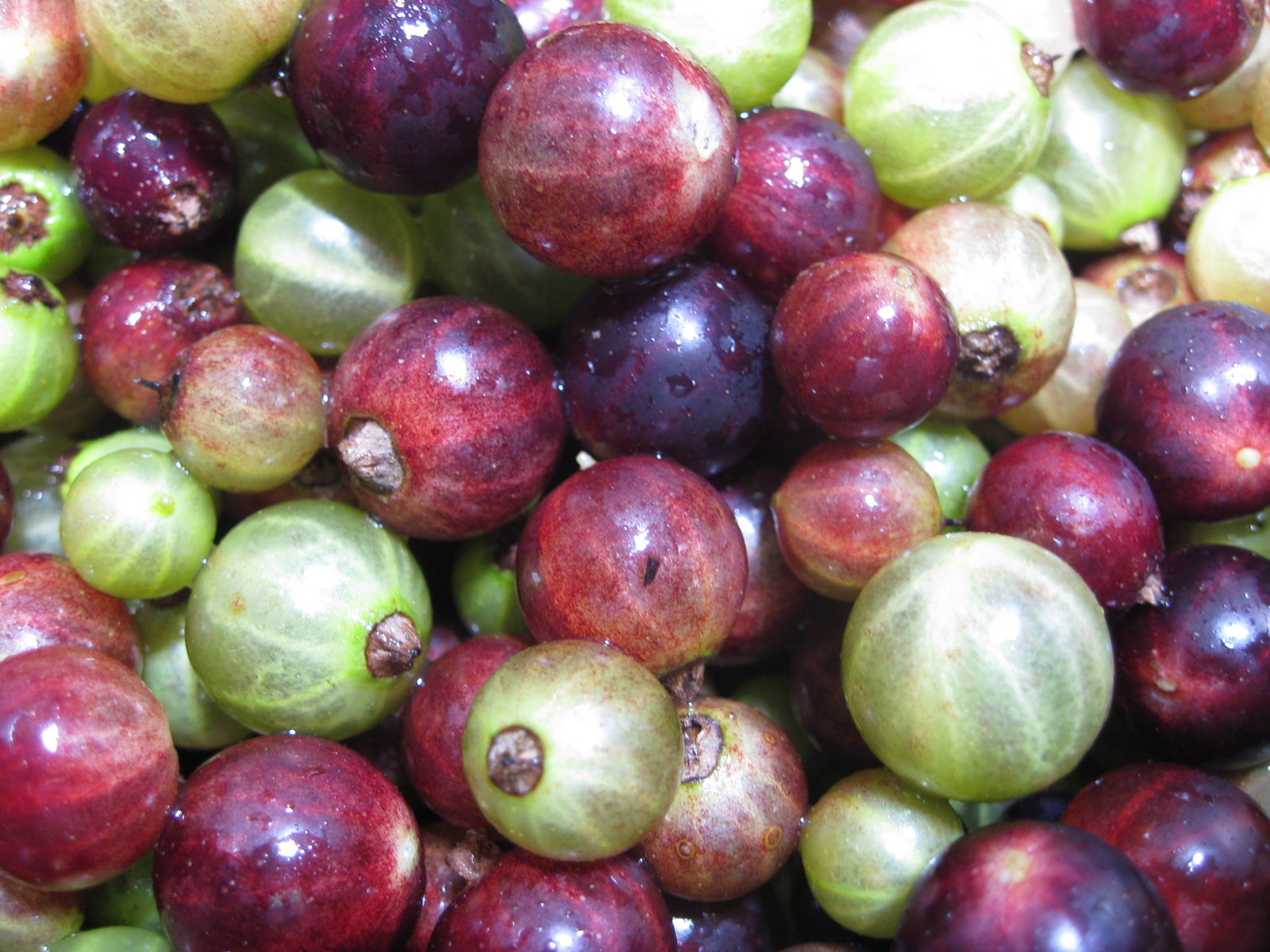
There are three kinds of currants---black, red and white. The red currant bushes grow about four feet tall and benefit from a little structural assistance to help prevent them flopping over. Red currants are tiny--slightly smaller than a pea--and they grow in long, dangling clusters. White currant bushes are sometimes referred to as pink or champagne. They have a similar growth pattern as the reds. Black currants are smaller, sturdier bushes about three feet tall, with slightly larger fruits that grow in clumps close to the branches. Perhaps there is a flavor difference between the different colored fruits, but you might need some experience to develop an appreciation for those differences.
Here at Red Bucket Farm we have ten currant bushes growing in a narrow side yard under partial shade. We water the new plants for their first year, and after that we don't tend them often. They produce fruit in early summer, which we make into jams and sauces. This year we made seven pints of red currant sauce (for pancakes, yogurt, ice cream), three cups of white currant jam and six cups of black currant jam. (When making currant jam, do NOT add pectin! Currants contain plenty of natural pectin and need no extra help. Ask me how I know this.....)
The only reason I can think that currants aren't more commonly grown is that it is tedious work to pick the little fruits off the vine, but the results are delicious. I recommend growing currants in your backyard garden!
Tuesday, April 3, 2012
Fruit Blossoms
The unusually warm spring weather in March has brought early April blossoms to Wisconsin. All eight blueberry bushes at Red Bucket Farm have fruit blossoms as seen above. It's taken a few seasons to establish these bushes, and we're pretty happy to see them blooming enthusiastically.
Our three-year old peach tree is full of pink blooms and the bees are busy pollinating them. This year we'll remember to thin the fruits for increased harvest. The younger peach tree and apricot trees have finished blooming.
We have three varieties of sour pie cherry trees--Meteor, North Star, Montmorency. They tend to bloom and ripen at slightly different times.
All eight currant bushes are blooming, seen above. The bushes are heavily loaded this year and we're hoping for an overflow crop. We're looking forward to a large batch of currant jam.
Finally, the ubiquitous dandelions have begun to bloom. Most folks see them as weeds, but to me they are bee food.
Enjoy the spring blossoms!
Tuesday, August 16, 2011
Peaches Dropping Prematurely
Our little peach tree has been loaded with fruit this summer, and we've been anxiously anticipating harvest of these delicious morsels. This tree was planted as a bare root stick only three years ago, and we've been delighted in its growth. But in the last week or so, we've been noticing small green peaches fallen to the ground. At first, it was just a little peach here and there. I didn't know if I should blame the chipmunks or the robins. Today, however, at least a dozen peaches dropped to the ground and they're not quite ripe. Hang on, little peaches!
A bit of internet research has revealed my ignorance. My brave peach tree has done very well holding on to all its fruit for so long. I should have thinned the crop weeks ago, when the fruits were the size of a cherry or grape. Peaches should not be touching each other on the branches; they should grow at least three to six inches apart on the branches. Otherwise, I'll end up with lots of teeny little fruits rather than a harvest of reasonable sized peaches.
We picked some green fruit off the tree this afternoon that we hope will ripen well enough to make into crisp or cobbler. Meanwhile, there are still quite a few peaches on the tree that should mature soon.
Live and learn.....
A bit of internet research has revealed my ignorance. My brave peach tree has done very well holding on to all its fruit for so long. I should have thinned the crop weeks ago, when the fruits were the size of a cherry or grape. Peaches should not be touching each other on the branches; they should grow at least three to six inches apart on the branches. Otherwise, I'll end up with lots of teeny little fruits rather than a harvest of reasonable sized peaches.
We picked some green fruit off the tree this afternoon that we hope will ripen well enough to make into crisp or cobbler. Meanwhile, there are still quite a few peaches on the tree that should mature soon.
Live and learn.....
Tuesday, August 2, 2011
Controlling Japanese Beetles
Japanese beetles are a common garden pest. They invade in mid-summer, usually from early July to the middle of August. They are voracious leaf-eaters. In my garden they seem to focus on fruit trees, especially the tender new trees, as well as grapes and raspberries.
It's not possible to eradicate the little buggers, so I'm concentrating on controlling them enough to limit damage. A few years ago we tried Japanese beetle traps, which use a pheromone to lure the bugs into the trap. It was successful (and disgusting to clean out), but some studies indicate that the traps actually increase the population of beetles in a property.
The same year that we used traps, we gave one application of beneficial nematodes to the lawn. This will help reduce the growth of the grubs in the grass and should last a few years. We also applied milky spore, another biological control method.
Lately, we've been using more immediate and practical controls. Hand picking the little rascals and crushing them between thumb and forefinger is icky, but it allows us to feed the bugs to the chickens. Most gardeners who hand pick just toss the bugs into a jar of soapy water. Finally, we let the hens into the lawn each evening to graze beneath the fruit trees. They enjoy scratching and pecking the grubs and beetles.
Japanese beetles won't kill a tree or plant, but the leaf damage weakens and stresses. The apricot tree in the photo above shows almost lacy leaves from beetle damage. The trees will survive to next year, and we'll continue to pick bugs during the most intense weeks of summer. Soon the apricots will make it all worthwhile.
It's not possible to eradicate the little buggers, so I'm concentrating on controlling them enough to limit damage. A few years ago we tried Japanese beetle traps, which use a pheromone to lure the bugs into the trap. It was successful (and disgusting to clean out), but some studies indicate that the traps actually increase the population of beetles in a property.
The same year that we used traps, we gave one application of beneficial nematodes to the lawn. This will help reduce the growth of the grubs in the grass and should last a few years. We also applied milky spore, another biological control method.
Lately, we've been using more immediate and practical controls. Hand picking the little rascals and crushing them between thumb and forefinger is icky, but it allows us to feed the bugs to the chickens. Most gardeners who hand pick just toss the bugs into a jar of soapy water. Finally, we let the hens into the lawn each evening to graze beneath the fruit trees. They enjoy scratching and pecking the grubs and beetles.
Japanese beetles won't kill a tree or plant, but the leaf damage weakens and stresses. The apricot tree in the photo above shows almost lacy leaves from beetle damage. The trees will survive to next year, and we'll continue to pick bugs during the most intense weeks of summer. Soon the apricots will make it all worthwhile.
Friday, July 8, 2011
Gooseberry Sawfly
This morning I removed all three of my gooseberry bushes. The poor things were barely larger than when we planted them two years ago. In spite of the raised beds and organic fertilizer, these bushes (or sticks, really) were simply not making it.
The problem is tiny in size, but massive in scope: the gooseberry sawfly. The larvae of sawfly are tiny green caterpillars, less than an inch long. Their color blends perfectly with the leaves, making it nearly impossible to see them. But in the space of 24 hours, these little buggers can strip the bush clean of its foliage. Then the larvae drop to the soil to spin cocoons and pupate. The life cycle happens two or three times per summer. Just as the bush begins to recover, the attack happens all over again.
Sawflies are primarily specific to gooseberries, so removing the plants and the first few inches of soil should alleviate the problem. There is a chance that some sawflies will also defoliate currant bushes, and this was a significant concern for us at Red Bucket Farm.
I've been spraying the bushes diligently with soapy water, unwilling to take more drastic chemical measures on food crops. Unfortunately, it doesn't seem likely that this will adequately control the problem. We decided to eliminate the gooseberry bushes to save the currants.
Now we have three small raised beds waiting for their next job. We may plant leafy greens for the remainder of this season. Long term, we're thinking of more disease resistant fruit bushes such as goumi, sea berry, honeyberries or nero aronia. Meanwhile, we hope our five currant bushes stay healthy.
The problem is tiny in size, but massive in scope: the gooseberry sawfly. The larvae of sawfly are tiny green caterpillars, less than an inch long. Their color blends perfectly with the leaves, making it nearly impossible to see them. But in the space of 24 hours, these little buggers can strip the bush clean of its foliage. Then the larvae drop to the soil to spin cocoons and pupate. The life cycle happens two or three times per summer. Just as the bush begins to recover, the attack happens all over again.
Sawflies are primarily specific to gooseberries, so removing the plants and the first few inches of soil should alleviate the problem. There is a chance that some sawflies will also defoliate currant bushes, and this was a significant concern for us at Red Bucket Farm.
I've been spraying the bushes diligently with soapy water, unwilling to take more drastic chemical measures on food crops. Unfortunately, it doesn't seem likely that this will adequately control the problem. We decided to eliminate the gooseberry bushes to save the currants.
Now we have three small raised beds waiting for their next job. We may plant leafy greens for the remainder of this season. Long term, we're thinking of more disease resistant fruit bushes such as goumi, sea berry, honeyberries or nero aronia. Meanwhile, we hope our five currant bushes stay healthy.
Subscribe to:
Posts (Atom)