Welcome

Red Bucket Farm is an urban farm on a quarter acre property in an average residential neighborhood. We are located in Wisconsin, USDA Zone 5. We focus on chickens, bees, orchard fruit, and raised garden beds for fruits and veggies. We hope to reduce our footprint on the planet by growing some of our food, reducing our use of fossil fuels, and gardening with sustainable practices. Thanks for visiting!

Showing posts with label greenhouse. Show all posts

Thursday, October 30, 2014

Drying Herbs

As the growing season slowly comes to an end, I'm experimenting with drying herbs for cooking use as well as for my chickens.


A farm colleague has suggested that using dried herbs in the hen house over the winter will help discourage mites or creepy crawlies and will certainly help the fragrance in that crowded space. For that goal, I've been harvesting the herbs that are underplanted in my front yard orchard--oregano, lemon balm and lavender. It's important to keep these herbs separate from those designated for human consumption because the front yard is subject to every dog in the neighborhood. 'Nuff said?

Other herbs at the farm have been living comfortably in the green house--basil, sage, rosemary, and chives. These I can dry and crush, then store in jars in the kitchen.


The process of drying herbs is simple. I cut the stems into a size that will fit in my large roasting pan and place it in a cool oven at 140 degrees Fahrenheit with the fan running. (I have a convection oven.) I prop the oven door open an inch or so to allow moisture to escape, checking on them periodically. The timing will vary depending on the herb and quantity being processed. When it all seems a bit crunchy, I take it out of the oven and gently pull the leaves off the stems. Then I crush it with my hands and place it in storage containers. The herbs for use in the hen house are stored in large plastic bags in the freezer.

Drying herbs in the oven makes my house smell fantastic. It's quicker than the traditional method of hanging bunches of herbs in the basement or garage, which (for me) usually results in messy bits of dropped leaves and stems. Give this a try!

Thursday, October 2, 2014

Fall Crops

One of the challenges of urban farming is learning how to keep all the garden beds productive through the fall months.


This morning's harvest was a continuation of late summer crops---tomatoes, beans and elderberries. About two dozen butternut squash remain on the vines. The fall-bearing raspberries ("Heritage Everbearing") are producing heavily, unlike the summer raspberries ("Nova" and "Latham") which produced almost nothing. We're not sure if that is the result of a harsh winter or uninformed pruning.

After harvesting potatoes, onions and garlic in mid-summer, I replanted those beds with bok choy, spinach, Swiss chard, scallions and beets. Most of these were started by seed in the greenhouse and were ready for transplant when the root crops were harvested. This is the tricky part---knowing when to seed so fall crops are ready to transplant to available beds. I've found that sowing fall crop seeds in the greenhouse in early July is helpful, and sowing seeds outdoors in the beds no later than mid-August is most productive. Any later than that, and our daylight is just too limited to get those seeds germinating even if the weather is cooperative.

Now I'm off to the kitchen to process my crops for winter storage.

Thursday, June 5, 2014

Container Gardening


Every year my gardening ambitions exceed my ground space, and so I use containers as overflow.  Many herbs grow well in pots. I'm growing parsley, rosemary, chives, pineapple sage and basil in containers on our back patio. Elevating them off the ground keeps the voracious bunnies from eating tender seedlings. Fresh herbs are amazing to eat and easy to grow.


This year is the first time I'm growing "Tom Thumb" dwarf peas in containers. The pea pods are beginning to form and we're excited to sample them soon.


I'm experimenting with growing leafy greens in shallow planting dishes that we like to call "salad bowls." In the foreground is kale, plus spinach and bok choi in the background (not yet germinated). Notice that I've hung the shade cloth in the greenhouse. It's frequently 100 degrees in there!


Finally, I intended to put this broccoli in the ground in a new raised bed, but it's not going to happen this year. I transplanted the little seedlings into 6" pots. I've got nothing to lose at this point, so we'll see if it works.

If you have even a tiny patio or balcony, you can do this too!

Tuesday, July 23, 2013

Onion Harvest


In April I planted two different varieties of onion: Copra hybrid for long term storage through the winter, and Candy hybrid for sweet eating. The onions have grown well this year, presumably due to so much rain in June and plenty of heat in July.


Last week the Candy hybrid onions began flopping their leaves dramatically, indicating they are mature and ready to harvest. This week they became uniformly droopy, although it seems rather early in the summer to harvest. Nevertheless, I decided to get them out of the ground this week so they won't rot in the ground next week while I am away from the farm.


The Candy hybrid onions are now drying and curing on open shelves inside the greenhouse. After curing, they'll store in a cool place for several weeks. The Copra hybrid, which is most of my crop, is still in the ground. I'll harvest the Copras in a couple of weeks, and then replant that raised bed with spinach, arugula and Swiss chard.

Thursday, June 13, 2013

Greenhouse Transition


Our little greenhouse is a hard-working element at Red Bucket Farm. In March we began raising seedlings inside the greenhouse. We started with hardy herbs (rosemary, chives, lavender) and cool season veggies like peas, carrots, beets, and Brussels sprouts. In mid-April we added warm-weather veggies including tomatoes, peppers, eggplant, and basil. The shelving units were loaded with containers and flats of seedling pots. We used a water thermal inside to moderate cold night temperatures as well as a fan to keep the air circulating.


This week we transitioned the greenhouse from spring nursery to summer growth. I removed the water thermal and three of the four shelving units. We hung shade cloth over the southern exposure to limit the sunshine, which gets overpowering in the summer. One shelving unit remains for ongoing seedling projects.


I potted the eggplant and peppers into their summer containers and gave them each a tomato cage for support. Although the space appears relatively empty now, it will soon be crowded with foliage and veggies. A tall tower-style fan remains in one corner of the greenhouse all year.


Monday, June 3, 2013

Coop Tour Fun

On Saturday, we volunteered as one of a dozen host sites for the Mad City Chicken Coop Tour. Visitors began arriving just after 9 am and continued in a steady stream all morning. Although the tour was scheduled to end at 1 pm, we chatted with guests until 2:00.


We met so many wonderful chicken enthusiasts, all of them curious and ready to learn. We shared our chicken-keeping philosophy---why we chose a walk-in style coop and elevated hen house, and the importance of hardware cloth over chicken wire. We talked about chicken breeds, egg color, heated water dishes, supplemental lighting, insulation, ventilation, winter protection, hawks and owls and coyotes. Oh, my! Many of our guests also asked about our top bar beehives, raised garden beds, hops towers, hillside terraces, home orchard and greenhouse.


In return, visitors were happy to share their own expertise with us. We learned that lemon balm is just as invasive as mint. One person shared a recipe for making skin balm from beeswax, almond oil and essential oil. Another new friend offered to share a bit of SCOBY (symbiotic colony of bacteria and yeast) or "mother culture" for making kombucha.

We estimate that our visitors numbered between 60 and 70. A few guests came from the neighborhood, others from across Madison, Middleton, McFarland, Stoughton, Columbus, Walworth County, Milwaukee and even northern Illinois. Several folks expressed frustration at their restrictive local ordinances.


The only problem with volunteering as a host is that we didn't get to visit other coops. We managed a quick after-hours peek at one other host site where we discovered a wonderful and creative adaptive reuse of a child's play house.

It was a fabulous (and exhausting) day. The weather was beautiful, the chickens showed well, and the people were supportive and fun. If you haven't experienced a coop tour, give it a try!

Tuesday, May 7, 2013

Tomatoes and Basil


I planted tomatoes and basil today. Spring is really here! Yay!

I started three varieties of tomato plants by seed in early March, first under growing lights in the basement, and more recently in the greenhouse. These plants had been growing in 4" pots. They were nearly root bound and had grown to an enthusiastic 24" tall. They were beginning to bloom---it was high time to move outdoors.

I removed the straw mulch from the beds, which I had laid in November before it snowed. I set the mulch aside on a tarp while I loosened the soil by hand with my Japanese gardening tool. Then I added a layer of sifted compost and got some help to pound in tall support stakes. Installing the stakes before planting helps avoid damaging roots later in the summer. The stakes seem huge now, but will support many pounds of fruit in due course.


It's a good idea to plant tomatoes deeply in the soil, even a little deeper than they were in their small containers. I alternated tomatoes and basil in the beds (they are companion plants) and gave them plenty of breathing room which will help avoid blight. Remember to rotate crops---tomatoes should not be planted in the same beds as last year.

Finally, I mulched again with a thick layer of straw and gave it a quick drink of water (we've had plenty of rain). Mulching helps keep the soil warm on chilly nights, holds in moisture on hot days, and keeps down the weeds. Of course, I was finished when I realized that I might have also planted some dill or parsley in these beds. Tomorrow.....

Thursday, August 9, 2012

Onion Harvest


A week ago my onion bed looked tired. The leaves had been flopping over for several days and it wasn't due to lack of water. The plants were finished and ready for harvest.


At the end of April, I planted a hundred purchased Copra Hybrid onion plants and forty onion "sets" of generic purple onions given to me by a fellow gardener. Onion sets are tiny little bulbs that were sown the previous year and then stored over winter for spring planting. Onion plants, which look like a bundle of thick grass, were seeded a few months earlier and then gathered for transplanting. Both methods are tried and true, although sets are sometimes more disease prone. I planted my onions in a 12'x3' raised bed in full sunshine where they have grown without much fuss.


Last week, after carefully lifting the onions out of the soil, I gently rubbed them clean and placed them on top of the soil to dry for a week. It's important to cure the onions until the outer skin becomes dried and crispy.


Since it's been a rainy week, I transferred the onions to wire tables in the greenhouse and kept the fan running to dry them. The Copra onions will store well in mesh bags, so we'll use the purple onions first.

This is the first time we've grown onions at Red Bucket Farm. So far, it's been pretty easy and we're looking forward to eating this crop!

Monday, July 30, 2012

Greenhouse Shadecloth


In my life as a Wisconsin gardener, much of my thought process is about how to get bushes, vines, trees, chickens and bees to survive the bitter cold winter. But this year, I'm learning how to get those same bushes, vines, trees, chickens and bees to survive an extraordinarily blistering summer. And although it's been hot outside, it's been even hotter in the greenhouse.

Daytime temperatures in the greenhouse are frequently more than 100 degrees. Inside, we're growing eggplant and peppers in large containers. These two veggies theoretically love the heat, and I thought they would enjoy the protection of the greenhouse. I was surprised to discover that the leaves of the eggplant bushes were bleaching and dropping. Once it dawned on me that it was just too sunny in there, I draped an old sheet over the top of the greenhouse. Within a couple days, the leaves began to turn green again.


We ordered a "shadecloth kit" and installed it inside the greenhouse. It's not perfect, but it certainly makes the greenhouse more tolerable in the heat. The eggplants are recovering and shooting out more blossoms and fruit. I imagine that I'll remove the shade cloth in a few weeks and store it until next year. I've also added a fan to the greenhouse. It's important to keep the air moving, which seems to keep the whiteflies under control.

Whether it's too hot or too cold, we always enjoy eating whatever fresh food we manage to grow.

Thursday, April 12, 2012

Moving the Greenhouse


On Saturday we moved the greenhouse to a sunnier location. The aluminum frame greenhouse with polycarbonate panels isn't very heavy, so carrying it intact wasn't as difficult as anticipated. After removing the plastic shelving units and all the plants and seedlings, we unscrewed the greenhouse from its 4x4 wooden base and attached it to 2x4s for carrying up the hill. Next we carried up the wooden base itself and set it on the lawn.


Preparing the new site was most time consuming and labor intensive. We leveled a site with concrete blocks. In the photo above, you can see the kids in the background bringing up the blocks from the old site.


Once the bricks were in place, we transferred the gravel flooring from the old site to the new, using a wheelbarrow and old fashioned elbow grease.


Finally, we placed the 4x4 wood foundation on the bricks and reattached the greenhouse. I was surprised how quickly this project transpired---just a morning's work, less time than assembling the greenhouse when we first built it.


The new location is significantly more sunny than before, and will help extend the growing season in spring and fall. Also, it's closer to the house and more convenient for retrieving fresh herbs when I'm making dinner. We're happy with this improvement to our urban farm.

Friday, December 2, 2011

Frosty Greenhouse


Overnight temperatures dipped into the mid-20s last night and early this morning. Winter is slowly creeping upon us. Although the greenhouse is covered in heavy frost each morning, I notice that the polycarbonate walls are clear of frost immediately next to my low-tech thermal heat device---a black plastic garbage can filled with water. It absorbs heat during the day and releases it at night, modifying the air temperature inside the greenhouse ever so slightly. As long as daytime temperatures are above freezing, it's a useful technique. Soon, I'll empty the water or else I'll have an ice-box in the greenhouse, which will modify air temperatures in the wrong direction. It's good to know that the garbage can technique is making a difference.


We're still growing spinach and herbs in the greenhouse. Spinach survives sub-freezing temperatures and tastes crisp and fresh. In the photo above, you can see that we've covered the raised bed with hoops and row fabric. This extra layer of protection will ensure survival over the winter. The greenhouse is also cold winter storage for a few small trees, specifically a zone 5 brown Turkey fig tree, and several small oak trees that we started from acorns a few years ago.

Our unheated greenhouse at Red Bucket Farm is small and humble, but it remains a useful tool to extend the seasons in fall and early spring. If you've ever dreamed of owning a greenhouse or hoophouse for gardening, I recommend giving it a try.

Thursday, September 1, 2011

Midget Melons


It's important to try growing new things in the garden each year. One of my experimental crops this year is muskmelon. (I grew up thinking of this as cantaloupe, but I guess it's technically a muskmelon.) I chose to grow a variety called "Minnesota Midget," bred at the University of Minnesota. It is known as an early-growing variety and a good choice for northern gardeners.


In mid-April I started the seeds indoors under bright lights. Since melons love heat, I transplanted the seedlings into large containers in the greenhouse, where it's extra hot all summer. The vines of Minnesota Midget grow only three feet long, making them suitable for containers. The fruits are small, about the size of a softball.


How do you know when a melon is ripe? When they turn from green to yellow and the stem is loose on the vine. If they fall off, they're over ripe, but the chickens love them that way!

We've harvested a handful of these cute little melons, perhaps five or six. The fruit has been juicy and the texture is not mealy or unpleasant. Unfortunately, they are almost tasteless. Considering that we've grown three large containers full of abundant vines and harvested only a few boring melons, I'm thinking it's unlikely we'll grow melon again next year. Still, it wasn't a complete failure and we don't regret this experiment.

Monday, May 16, 2011

Crowded in the Greenhouse

Our small unheated greenhouse is proving to be a wonderful gardening tool. Today it is so crowded with seedlings and potted plants that I can barely step inside to water. I'm ready to begin setting plants into the raised beds outdoors, but the weather still isn't cooperating and we're expecting frost again tonight. The greenhouse has become a holding zone until we can plant outdoors.
The biggest challenge in the greenhouse is maintaining acceptable temperatures. On a sunny day, it can easily reach 100 degrees in there, far too warm for my little seedlings. I raise the roof vent in the morning and open the sliding door to allow air exchange. By late afternoon I'm closing it again to retain heat through the night. Also, my 30 gallon water storage (black plastic garbage can) absorbs heat during the day and releases it at night. I'll remove this in another month, but for now it helps moderate temperatures.

If you haven't space for a green house, a cold frame can also help raise seedlings. With a little imagination you can fashion these small garden structures from recycled items. This is my first spring with the greenhouse. I'm so grateful to have it!

Wednesday, May 11, 2011

Spring Blossoms

We have the usual spring blossoms at Red Bucket Farm---tulips, daffodils, trillium, bleeding heart, wood violets, jack-in-the-pulpit, and dandelions (good for the bees).

I'm thrilled to report that the cherry trees and the established peach tree are blooming. And yes, the bees are busy pollinating.

We also have good old fashioned spring crops like rhubarb and asparagus that have just emerged. The snap peas have sprouted in the raised bed along with spinach and swiss chard. Inside the greenhouse, the potted blueberries are blooming well ahead of the outdoor blueberry bushes.

My currant bushes have been established for a few years. They were the first "crop" that I attempted to grow. I appreciate these old standards that have somehow fallen out of fashion. I love currant jam. And if you've never tasted currant sauce on vanilla ice cream, well, you're missing out on something special.

I'd stay and chat, but there's work on the farm. Thanks for visiting!

Friday, March 18, 2011

Starting Seeds Indoors

I got spring fever early this year. I needed to do something garden-related, so I started some perennial flowers by seed indoors in very early February. I was thinking about blossoms for my honeybees. Truth be told, the perennials-by-seed have been only marginally successful. I have one echinacea plant, a couple of hollyhock seedlings, and several lemon balm.

At the same time I started spinach, chard and lettuce in bowls for indoor germination. This has been far more successful. Today I moved the salad bowls out to the greenhouse.
Later in February I started some vegetable seeds in peat pots for indoor germination. I planted Amish Paste Tomatoes, Sun Sugar Cherry Tomatoes, Flamme Tomatoes, Brussels Sprouts, Basil, Yummy Mini Bell Peppers, Carmen Hybrid Peppers, and Eggplant Rosa Bianca.

I don't have the greatest conditions for starting seeds indoors. I keep my house rather cool (62 degrees during the day) and the soil might need to be warmer for those seeds to germinate. Still, with a little creativity my plants are slowly getting started and I'm trying to remain hopeful.
In a few more weeks, I'll move all the seedlings to the greenhouse, but temperatures out there still fluctuate too widely for the tender seedlings.

Monday, March 14, 2011

Greenhouse Construction

I have always loved a greenhouse. I love the way the soil smells clean and earthy, the humidity steams my skin and hair, the plants may be blooming and fragrant. I've been known to visit a greenhouse just for a mental health break.

As my interest in urban farming has grown, I've become aware that a greenhouse is more than just a luxury location for potted flowers. A greenhouse is an urban farming tool that can significantly expand the seasons in spring and fall. 

Last summer we purchased a greenhouse kit on sale for $350 at our local home supply store. It was a humble kit for a 6x8 foot greenhouse with aluminum frame and 6mm polycarbonate twin walls. There is a sliding door in one end and a small roof vent in the top to allow for air exchange.

The boxes waited in the garage until Labor Day weekend when my work crew leveled a site, built a concrete block foundation and assembled the kit on a heavy wood base. The floor is crushed gravel to allow for drainage beneath containers.

We decided to build a raised bed along one of the 8 foot wall lengths. The other half of the greenhouse is open floor, which allows flexibility in terms of container plants, shelves for seed starting, or general winter storage.

For the fall months, we planted spinach, swiss chard and lettuce in the raised bed. We moved in herbs and peppers in containers. Our greenhouse crops did nicely until Thanksgiving. After that, we tucked it away for the winter months. But spring is flirting with us, and I'll be posting more about activities in the greenhouse.

Wednesday, March 9, 2011

Yesterday was Spring

Spring in this part of the country is a fickle thing.

Yesterday was spring----I hung jeans out on the clothesline and mopped up leaking water in the greenhouse. The chickens enjoyed pecking around in the mud and there were large patches of open grass.


The Canada geese have been returning for a few weeks. We've also caught fleeting glimpses of other migrating water fowl, probably little grebes who keep a low profile and hide shyly when people are around. The Sandhill Cranes are also returning with their loud, rattling call flying overhead. I even heard the familiar call of Redwing Blackbirds when driving through a swampy area earlier this week. My mother-in-law used to say that the Robins always returned on March 8 regardless of the weather.

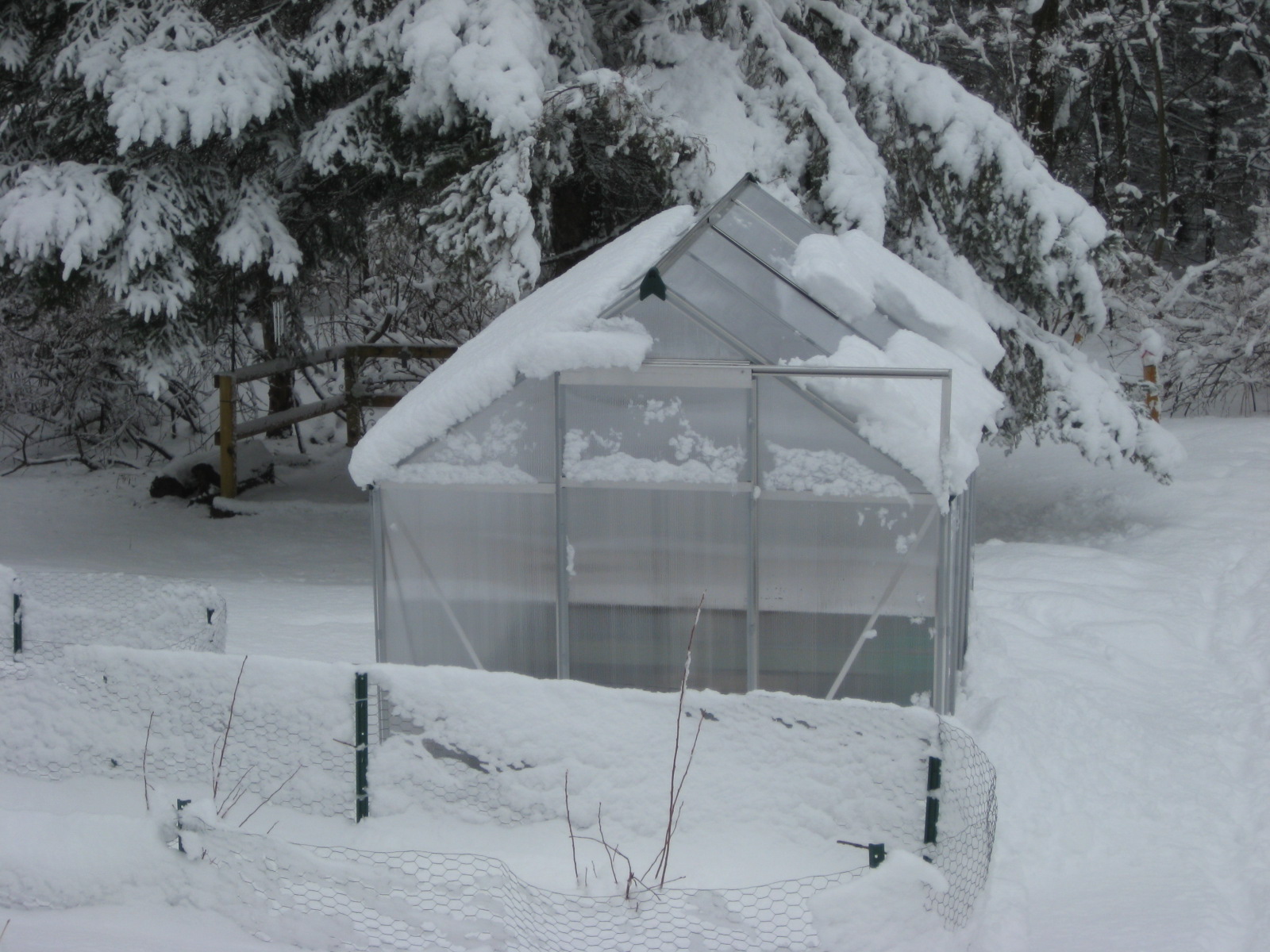
But in spite of the all signs of spring, this morning we awoke to five inches of fresh snow. It's the heavy, sticky kind of snow that can really do number on your back when shoveling. The greenhouse is covered in a thick layer, which is slowly slipping off the edge of the roof panels.
Looks as if I'd better go shovel a little patch for the chickens. Perhaps tomorrow it will be spring again.