Over the winter, I read Craig LeHoullier's new book, Epic Tomatoes (2015, Storey Publishing). I was dubious that I could read an entire book about nothing but tomatoes, but Craig's book is compelling and inspiring; it influenced me to grow a much wider variety of tomatoes than ever before. His focus is on "heirloom" or open-pollinated varieties rather than hybrids. I've learned that if I'm willing to compromise on appearance and shipping/storage qualities, I'm likely to gain in fantastic and unique flavors.
Here is a photo of a variety called Purple Cherokee. The flesh is sweet, juicy and it is indeed purple-ish in color. Notice that this tomato is huge---one pound and four ounces. There are so many varieties of tomatoes to grow. It's ridiculously limiting to buy the few varieties that your garden center provides. We urge you to plan ahead for next year and try something new.
Now I'm back to the canning, freezing and processing that consumes my day. Happy gardening!
Welcome
Red Bucket Farm is an urban farm on a quarter acre property in an average residential neighborhood. We are located in Wisconsin, USDA Zone 5. We focus on chickens, bees, orchard fruit, and raised garden beds for fruits and veggies. We hope to reduce our footprint on the planet by growing some of our food, reducing our use of fossil fuels, and gardening with sustainable practices. Thanks for visiting!
Friday, August 21, 2015
Tuesday, August 4, 2015
Ruthless and Strategic
Dee and Cathy have watched Red Bucket Farm grow over the last several years. They are dear friends who have shared many meals with us; they have also laughed and cried with us. So I'm not offended when they refer to my last blog as "the best rant on the internet" or when they describe me as a "ruthless and strategic" urban farmer.
Ruthless and strategic refers to the fact that I don't get emotionally attached to a bush or a tree or even a chicken. For example, we have been attempting to grow gooseberries for years. After two attempts in different locations and about six years invested, we have finally arrived at a crop large enough to produce one fruit pie. And guess what? Even though it was delicious, I'm pulling out those thorny bushes---way too much trouble and space for too little food. It's just a matter of practicality.
Reactions to my last blog (May 29, 2015, The Cost of Gardening) varied widely. Many were stunned and silent, and one person accused me of being hostile. Interestingly, the folks who agreed with me felt the need to do so privately. A friend who operates a small business understood entirely---so many people expect a discount large enough to obliterate his profit. But the most telling response came from a lifelong farmer, a pig expert who I know at my church. When I told him about the cost-of-gardening blog and the responses to it, he laughed out loud and said, "Now you understand the economics of agriculture."
Ruthless and strategic? Yes, indeed.
Ruthless and strategic refers to the fact that I don't get emotionally attached to a bush or a tree or even a chicken. For example, we have been attempting to grow gooseberries for years. After two attempts in different locations and about six years invested, we have finally arrived at a crop large enough to produce one fruit pie. And guess what? Even though it was delicious, I'm pulling out those thorny bushes---way too much trouble and space for too little food. It's just a matter of practicality.
Reactions to my last blog (May 29, 2015, The Cost of Gardening) varied widely. Many were stunned and silent, and one person accused me of being hostile. Interestingly, the folks who agreed with me felt the need to do so privately. A friend who operates a small business understood entirely---so many people expect a discount large enough to obliterate his profit. But the most telling response came from a lifelong farmer, a pig expert who I know at my church. When I told him about the cost-of-gardening blog and the responses to it, he laughed out loud and said, "Now you understand the economics of agriculture."
Ruthless and strategic? Yes, indeed.
Friday, May 29, 2015
The Cost of Gardening
When I mention to acquaintances that I'm an urban farmer, they seem to have visions of pastoral beauty---tomatoes dangling lusciously from the vine, bees buzzing around the lavender, vegetable beds neatly weeded, homemade lemonade on the picnic table. Sounds fantastic, doesn't it? And oh, by the way, if you have a surplus of tomatoes, I'll be happy to take some off your hands, they mention casually.
Let's get this straight. Tomatoes do not just happen. Any serious urban farmer works year-round to make it happen. We order seeds in January and begin sowing indoors immediately. We carefully watch the spring weather, cultivating beds, adding compost, and finding the right time to transfer seedlings to the greenhouse for hardening, and ultimately to the beds. Then we watch for bugs and disease, using labor-intensive methods to organically solve problems. Finally, we enjoy the harvest. If we've done our work properly and the weather has been generous, there will be enough to freeze, can and preserve for use all winter long, perhaps even into the next season.
Several years ago, before I was a gardener, my friend Diana gave me one, gigantic sweet onion. It was the size of a softball. I cradled the onion in my hands and planned carefully how to use it in a meal, because I knew the onion came from her garden.
Gardening is like quilting. It's a labor of love. I don't give a quilt to anybody who does not truly understand and appreciate the hours it took to create. Quilters refer to gift recipients as "quilt worthy."
Gardening is not free. At Red Bucket Farm, we have thousands of dollars invested in raised beds, compost bins, bee hives, rain barrels, terracing (both wood and brick), fencing, sheds, coops, greenhouses, trellises, and arbors. We consider this our retirement investment plan. Plants also cost plenty, even when purchased bare root in the spring. Fruit trees run about $25 each, and that's when they are a tiny stick in the ground. It takes years for a tree to become fruitful. Chickens are not free, nor is chicken food.
I don't mean to be ungenerous, but urban farming is my job. Asking for the fruits of my labor is like asking for my paycheck. I'm happy to share with my friends, those lovely folks who pray for me and check on me regularly to make sure that I'm doing okay. I'm also happy to sell a few eggs when the flock is producing abundantly. But please---think twice before making assumptions. Are you veggie worthy?
Let's get this straight. Tomatoes do not just happen. Any serious urban farmer works year-round to make it happen. We order seeds in January and begin sowing indoors immediately. We carefully watch the spring weather, cultivating beds, adding compost, and finding the right time to transfer seedlings to the greenhouse for hardening, and ultimately to the beds. Then we watch for bugs and disease, using labor-intensive methods to organically solve problems. Finally, we enjoy the harvest. If we've done our work properly and the weather has been generous, there will be enough to freeze, can and preserve for use all winter long, perhaps even into the next season.
Several years ago, before I was a gardener, my friend Diana gave me one, gigantic sweet onion. It was the size of a softball. I cradled the onion in my hands and planned carefully how to use it in a meal, because I knew the onion came from her garden.
Gardening is like quilting. It's a labor of love. I don't give a quilt to anybody who does not truly understand and appreciate the hours it took to create. Quilters refer to gift recipients as "quilt worthy."
Gardening is not free. At Red Bucket Farm, we have thousands of dollars invested in raised beds, compost bins, bee hives, rain barrels, terracing (both wood and brick), fencing, sheds, coops, greenhouses, trellises, and arbors. We consider this our retirement investment plan. Plants also cost plenty, even when purchased bare root in the spring. Fruit trees run about $25 each, and that's when they are a tiny stick in the ground. It takes years for a tree to become fruitful. Chickens are not free, nor is chicken food.
I don't mean to be ungenerous, but urban farming is my job. Asking for the fruits of my labor is like asking for my paycheck. I'm happy to share with my friends, those lovely folks who pray for me and check on me regularly to make sure that I'm doing okay. I'm also happy to sell a few eggs when the flock is producing abundantly. But please---think twice before making assumptions. Are you veggie worthy?
Thursday, April 30, 2015
Spring Chicks 2015
Spring chicks are a happy event at Red Bucket Farm. Some years we obtain chicks from a local hatchery so that we can drive over and pick them up. This year we opted for more unusual breeds, so we ordered from My Pet Chicken. Our chicks hatched on April 6 and arrived by USPS on April 8.
Baby chicks are packaged carefully with a gel heat pack, but it's a difficult trip. All of our little ones were alive upon arrival, but we lost one within 24 hours. It was disappointing but not unexpected. The plumage (really it's fluff) of little chicks doesn't necessarily reflect their mature colors, so it can be difficult to ascertain which breed is which. We think the one that died immediately was a Partridge Plymouth Rock.
The new chicks are now three weeks old. They live in their brooder box in the basement. A heat lamp keeps them nice and warm. We refill water and food regularly, and check for vent blockage to make sure all systems are operating properly. (That's a nice way of saying that we check for poopy butts.)
This particular flock has seemed more flighty than previous flocks. We suspect that our choice of breeds may be playing into this. We decided to try Light Brown Leghorn, Exchequer Leghorn, Buff Chantecler, Silver Cuckoo Marans and Ancona as new breeds. Some of these breeds have a reputation for nervousness and flightiness.
Late last night I removed their water and stepped to the sink to refill. The girls were scrambling around in their brooder box in their usual panicky manner. Suddenly I heard a loud squawk and returned to find one little chick laying on her side, evidently paralyzed. She died in a minute. It's a mystery to us. Did she have a heart attack or aneurysm? Can a flighty chick die of a panic attack? We think the victim was either the Exchequer Leghorn or the Ancona.
We always order extra chicks so our flock will be strong enough to survive winter. Perhaps we'll try the new breeds again next, or maybe we'll just stick with the hardy heritage breeds. Stay tuned.
Baby chicks are packaged carefully with a gel heat pack, but it's a difficult trip. All of our little ones were alive upon arrival, but we lost one within 24 hours. It was disappointing but not unexpected. The plumage (really it's fluff) of little chicks doesn't necessarily reflect their mature colors, so it can be difficult to ascertain which breed is which. We think the one that died immediately was a Partridge Plymouth Rock.
The new chicks are now three weeks old. They live in their brooder box in the basement. A heat lamp keeps them nice and warm. We refill water and food regularly, and check for vent blockage to make sure all systems are operating properly. (That's a nice way of saying that we check for poopy butts.)
This particular flock has seemed more flighty than previous flocks. We suspect that our choice of breeds may be playing into this. We decided to try Light Brown Leghorn, Exchequer Leghorn, Buff Chantecler, Silver Cuckoo Marans and Ancona as new breeds. Some of these breeds have a reputation for nervousness and flightiness.
Late last night I removed their water and stepped to the sink to refill. The girls were scrambling around in their brooder box in their usual panicky manner. Suddenly I heard a loud squawk and returned to find one little chick laying on her side, evidently paralyzed. She died in a minute. It's a mystery to us. Did she have a heart attack or aneurysm? Can a flighty chick die of a panic attack? We think the victim was either the Exchequer Leghorn or the Ancona.
We always order extra chicks so our flock will be strong enough to survive winter. Perhaps we'll try the new breeds again next, or maybe we'll just stick with the hardy heritage breeds. Stay tuned.
Saturday, December 27, 2014
Winter Bees
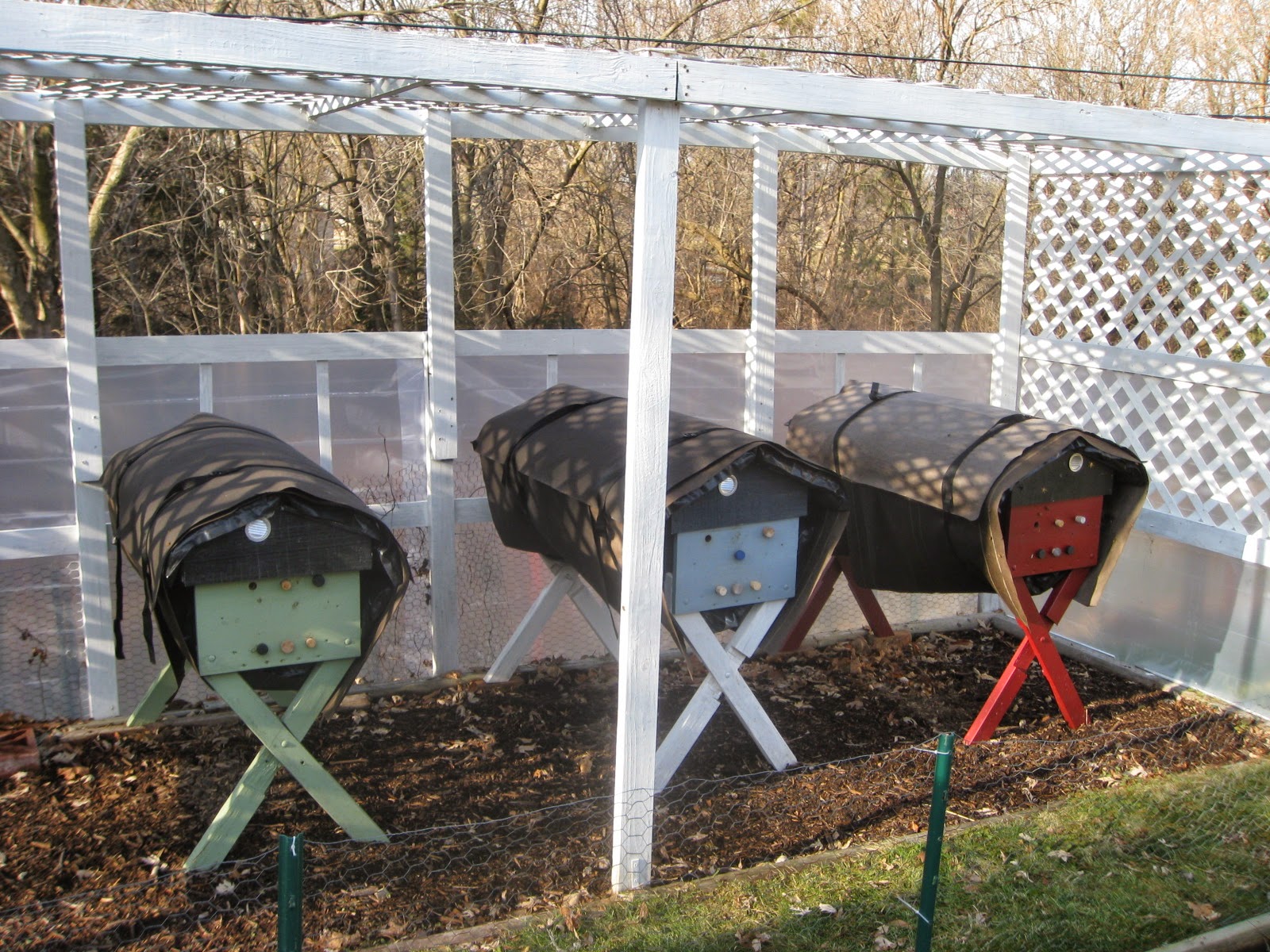
The weather at Red Bucket Farm has been fairly dreadful in terms of our honeybees. Towards the end of October, we covered the hives with insulation blankets and wrapped the entire bee yard with plastic to protect the hives from western winds.
November was just plain cold. Outdoor air temperatures were way below normal, hovering in the teens during the day and close to zero at night. The bees disappeared into the hives where they clustered together in a tight ball around the queen.
December has been warmer but cloudy, foggy, damp and drippy. It's normal for bees to take "cleansing flights" during winter months. They prefer to not poop in their hives and will slip outside on a sunny afternoon for quick trip to the ladies room. Unfortunately, we haven't seen the sun or the bees in weeks---until yesterday. Finally we had a few hours of sunshine and one of our hives took the opportunity to get outside.
This video is about one second long, but you get the idea. (Sorry that I'm not so clever with technology.) We'll be happy if even one hive survives the winter so that we can build and split with the hardy bees that make it. Replacing bees each spring is expensive---about $100 per hive---and we may not be able to justify the expense if they die each winter.
So, at the risk of repeating myself endlessly, if you still use lawn chemicals, please reconsider. Chemicals weaken the bee population significantly. If the bees approach winter in a compromised state, they can't possibly survive. Pollination is tenuous these days, and without it, we all suffer. Backyard bees are better off than rural bees because foraging is more varied, but lawn chemicals are toxic. Remember that dandelions are bee food.
Meanwhile, we have a glimmer of hope that some of our bees are still alive!
Tuesday, November 4, 2014
Planting Garlic
Planting garlic is similar to planting tulip and daffodil bulbs: push them deep in the soil in the late fall and wait for the magic to happen in the spring.
First make sure the soil is loose, friable, and free of weeds. Add a bit of compost and get ready to plant. I placed my garlic cloves gently on the surface of the soil to get a sense of how closely to space them. Then I pushed my garden knife into the soil the full length of the blade and dropped the garlic down. After all were planted, I covered the bed with a layer of hay and watered.
Garlic is the crop that keeps on giving. Two years ago I visited Seed Savers Exchange in Decorah, Iowa, where I purchased one head of Inchelium Red (softneck) Garlic and one head of Eric's German White (hardneck) Garlic. I planted them in October 2012 and saved my entire harvest the next summer without eating a bite.
In November 2013, I separated the cloves from the heads of garlic and planted again. By July 2014, I had 73 heads of softneck garlic (about 3.75 pounds) and 31 heads of hardneck garlic. From that harvest, I reserved five heads each of hardneck and softneck for replanting. The five heads of hardneck garlic separated into 17 large cloves; the five heads of softneck garlic separated into 62 small cloves.
I learned that garlic slowly adapts to its micro climate, so my garlic is now Red Bucket Farm garlic, specific to my little piece of paradise. Garlic smells fantastic even when planting, and it's not too late to plant this fall. What are you waiting for?
First make sure the soil is loose, friable, and free of weeds. Add a bit of compost and get ready to plant. I placed my garlic cloves gently on the surface of the soil to get a sense of how closely to space them. Then I pushed my garden knife into the soil the full length of the blade and dropped the garlic down. After all were planted, I covered the bed with a layer of hay and watered.
Garlic is the crop that keeps on giving. Two years ago I visited Seed Savers Exchange in Decorah, Iowa, where I purchased one head of Inchelium Red (softneck) Garlic and one head of Eric's German White (hardneck) Garlic. I planted them in October 2012 and saved my entire harvest the next summer without eating a bite.
In November 2013, I separated the cloves from the heads of garlic and planted again. By July 2014, I had 73 heads of softneck garlic (about 3.75 pounds) and 31 heads of hardneck garlic. From that harvest, I reserved five heads each of hardneck and softneck for replanting. The five heads of hardneck garlic separated into 17 large cloves; the five heads of softneck garlic separated into 62 small cloves.
I learned that garlic slowly adapts to its micro climate, so my garlic is now Red Bucket Farm garlic, specific to my little piece of paradise. Garlic smells fantastic even when planting, and it's not too late to plant this fall. What are you waiting for?
Thursday, October 30, 2014
Drying Herbs
As the growing season slowly comes to an end, I'm experimenting with drying herbs for cooking use as well as for my chickens.
A farm colleague has suggested that using dried herbs in the hen house over the winter will help discourage mites or creepy crawlies and will certainly help the fragrance in that crowded space. For that goal, I've been harvesting the herbs that are underplanted in my front yard orchard--oregano, lemon balm and lavender. It's important to keep these herbs separate from those designated for human consumption because the front yard is subject to every dog in the neighborhood. 'Nuff said?
Other herbs at the farm have been living comfortably in the green house--basil, sage, rosemary, and chives. These I can dry and crush, then store in jars in the kitchen.
The process of drying herbs is simple. I cut the stems into a size that will fit in my large roasting pan and place it in a cool oven at 140 degrees Fahrenheit with the fan running. (I have a convection oven.) I prop the oven door open an inch or so to allow moisture to escape, checking on them periodically. The timing will vary depending on the herb and quantity being processed. When it all seems a bit crunchy, I take it out of the oven and gently pull the leaves off the stems. Then I crush it with my hands and place it in storage containers. The herbs for use in the hen house are stored in large plastic bags in the freezer.
Drying herbs in the oven makes my house smell fantastic. It's quicker than the traditional method of hanging bunches of herbs in the basement or garage, which (for me) usually results in messy bits of dropped leaves and stems. Give this a try!
A farm colleague has suggested that using dried herbs in the hen house over the winter will help discourage mites or creepy crawlies and will certainly help the fragrance in that crowded space. For that goal, I've been harvesting the herbs that are underplanted in my front yard orchard--oregano, lemon balm and lavender. It's important to keep these herbs separate from those designated for human consumption because the front yard is subject to every dog in the neighborhood. 'Nuff said?
Other herbs at the farm have been living comfortably in the green house--basil, sage, rosemary, and chives. These I can dry and crush, then store in jars in the kitchen.
The process of drying herbs is simple. I cut the stems into a size that will fit in my large roasting pan and place it in a cool oven at 140 degrees Fahrenheit with the fan running. (I have a convection oven.) I prop the oven door open an inch or so to allow moisture to escape, checking on them periodically. The timing will vary depending on the herb and quantity being processed. When it all seems a bit crunchy, I take it out of the oven and gently pull the leaves off the stems. Then I crush it with my hands and place it in storage containers. The herbs for use in the hen house are stored in large plastic bags in the freezer.
Drying herbs in the oven makes my house smell fantastic. It's quicker than the traditional method of hanging bunches of herbs in the basement or garage, which (for me) usually results in messy bits of dropped leaves and stems. Give this a try!
Labels:
chickens,
gardening,
greenhouse,
herbs,
orchard,
urban farm
Subscribe to:
Posts (Atom)